
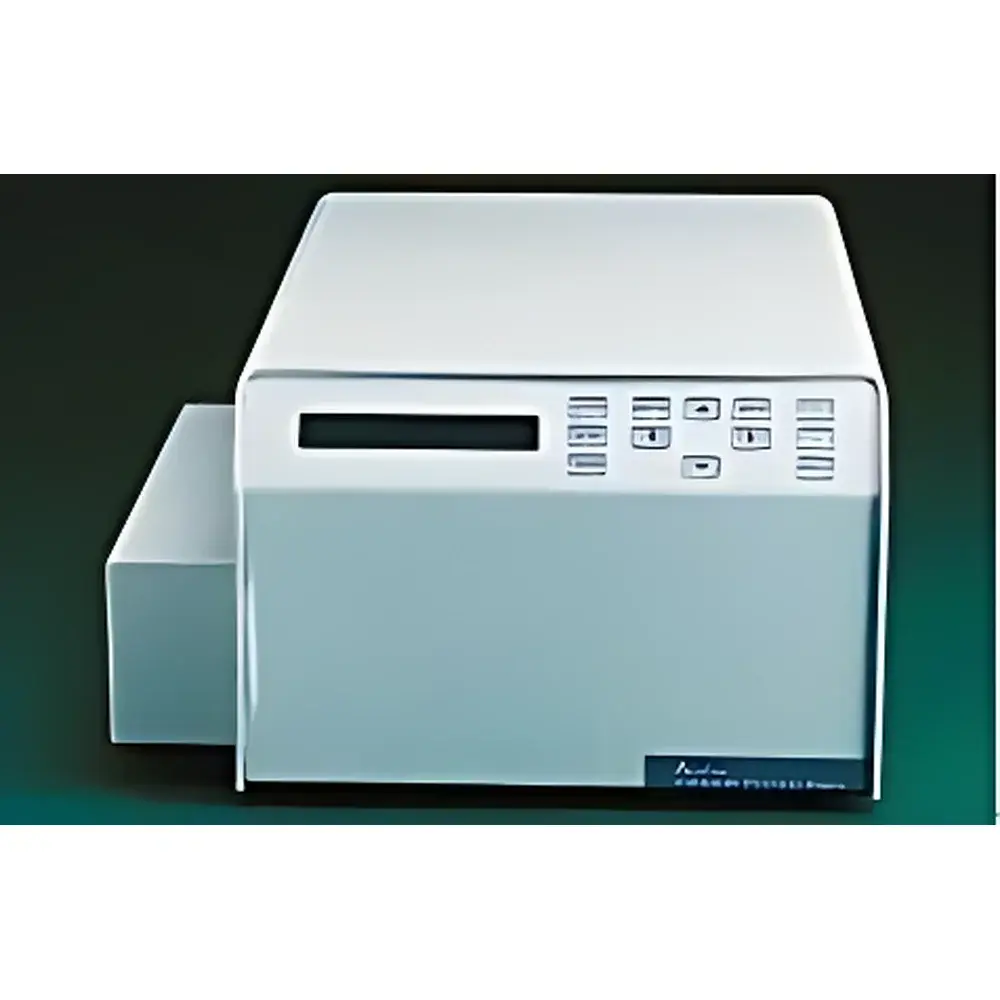
502 Programmable Fluorescence Detector
| Origin | Imported |
|---|---|
| Manufacturer Type | Authorized Distributor |
| Model | 502 |
| Instrument Type | Fluorescence Detector (FD) |
| Excitation/Emission Wavelengths | Dual-Programmable |
| Spectral Range | Broad (Typical UV-Vis, e.g., 200–700 nm) |
| Bandwidth Options | Multiple Fixed and Variable Slit Widths |
| Sensitivity | High (Sub-picomolar Detection Limit for Standard Fluorophores) |
| Noise Level | Ultra-Low (RMS < 0.5 mV at 1 s time constant) |
| Scan Mode | Point-Scan Fluorescence Acquisition |
| Spectral Storage Capacity | ≥64 Predefined Method-Linked Spectral Profiles |
| Dynamic Range | >4 Orders of Magnitude (Linear Response from 10⁻¹² to 10⁻⁸ M for quinine sulfate equivalent) |
Overview
The 502 Programmable Fluorescence Detector is a high-performance, dual-wavelength programmable fluorescence detection module engineered for integration with high-performance liquid chromatography (HPLC) and ultra-high-performance liquid chromatography (UHPLC) systems. It operates on the principle of photoluminescence detection: analytes eluting from the column are excited by a tunable light source (typically a xenon flash lamp or solid-state LED array), and emitted fluorescence photons are collected at right angles via a precision optical path, filtered through independently adjustable excitation and emission monochromators or interference filters, and quantified by a low-noise photomultiplier tube (PMT) or silicon photodiode detector. Designed for trace-level quantification of native or derivatized fluorophores—including polycyclic aromatic hydrocarbons (PAHs), amino acids, vitamins (e.g., B2, B6), pharmaceuticals (e.g., fluoroquinolones, tetracyclines), and biomolecules—the 502 delivers exceptional signal-to-noise ratios and wavelength flexibility without compromising robustness or operational stability in regulated laboratory environments.
Key Features
- Dual independent wavelength programming: Excitation and emission wavelengths are separately configurable in real time, enabling synchronous scanning, wavelength switching between peaks, and optimization for multi-analyte methods.
- Ultra-low electronic and optical noise architecture: Achieves RMS noise < 0.5 mV under standard acquisition conditions (1-s time constant, 5-nm bandwidth), supporting reliable detection at sub-picomolar concentrations for reference standards such as quinine sulfate in 0.05 M H2SO4.
- Point-scan fluorescence acquisition mode: Enables rapid, high-fidelity spectral profiling across user-defined wavelength grids—ideal for peak identification, purity assessment, and method development.
- Extended spectral coverage: Standard configuration supports excitation from 200 nm to 700 nm and emission from 220 nm to 800 nm, compatible with both deep-UV and near-infrared fluorophores.
- Selectable spectral bandwidths: Interchangeable slit assemblies or motorized bandpass filters allow bandwidth selection from 2 nm to 20 nm, balancing sensitivity, resolution, and stray-light rejection per application requirement.
- Wide linear dynamic range: Maintains photometric linearity over four orders of magnitude (10−12–10−8 M), minimizing need for sample dilution or gain adjustment across heterogeneous sample matrices.
- Modular design with front-access service panels: Simplifies lamp replacement, optical alignment verification, and routine cleaning—reducing instrument downtime and technician dependency.
Sample Compatibility & Compliance
The 502 detector is compatible with standard 3.9–4.6 mm I.D. analytical columns and microbore formats (e.g., 2.1 mm I.D.) when used with appropriate flow-cell configurations (e.g., 1–2 µL volume, stainless steel or fused silica capillary). It supports aqueous, organic, and mixed mobile phases common in reversed-phase, normal-phase, and HILIC separations. The detector’s firmware and hardware architecture comply with foundational requirements for regulated environments: audit-trail-capable method storage, user-access-level controls (admin/operator/guest), and non-volatile memory retention of calibration logs and spectral profiles. While not pre-certified as standalone 21 CFR Part 11 compliant, its data output format (ASCII .csv, .txt, and vendor-neutral .cdf) and metadata tagging support integration into validated LIMS or CDS platforms that implement electronic signature, change control, and archival protocols per GLP, GMP, and ISO/IEC 17025 frameworks.
Software & Data Management
Control and data acquisition are managed via a dedicated Windows-based instrument driver compatible with major chromatography data systems (CDS), including Empower, Chromeleon, OpenLab CDS, and LabSolutions. Raw fluorescence intensity vs. time/wavelength datasets are timestamped and annotated with full method parameters (wavelengths, bandwidths, PMT voltage, scan rate). Up to 64 spectral profiles—including excitation/emission matrices, synchronous scans, and fixed-wavelength traces—can be stored onboard and recalled with method loading. All spectral files include embedded metadata (operator ID, date/time, instrument serial number, lamp usage hours) to satisfy traceability requirements. Export options include baseline-corrected spectra, peak-integrated fluorescence area/volume, and ratio-metric outputs (e.g., EEM contour plots) for advanced chemometric analysis.
Applications
- Pharmaceutical QC: Quantification of fluorescent impurities and degradation products in APIs (e.g., cephalosporins, anthracyclines) per USP & EP monographs.
- Environmental analysis: Detection of PAHs, aflatoxins, and pesticide metabolites (e.g., carbaryl, thiabendazole) in soil, water, and food extracts.
- Clinical research: Measurement of homovanillic acid (HVA), vanillylmandelic acid (VMA), and serotonin in urine and cerebrospinal fluid using pre-column o-phthalaldehyde derivatization.
- Nutritional science: Simultaneous determination of B-group vitamins in fortified beverages and dietary supplements.
- Biopolymer characterization: Monitoring intrinsic tryptophan/tyrosine fluorescence during protein folding/unfolding studies coupled with SEC or FFF.
FAQ
Is the 502 compatible with UHPLC systems operating above 1000 bar?
Yes—when equipped with a low-dead-volume flow cell (< 1.5 µL) and paired with pressure-rated tubing and fittings, the detector maintains optimal response time and minimal band broadening up to 1300 bar.
Can excitation and emission wavelengths be changed during a single chromatographic run?
Yes—method-defined wavelength switching events can be scheduled at precise retention times, enabling multi-wavelength detection for co-eluting compounds with distinct fluorophore signatures.
What lamp lifetime can be expected under typical usage?
Xenon flash lamps typically deliver ≥1 × 10⁹ flashes (equivalent to ~18 months of continuous daily operation at 10 Hz pulse rate); LED-based excitation modules offer >20,000 hours of stable output.
Does the detector support fluorescence polarization (FP) or anisotropy measurements?
No—this model is optimized for intensity-based detection; FP capability requires additional polarizing optics and dual-channel detection, available only in specialized research-grade configurations.
How is calibration verified and documented?
Built-in diagnostic routines validate lamp intensity, monochromator wavelength accuracy (using holmium oxide or didymium filters), and PMT dark current; all results are logged with operator signature and exported as PDF reports.





