
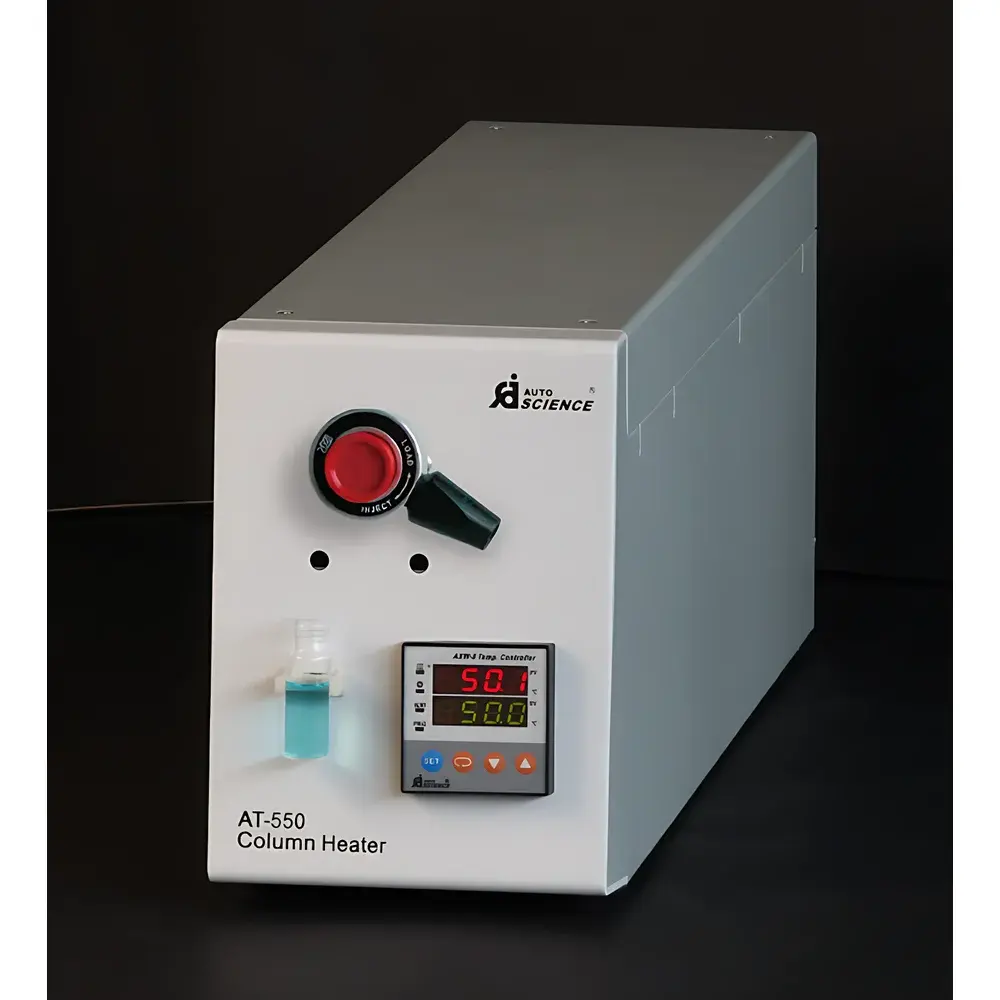
AT-550/AT-550C Chromatography Column Oven by Autoscience
| Brand | Autoscience |
|---|---|
| Model | AT-550 / AT-550C |
| Temperature Control Algorithm | AI-based self-tuning (AT) |
| Display | Dual 4-digit LED (SV/PV) |
| Chamber Configuration | Three independent temperature-controlled zones |
| Max. Column Capacity | Three 4.6 mm × 300 mm columns + integrated valve placement |
| Flow Path Preconditioning | Dedicated capillary preheating/cooling grooves |
| Safety | Automatic over-temperature cutoff |
| Drainage | Integrated bottom-mounted condensate and leakage drainage channel |
| Origin | Tianjin, China |
| Compliance | Designed for GLP-compliant HPLC environments |
Overview
The AT-550 and AT-550C Chromatography Column Ovens are precision-engineered thermostatic enclosures developed by Autoscience (Tianjin) Co., Ltd. for high-stability thermal management of analytical and preparative liquid chromatography systems. These ovens operate on the principle of active air-circulated convection heating and cooling—optimized via an embedded AI-based self-tuning (AT) temperature control algorithm—to maintain uniform thermal conditions across multiple chromatographic components simultaneously. Unlike single-zone column heaters, the AT-550 series features three physically isolated temperature chambers, enabling independent thermal regulation of individual columns, switching valves, or detector flow cells. This architecture directly addresses a critical source of retention time variability in HPLC and UHPLC: thermal lag and gradient-induced phase transition in mobile phase delivery. By thermally conditioning not only the column(s) but also upstream fluidic elements—including injection valves and connecting capillaries—the system minimizes baseline drift, improves peak symmetry, and enhances method robustness under variable ambient conditions.
Key Features
- Horizontal integrated chassis design for low-profile installation beneath or adjacent to standard HPLC modules—optimized for benchtop footprint and cable/line routing.
- Triple-zone thermal architecture: three independently controlled chambers accommodate up to three 4.6 mm × 300 mm analytical columns, with additional space for solenoid valves, T-connectors, or pressure regulators—all maintained at user-defined setpoints.
- Dedicated capillary preconditioning grooves machined into chamber walls allow precise thermal coupling of PEEK or stainless-steel transfer lines, reducing heat loss between pump and column inlet and stabilizing dwell volume effects.
- AI-driven PID controller with auto-tuning (AT) functionality dynamically adjusts control parameters based on real-time thermal load, ambient fluctuation, and chamber occupancy—eliminating manual tuning while ensuring ±0.1 °C stability over 8-hour continuous operation.
- Dual 4-digit LED display shows setpoint temperature (SV) and actual chamber temperature (PV) simultaneously; programmable over-temperature cutoff halts heating at user-defined thresholds (default: 85 °C) to protect column packing and instrument integrity.
- Integrated bottom-channel drainage system evacuates condensate formed during sub-ambient operation or column leakage—preventing pooling, corrosion, or electrical hazards in long-duration unattended runs.
Sample Compatibility & Compliance
The AT-550/AT-550C is compatible with all standard stainless-steel, PEEK, and fused-silica HPLC/UHPLC columns (ID range: 2.1–10.0 mm; length ≤ 300 mm), including those packed with C18, phenyl-hexyl, HILIC, and chiral stationary phases. It supports integration with major OEM systems (Waters, Agilent, Shimadzu, Thermo Fisher) via standard DIN rail mounting or custom bracket kits. The unit’s thermal performance meets ASTM E2927-21 requirements for chromatographic oven qualification and aligns with ISO/IEC 17025:2017 clause 6.4.7 on environmental condition control for accredited testing laboratories. Its firmware architecture supports audit-trail-ready operation when paired with compliant LIMS or CDS platforms, satisfying FDA 21 CFR Part 11 data integrity expectations for electronic records in regulated pharmaceutical QC workflows.
Software & Data Management
While the AT-550/AT-550C operates as a standalone analog-controlled oven, its digital interface provides RS-232/RS-485 output for optional integration with third-party chromatography data systems (CDS) or lab automation controllers. Temperature logs (timestamped SV/PV pairs at 1-second intervals) can be exported via serial command protocol for post-run correlation with chromatogram metadata. Firmware supports user-defined calibration offsets per chamber—traceable to NIST-traceable RTD probes—and stores up to 100 runtime profiles (setpoint, ramp rate, hold time) for method-specific thermal protocols. All configuration changes are timestamped and retained in non-volatile memory, fulfilling GLP documentation requirements for instrument setup history.
Applications
- Retention time reproducibility enhancement in gradient HPLC methods operating at elevated temperatures (e.g., 40–60 °C) for improved resolution of structurally similar analytes.
- Stabilization of retention behavior in temperature-sensitive separations, including oligonucleotide analysis, glycoprotein mapping, and polymer characterization.
- Minimization of solvent compressibility effects in UHPLC by pre-conditioning mobile phase lines prior to column entry—critical for sub-2 µm particle columns.
- Support of 2D-LC and heart-cutting applications where multiple columns require distinct thermal environments within a single instrument frame.
- Long-term method validation studies requiring ≥72-hour uninterrupted thermal stability under ISO 17025 or ICH Q2(R2) guidelines.
FAQ
Does the AT-550C support sub-ambient operation?
No—the AT-550 and AT-550C are convection-heated ovens rated for 5 °C above ambient to 85 °C. For refrigerated column control, Autoscience recommends pairing with external recirculating chillers via auxiliary fluid ports (available on request).
Can I mount a six-port switching valve inside the main chamber?
Yes—the central chamber accommodates standard HPLC valves (e.g., Rheodyne 7725i, Valco 6-port) with full thermal coverage. Valve actuation cables and fluid lines route through rear grommeted ports.
Is calibration certificate included with shipment?
A factory calibration report (per ISO/IEC 17025 Annex A.3) is provided with each unit, documenting RTD probe accuracy (±0.2 °C at 25/45/65 °C) and chamber uniformity (±0.3 °C across 3-point grid). NIST-traceable calibration services are available upon request.
What maintenance is required for long-term reliability?
Annual inspection of fan filters and thermal insulation integrity is recommended. No consumables or lubricants are required; the AI controller performs continuous diagnostic self-checks on heater response and sensor continuity.
How does the AI auto-tuning function differ from conventional PID tuning?
Unlike static PID coefficients, the AT algorithm executes step-response characterization during initial power-up and adapts gain, integral, and derivative terms in real time based on thermal mass loading, airflow resistance, and ambient drift—reducing overshoot by >40% compared to fixed-parameter controllers under dynamic load conditions.



