
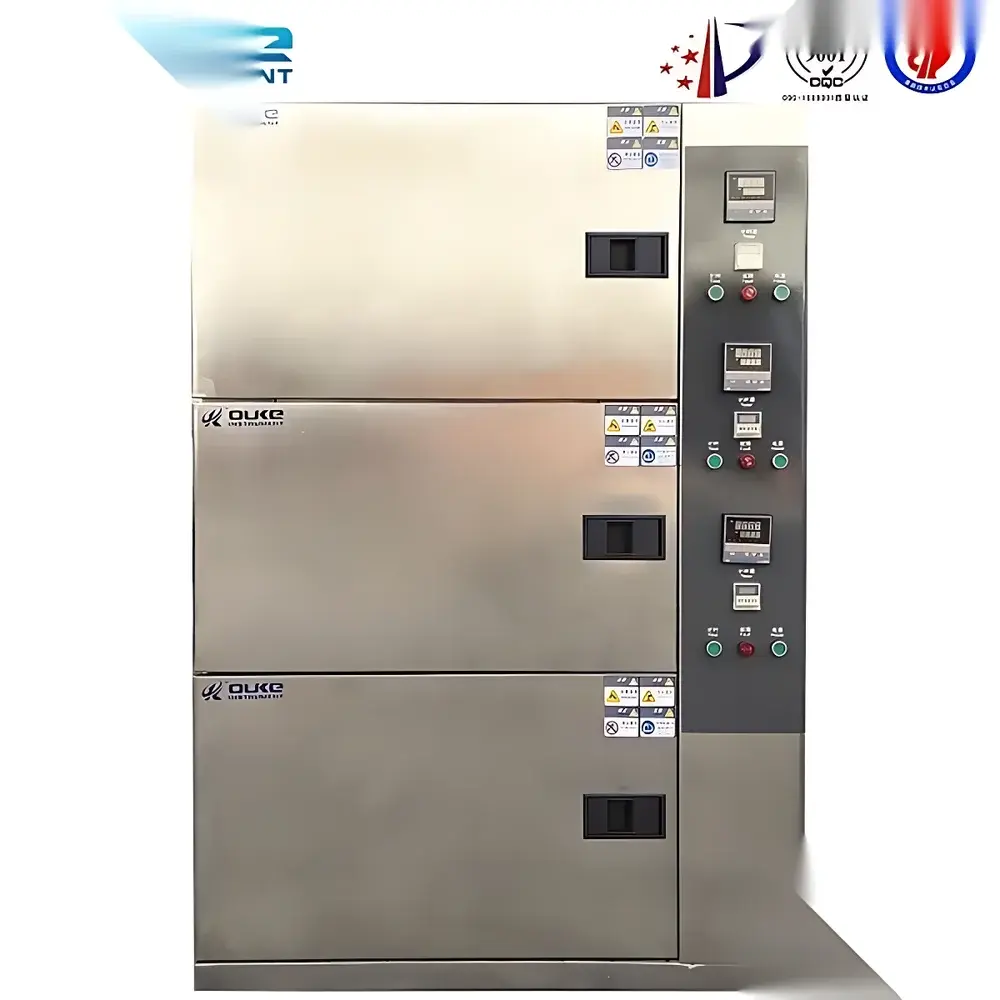
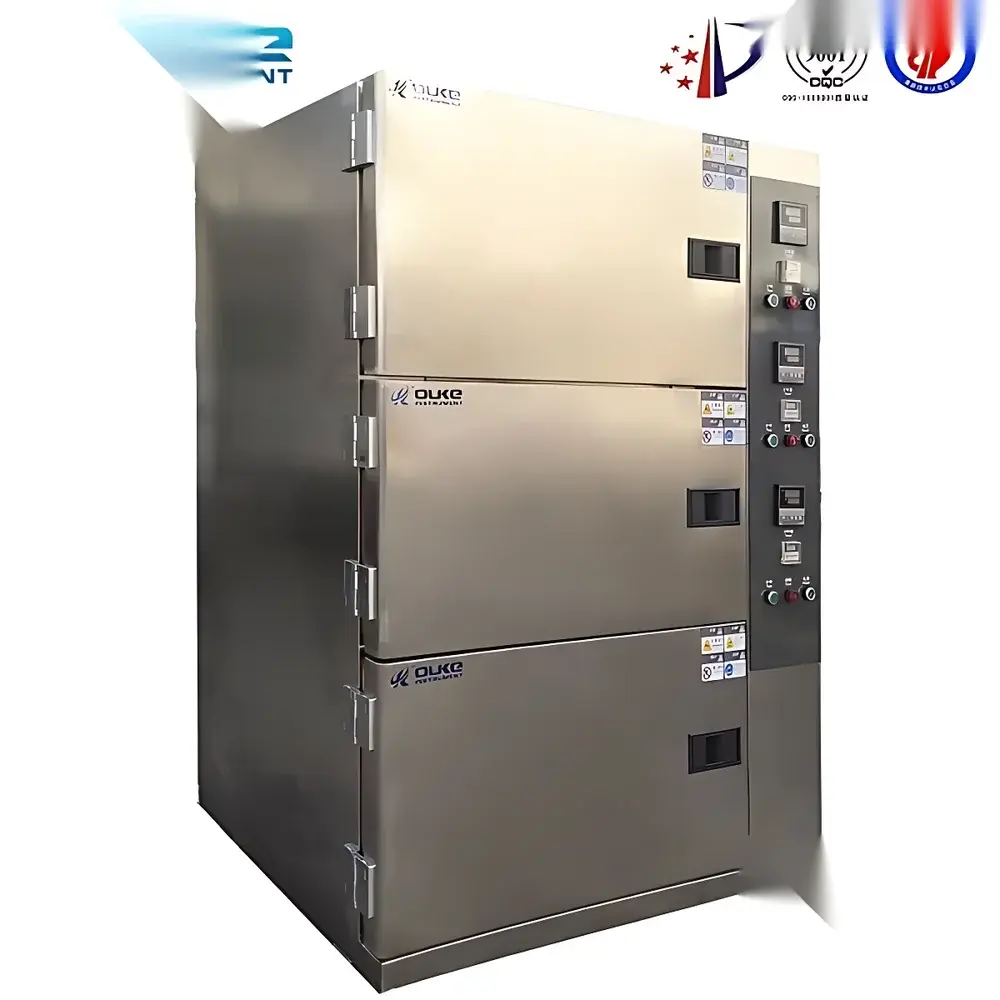
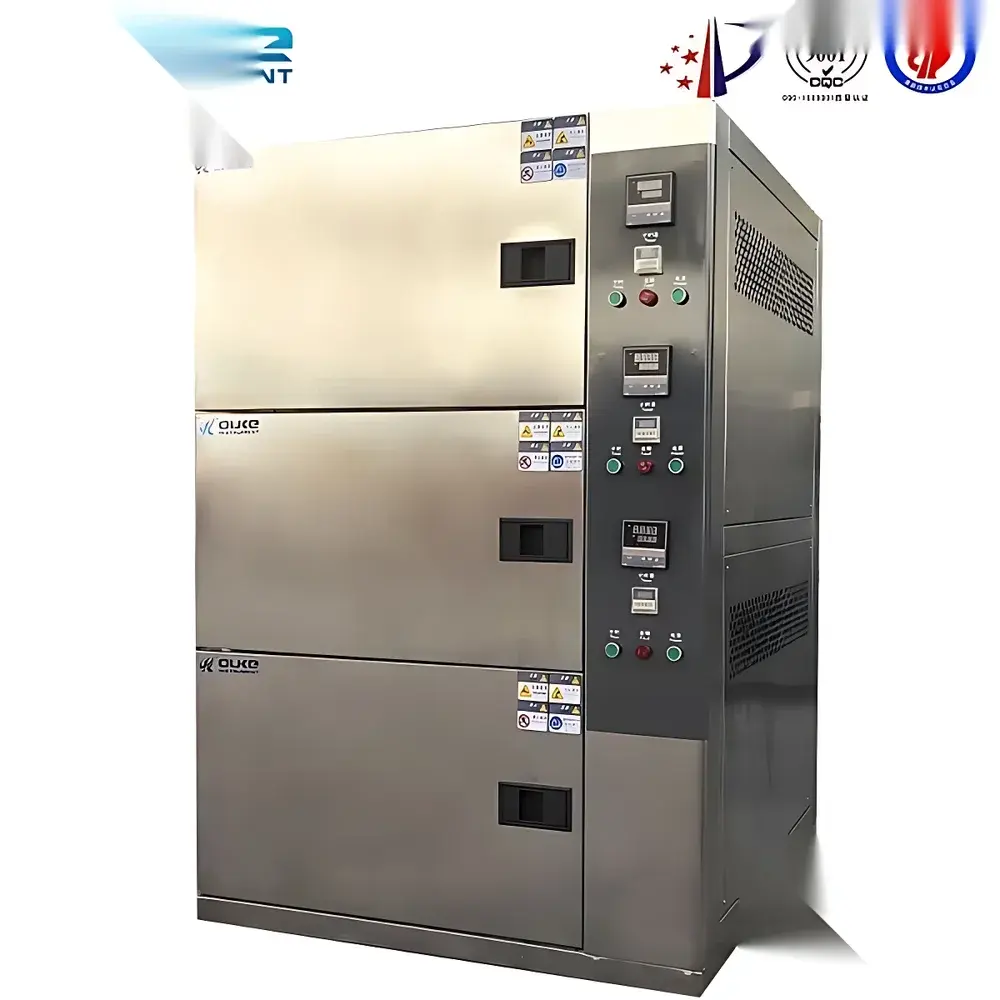
OK-T-72 High-Temperature Forced-Air Oven
| Brand | OK Instrumentation |
|---|---|
| Temperature Range | RT +10°C to 290°C |
| Internal Dimensions (W×H×D) | 450 × 400 × 400 mm |
| External Dimensions (W×H×D) | 650 × 900 × 600 mm |
| Temperature Control Accuracy | ±1.0°C |
| Temperature Uniformity | ±1.5°C |
| Heating Power | 2000 W (2 kW × 1 far-infrared Ni-Cr alloy heater) |
| Controller | LED digital display, microprocessor-based intelligent temperature controller with timer (0–999 min) |
| Sensor | PT100 platinum resistance thermometer |
| Air Circulation | Bottom-mounted centrifugal blower, vertical upward airflow through side ducts |
| Standard Shelving | 3 stainless steel wire shelves (SUS 304) |
| Power Supply | AC 220 V, 50 Hz |
| Safety Features | Over-temperature alarm, over-temperature cut-off, earth leakage protection |
| Compliance | GB/T 2423.2 (High-Temperature Environmental Testing for Electrical and Electronic Products) |
| Warranty | 12 months |
Overview
The OK-T-72 High-Temperature Forced-Air Oven is an industrial-grade environmental test chamber engineered for precise thermal aging, drying, curing, and stabilization of materials under controlled elevated temperatures. It operates on the principle of forced convection—using a bottom-mounted centrifugal blower to circulate heated air vertically upward through dedicated ducts, ensuring consistent thermal distribution across the working chamber. Designed in strict accordance with GB/T 2423.2 (equivalent to IEC 60068-2-2), this oven supports standardized high-temperature testing protocols required by quality assurance departments, R&D laboratories, and manufacturing facilities involved in electronics, polymers, composites, and pharmaceutical packaging validation. Its dual-heating-zone architecture enables independent thermal management for improved process stability during extended dwell cycles at temperatures up to 290°C.
Key Features
- Microprocessor-based intelligent temperature controller with LED digital interface and programmable timer (0–999 minutes), supporting repeatable setpoint retention and power-loss recovery.
- Far-infrared nickel-chromium alloy heating elements (2 kW total output) mounted at the chamber base, delivering rapid thermal response and energy-efficient operation via PID-driven power modulation.
- High-reliability PT100 platinum resistance sensor integrated into the air stream path for real-time feedback and stable closed-loop control.
- Robust chamber construction: interior lined with SUS 304 stainless steel for corrosion resistance and ease of cleaning; exterior fabricated from cold-rolled steel with electrostatic powder coating.
- Forced-air circulation system optimized for uniform heat transfer—air drawn from the base passes through dual heating zones, then rises vertically and exits via left-side lateral vents to minimize thermal stratification.
- Comprehensive safety architecture including over-temperature cut-off (hardware-independent), audible/visual over-temperature alarm, and residual-current circuit breaker (RCCB) for personnel and equipment protection.
Sample Compatibility & Compliance
The OK-T-72 accommodates non-volatile, non-flammable solid and semi-solid samples—including PCB assemblies, elastomer seals, adhesive-coated substrates, ceramic components, and metal oxide powders—within its 72 L internal volume. It is explicitly unsuitable for flammable solvents, volatile organic compounds, or materials prone to outgassing or dripping under thermal stress. The chamber meets the thermal performance requirements of GB/T 2423.2 (Test Bb: Dry Heat), and its design aligns with foundational principles referenced in ISO 16750-4 (Road Vehicles – Environmental Conditions) and ASTM D5421 (Standard Practice for Thermal Aging of Plastics). While not inherently 21 CFR Part 11 compliant, optional audit-trail-enabled controllers and calibrated sensor validation kits are available upon request for GLP/GMP-regulated environments.
Software & Data Management
The standard configuration includes a stand-alone microcontroller with local data logging (up to 100 cycle records stored internally), timestamped setpoint history, and real-time deviation alerts. For integration into centralized laboratory information management systems (LIMS), optional RS485/Modbus RTU or Ethernet TCP/IP communication modules support remote monitoring and parameter adjustment via SCADA-compatible platforms. Optional software packages provide CSV export of temperature profiles, statistical process control (SPC) charts, and PDF report generation—including calibration certificate references and operator ID logging—to support ISO/IEC 17025 documentation requirements.
Applications
- Accelerated thermal aging of electronic components per JEDEC JESD22-A108 and IPC-TM-650 2.6.7.
- Drying of moisture-sensitive powders and granular pharmaceutical intermediates prior to tablet compression.
- Curing of epoxy-coated wires, silicone encapsulants, and UV-resistant polymer films.
- Stabilization of reference standards and calibration artifacts in metrology labs.
- Pre-conditioning of composite laminates and fiber-reinforced plastics before mechanical testing (ASTM D638, ISO 527).
- Residual solvent removal from coated optical filters and MEMS device wafers.
FAQ
What is the maximum continuous operating temperature?
The OK-T-72 is rated for continuous operation at 290°C. Extended exposure above 250°C requires periodic verification of sensor drift and door gasket integrity.
Can the chamber be customized for higher temperature ranges?
Yes—custom configurations supporting 300°C (with upgraded insulation and high-temp gaskets) or 500°C (with molybdenum heating elements and refractory lining) are available under OEM engineering review.
Is traceable calibration included with delivery?
A factory-assembled NIST-traceable calibration certificate (covering PT100 sensor and controller output at three points: 100°C, 200°C, and 290°C) is provided as standard. On-site IQ/OQ documentation support is available upon request.
How is temperature uniformity verified?
Uniformity is validated using a 9-point thermocouple mapping procedure per IEC 60068-3-5, conducted at 100°C, 200°C, and 290°C under no-load conditions. Full mapping reports are supplied with each unit.
What maintenance intervals are recommended?
Blower motor lubrication and filter inspection every 6 months; annual recalibration of PT100 sensor and full safety circuit functional test; replacement of door gasket every 24 months under daily use at >200°C.
Related Products



