
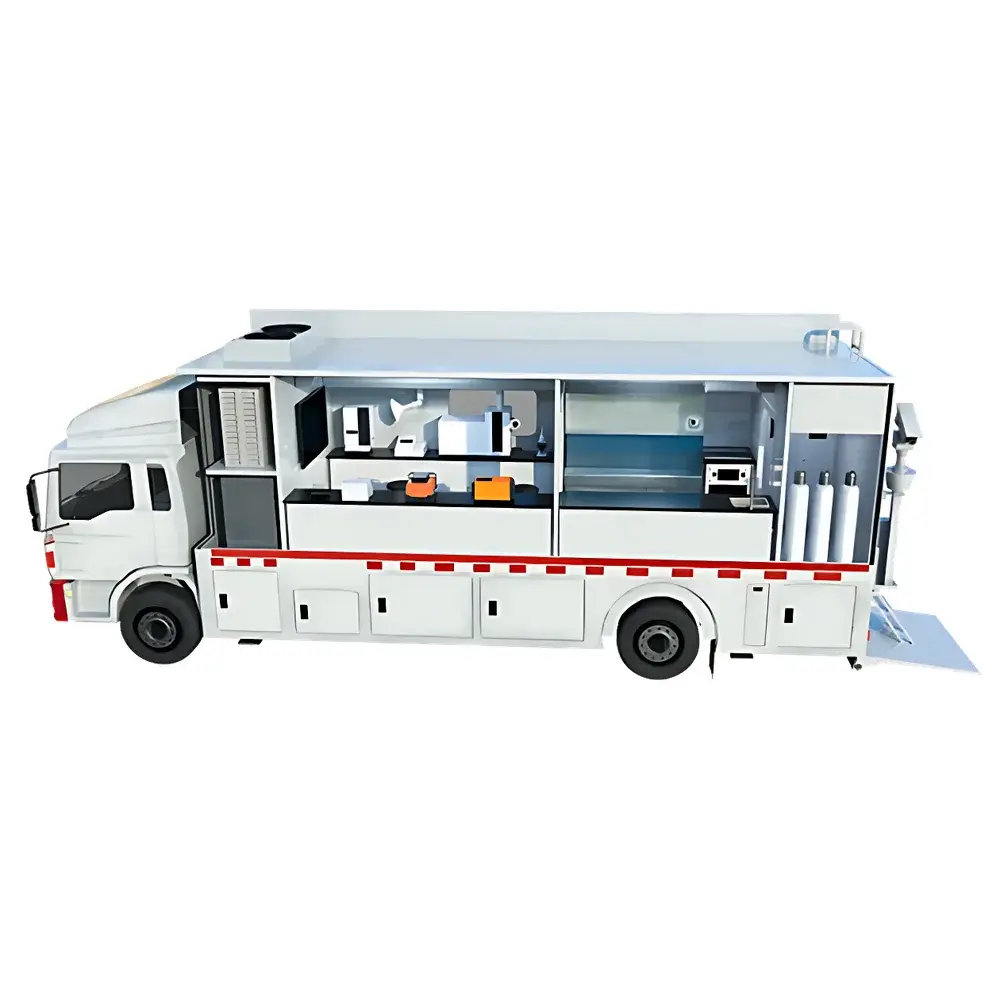
MOST 9000 Mobile Laboratory System by EXPEC
| Brand | EXPEC |
|---|---|
| Origin | Zhejiang, China |
| Manufacturer Type | Authorized Distributor |
| Country of Origin | China |
| Model | MOST 9000 |
| Pricing | Upon Request |
Overview
The EXPEC MOST 9000 Mobile Laboratory System is a fully integrated, vehicle-based analytical platform engineered for high-fidelity field deployment in environmental, public health, and regulatory enforcement applications. Unlike conventional portable kits or modular trailers, the MOST 9000 integrates laboratory-grade instrumentation—including in-house developed ICP-MS, GC-MS, and LC-MS/MS systems—into a structurally reinforced mobile chassis (e.g., heavy-duty box van, coach bus, or commercial chassis). Its architecture adheres to ISO/IEC 17025 principles for method validation and complies with national mobile laboratory standards (e.g., HJ 972–2018, China’s Technical Specifications for Mobile Environmental Monitoring Laboratories). The system operates on standardized 220 V AC / 50 Hz power with integrated UPS, compressed air generation (≥0.6 MPa), high-purity nitrogen supply (≥99.999%), and deionized water production (≥18.2 MΩ·cm resistivity), enabling uninterrupted execution of EPA Methods 200.8, 8270, 8321B, and ISO 17294-2 without dependency on external infrastructure.
Key Features
- Instrument Integration: Factory-engineered mounting, vibration isolation, and thermal management for ICP-MS, triple-quadrupole LC-MS/MS, and full-scan GC-MS—ensuring measurement reproducibility within ±3% RSD across field conditions.
- Multi-Mode Operational Architecture: Supports four distinct operational paradigms—stationary lab mode (anchored deployment), online monitoring mode (real-time data streaming via 4G/5G), mobile survey (‘drive-by’ ambient air/water profiling), and handheld sampling interface (for rapid sample triage and prep).
- Unknown Compound Screening Engine: Leverages hybrid spectral libraries (NIST MS Search, Wiley, EXPEC Custom Tox & Env Libraries) coupled with retention index alignment and isotopic pattern matching to deliver structural identification confidence scores ≥92% (per ASTM E2912-22 criteria) for untargeted analytes.
- Human-Centric Access Design: Hydraulic multi-stage ramp system and telescoping instrument docking rails enable safe, repeatable loading/unloading of >100 kg instruments; supports dual-role operation (field deployment ↔ fixed-lab calibration).
- Environmental Resilience: IP54-rated cabin enclosure with active HVAC maintaining 20–25°C ±2°C and <60% RH; shock-absorbing suspension calibrated per ISO 10816-3 for rotating equipment.
Sample Compatibility & Compliance
The MOST 9000 accommodates liquid (aqueous extracts, digests, organic solvents), gaseous (canister-, Tedlar bag-, or sorbent tube-collected), and solid-phase matrices (soil cores, sediment, food homogenates, swabs). All sample introduction modules comply with USP Analytical Instrument Qualification guidelines. Data acquisition workflows meet FDA 21 CFR Part 11 requirements for electronic records and signatures, including audit trail logging, user role-based access control, and cryptographic hash integrity verification. Method validation documentation aligns with ISO/IEC 17025:2017 Clause 7.2 and GLP Annex III (OECD Principles). Certified reference materials (CRMs) traceable to NIST, LGC, and CNAS are supported across all assay types.
Software & Data Management
EXPEC LabLink™ v4.2 serves as the unified control and data harmonization layer. It provides synchronized instrument orchestration, real-time QC flagging (e.g., internal standard recovery 0.1 Da), and automated report generation compliant with China’s HJ 630–2011 and EU Directive 2008/50/EC reporting templates. Raw data is stored in vendor-neutral mzML and netCDF formats. Integrated GIS mapping module overlays analytical results onto georeferenced coordinates (WGS84), enabling spatiotemporal trend analysis. Cybersecurity conforms to IEC 62443-3-3 SL2 requirements, with TLS 1.3 encryption for remote data transmission and secure boot firmware validation.
Applications
- Water Emergency Response: Rapid quantification of As, Cd, Pb, Hg (ICP-MS), PAHs, PCBs, and microcystins (LC-MS/MS) during drinking water contamination events or industrial spill incidents.
- Air Quality Mobile Surveillance: Real-time VOC speciation (GC-MS) and PM2.5-bound metal analysis (ICP-MS) along traffic corridors or near industrial clusters.
- Soil & Sediment Field Profiling: In situ screening for legacy pesticides (organochlorines), PFAS precursors, and heavy metal bioavailability using sequential extraction protocols.
- Food Safety Incident Management: Targeted screening for mycotoxins, veterinary drug residues, and adulterants (e.g., melamine) directly at distribution hubs or outbreak sites.
- Regulatory Enforcement Support: On-site evidentiary analysis for environmental inspections, satisfying chain-of-custody documentation per GB/T 27025–2019 and judicial admissibility standards.
FAQ
Does the MOST 9000 require external power or utility hookups during operation?
No. It operates autonomously using its onboard diesel generator (with exhaust aftertreatment), battery-backed UPS, and integrated gas/water generation systems.
Can the system be configured for specific regulatory methods (e.g., EPA, ISO, or Chinese HJ standards)?
Yes. Pre-validated method packages—including instrument parameters, calibration curves, and QC acceptance criteria—are available for over 120 HJ, EPA, and ISO methods, with full traceability to certified CRMs.
Is remote diagnostics and software update capability supported?
Yes. Secure OTA updates and live remote troubleshooting are enabled via EXPEC’s ISO 27001-certified support portal, with optional SLA-backed response tiers.
What is the typical deployment-to-first-result timeline after arrival at site?
Under standard conditions, instrument warm-up, calibration verification, and first sample injection can be completed within 45 minutes post-unparking.
How is data integrity ensured during mobile operation (e.g., vibration, temperature fluctuation)?
All analytical modules incorporate inertial compensation algorithms, real-time mass calibration (using lock mass), and dynamic baseline correction; raw data files include embedded environmental telemetry (GPS, temp, humidity, acceleration).





