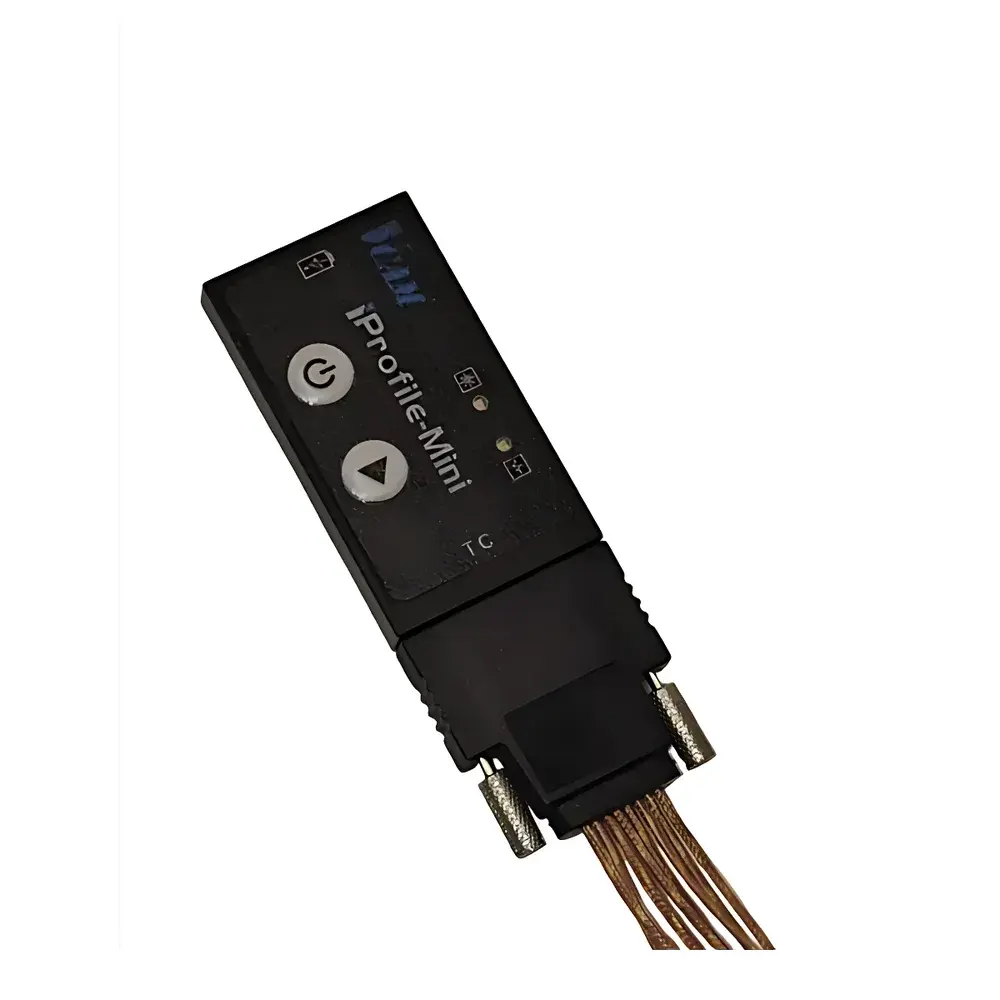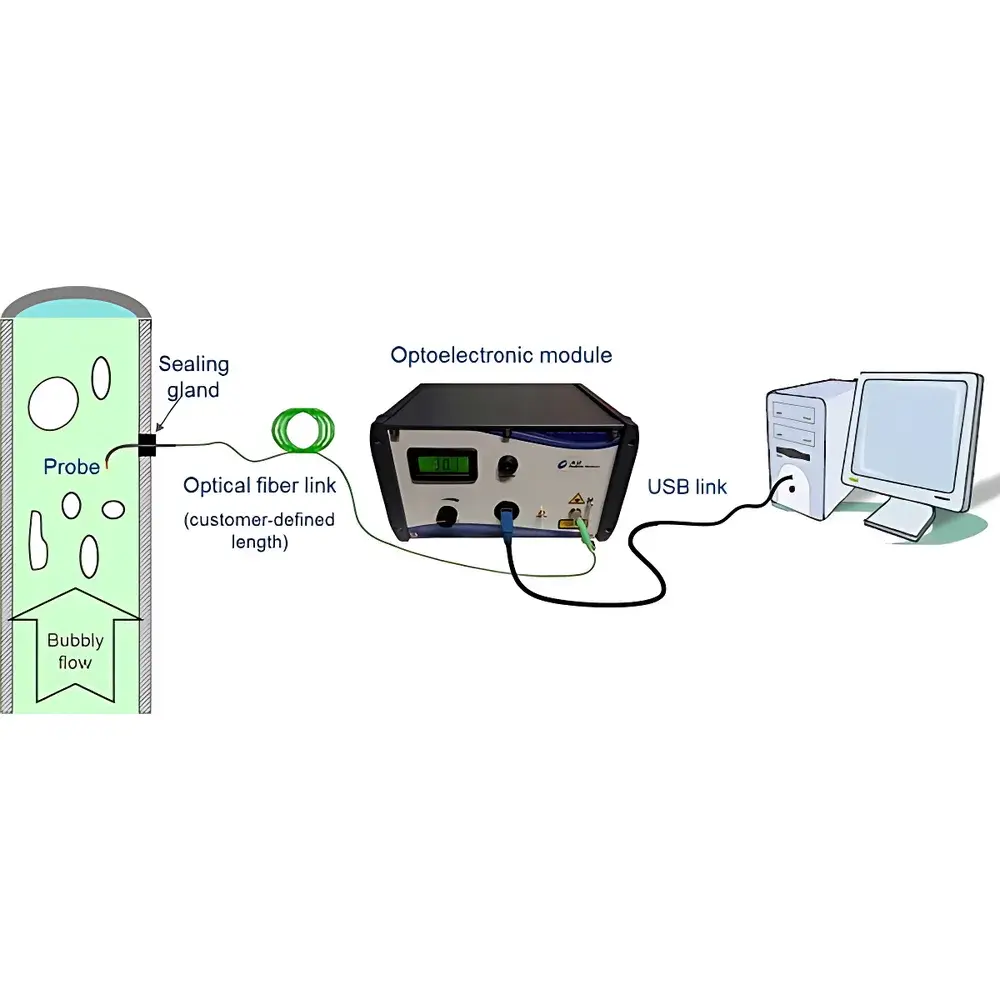
A2 Photonic Sensors Spray Sensor System for Two-Phase Flow Monitoring
| Brand | A2 Photonic Sensors |
|---|---|
| Origin | France |
| Manufacturer Type | Authorized Distributor |
| Origin Category | Imported |
| Model | Spray Sensor |
| Pricing | Upon Request |
| Void Fraction Range | 0 ≤ α ≤ 100% |
| Velocity Range | 0.1–160 m/s |
| Minimum Detectable Bubble Size | > 250 µm |
| Accuracy | Void Fraction ±5%, Velocity & Size ±10% |
| Data Interface | USB, PCIe, ExpressCard |
| Operating Pressure | Up to 10 bar |
| Operating Temperature | Up to 200 °C |
| Probe Type | Single-Point Optical Fiber Probe |
| Compatibility | Opaque Liquids, High-Viscosity Fluids, Turbulent & Complex Flow Regimes |
Overview
The A2 Photonic Sensors Spray Sensor System is a high-precision, single-point optical fiber probe engineered for real-time, localized monitoring of gas–liquid two-phase flows in demanding industrial and research environments. Based on the principle of optical reflectometry at the probe tip, the system detects changes in local refractive index caused by phase transitions—specifically, the passage of gas bubbles or droplets across the active sensing zone. Unlike imaging-based techniques (e.g., high-speed video or laser sheet tomography), this probe operates independently of liquid transparency, making it uniquely suited for opaque, highly viscous, or optically scattering media—including slurries, polymer melts, agrochemical sprays, and multiphase reactor effluents. Its micro-scale geometry (<1 mm probe diameter) ensures minimal flow disturbance while enabling spatially resolved measurements at a fixed point—critical for characterizing spray atomization, nozzle discharge patterns, bubble column dynamics, and hydraulic structures such as stepped spillways or aerated weirs.
Key Features
- Single-point optical fiber probe with sub-millimeter sensing volume for localized, non-intrusive measurement
- High temporal resolution capable of resolving bubble passage events at frequencies up to several kHz—ideal for high-velocity sprays (up to 160 m/s)
- Robust mechanical design rated for operation under pressures up to 10 bar and temperatures up to 200 °C
- No requirement for optical access: fully functional in turbid, pigmented, or opaque liquids where conventional imaging fails
- Insensitive to ambient lighting, particulate contamination, or electromagnetic interference—engineered for continuous operation in harsh industrial settings
- Real-time signal acquisition via USB, PCIe, or ExpressCard interfaces; compatible with standard Windows-based host systems
- Embedded signal processing algorithms deliver simultaneous, synchronized output of local void fraction, bubble velocity, and equivalent spherical bubble diameter
Sample Compatibility & Compliance
The Spray Sensor System is validated for use across diverse fluid systems including water–air sprays, fuel–oxidizer mixtures, pesticide emulsions, fermentation broths, and chemical process streams. Its physical robustness and lack of moving parts support long-term deployment in corrosive, abrasive, or high-vibration environments—such as offshore drilling platforms, wind tunnel test sections, agricultural spray booms, and high-pressure chemical reactors. While not certified to a specific ISO or ASTM standard *as a complete system*, its underlying measurement methodology aligns with established practices defined in ISO 3382-2 (acoustics of fluid flow), ASTM D7489 (standard test method for void fraction in two-phase flow), and IEC 61508 (functional safety of electrical/electronic/programmable electronic safety-related systems) for sensor-level integrity. Raw signal logging enables full traceability and supports GLP/GMP-compliant data archiving when integrated into validated laboratory workflows.
Software & Data Management
The included Windows-native software provides continuous signal acquisition, real-time waveform visualization, and automated parameter extraction. Each detected interface crossing triggers timestamped event logging, preserving raw voltage-time traces alongside derived metrics (void fraction, bubble transit time, peak amplitude). Users may configure sampling rates, trigger thresholds, and post-processing filters directly through an intuitive GUI. All raw data are stored in open-format binary files (.bin) with accompanying metadata headers (XML), ensuring interoperability with MATLAB, Python (NumPy/Pandas), or LabVIEW for custom analysis. Audit trails—including operator ID, calibration timestamps, and software version—are automatically embedded, facilitating compliance with FDA 21 CFR Part 11 requirements when deployed in regulated pharmaceutical or food manufacturing contexts.
Applications
- Agricultural spray nozzles: quantifying droplet size distribution, spray uniformity, and drift potential under field-representative pressure and flow conditions
- Turbine and combustion chamber atomization studies: mapping local air–fuel mixing efficiency in high-temperature, high-pressure test rigs
- Wave flumes and hydraulic structures: measuring entrained air concentration and bubble rise velocity in breaking waves or aerated overflow cascades
- Chemical process intensification: monitoring gas hold-up and bubble dynamics in stirred tank reactors, loop reactors, and microstructured contactors
- Oil & gas production: characterizing slug flow behavior in multiphase pipelines and downhole flow assurance applications
- Pharmaceutical spray drying: validating nozzle performance and particle formation kinetics in pilot-scale dryers
FAQ
Can the probe measure in completely opaque liquids?
Yes—the system relies on internal optical reflection at the probe tip and does not require transmitted light or visual access to the flow.
Is calibration required before each measurement?
No factory calibration is needed for relative void fraction or velocity trends; however, users may perform empirical gain adjustment using known reference flows for absolute accuracy.
What is the smallest detectable bubble size?
The practical lower limit is ~250 µm in diameter, determined by signal-to-noise ratio and interface rise time resolution.
Does the system support synchronization with external triggers (e.g., PIV lasers or pressure transducers)?
Yes—TTL-compatible trigger input/output ports enable hardware-level synchronization with complementary measurement systems.
Can multiple probes be operated simultaneously on one PC?
Yes—up to four independent Spray Sensor units can be daisy-chained or connected via separate USB/PCIe channels, with synchronized time-stamping across all channels.