A2PS POP Series Optical Probe for Bubble and Droplet Detection in Two-Phase Flow
| Brand | A2PS / A2 Photonic Sensors |
|---|---|
| Origin | France |
| Model | POP Series |
| Measurement Principle | Optical Phase-Detection at Probe Tip |
| Concentration Range | 0–100% Void Fraction |
| Velocity Range | 0.1–25 m/s (field-upgradable) |
| Minimum Detectable Bubble Size | ≥500 µm |
| Minimum Detectable Droplet Size | ≥15 µm |
| Typical Accuracy | ±5% for Void Fraction |
| Data Processing Modes | Real-time for Bubbly Flow, Post-Processing for Spray |
| Interface Options | USB, PCIe, ExpressCard |
| Compliance | Designed for GLP/GMP-aligned lab environments |
Overview
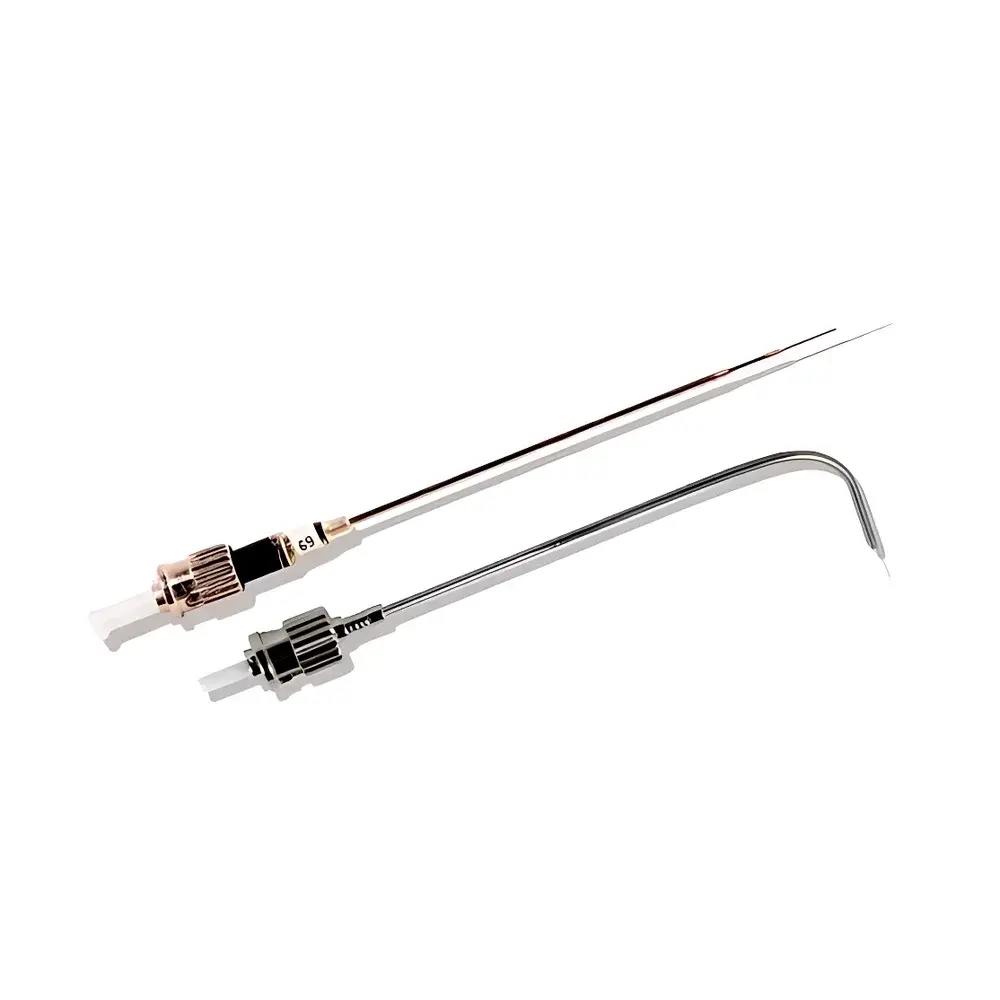
The A2PS POP Series Optical Probe is a contact-based, single-point optical sensor engineered for high-fidelity characterization of gas–liquid two-phase flows—specifically bubbly flow and spray (droplet-laden) regimes—in opaque, optically dense, or highly scattering media. Unlike conventional laser diffraction or high-speed imaging systems, the POP probe operates without requiring external optical access or collimated beam paths. Its core measurement principle relies on localized refractive index contrast detection at the probe tip: as the probe tip contacts the fluid medium, a focused laser beam reflects internally within the sapphire-tipped optical fiber. When a gas bubble or liquid droplet crosses the sensing zone, the abrupt change in local refractive index induces a measurable phase shift in the reflected signal. Time-resolved analysis of successive phase transitions enables simultaneous quantification of local void fraction (α), interfacial velocity (U), and discrete bubble/droplet chord length—converted to equivalent spherical diameter using validated geometric assumptions.
Key Features
- Contact-mode operation eliminates dependence on external optical windows, vessel transparency, or ambient lighting—enabling deployment in pressurized reactors, stirred tanks, and pipe sections where traditional optical diagnostics fail.
- Robust sapphire probe tip (Mohs hardness 9) ensures chemical inertness and mechanical durability in aggressive aqueous, acidic, or particulate-laden fluids.
- Multi-parameter output per acquisition cycle: real-time void fraction, instantaneous interfacial velocity, and chord-length distribution—each timestamped with microsecond resolution.
- Field-upgradable firmware supports extended velocity range (up to 25 m/s) and advanced signal conditioning algorithms for improved discrimination in polydisperse or overlapping events.
- Modular interface architecture: native USB 2.0 for portable lab use; PCIe and ExpressCard variants for integration into high-throughput industrial DAQ systems with deterministic latency.
Sample Compatibility & Compliance
The POP probe is validated for continuous immersion in conductive and non-conductive liquids—including water, glycerol–water mixtures, hydrocarbon solvents, and fermentation broths—across temperatures from 5 °C to 80 °C and pressures up to 10 bar (with optional pressure-rated housing). It complies with IEC 61000-6-2 (immunity) and IEC 61000-6-4 (emissions) standards. While not intrinsically safe certified, it is routinely deployed in Class I, Division 2 environments when used with appropriate barrier isolators. Data integrity protocols align with FDA 21 CFR Part 11 requirements for electronic records: audit trails, user authentication, and immutable raw-data archiving are supported via A2PS’ certified acquisition software suite.
Software & Data Management
The included A2PS FlowAnalyzer v4.2 software provides synchronized hardware control, real-time visualization, and post-acquisition statistical analysis. It exports time-series data in HDF5 and CSV formats, preserving metadata (probe calibration ID, temperature, sampling rate, trigger settings). Batch processing modules support automated bubble/droplet classification using adaptive thresholding and deconvolution of overlapping transit signals. All software modules undergo annual verification against NIST-traceable reference phantoms and are documented per ISO/IEC 17025 clause 5.9 for measurement uncertainty estimation.
Applications
- Chemical process intensification: quantifying gas holdup and bubble size distribution in aerated bioreactors and catalytic slurry reactors.
- Energy sector: void fraction profiling in nuclear coolant loops and geothermal two-phase pipelines.
- Pharmaceutical manufacturing: monitoring droplet size and concentration during spray drying and inhaler formulation development.
- Academic multiphase research: validation of CFD–Eulerian–Eulerian and population balance models under realistic boundary conditions.
- Food & beverage: characterizing CO₂ bubble dynamics in carbonated beverage filling lines and fermentation headspace evolution.
FAQ
Can the POP probe be used in opaque or turbid liquids?
Yes. Because it operates via direct contact and internal reflection—not transmission—the probe functions independently of bulk liquid opacity or suspended solids content.
What is the minimum detectable bubble size, and how is size accuracy affected by shape?
The nominal lower limit is 500 µm for spherical bubbles. For non-spherical or elongated bubbles, reported size represents the chord length perpendicular to flow; equivalent spherical diameter is derived assuming isotropic orientation distribution.
Is calibration required before each experiment?
No routine recalibration is needed. The probe is factory-calibrated using NIST-traceable refractive index standards. Users perform a one-time system verification using a known air–water interface prior to critical measurements.
Does the system support synchronization with other sensors (e.g., pressure transducers, thermocouples)?
Yes. Hardware TTL triggers and PTPv2 time-stamping enable sub-millisecond synchronization across distributed sensor networks.
How is data integrity ensured during long-term unattended operation?
The acquisition engine implements cyclic redundancy checks (CRC-32), automatic file segmentation, and write-verification logging—ensuring recoverability after power interruption or storage errors.