
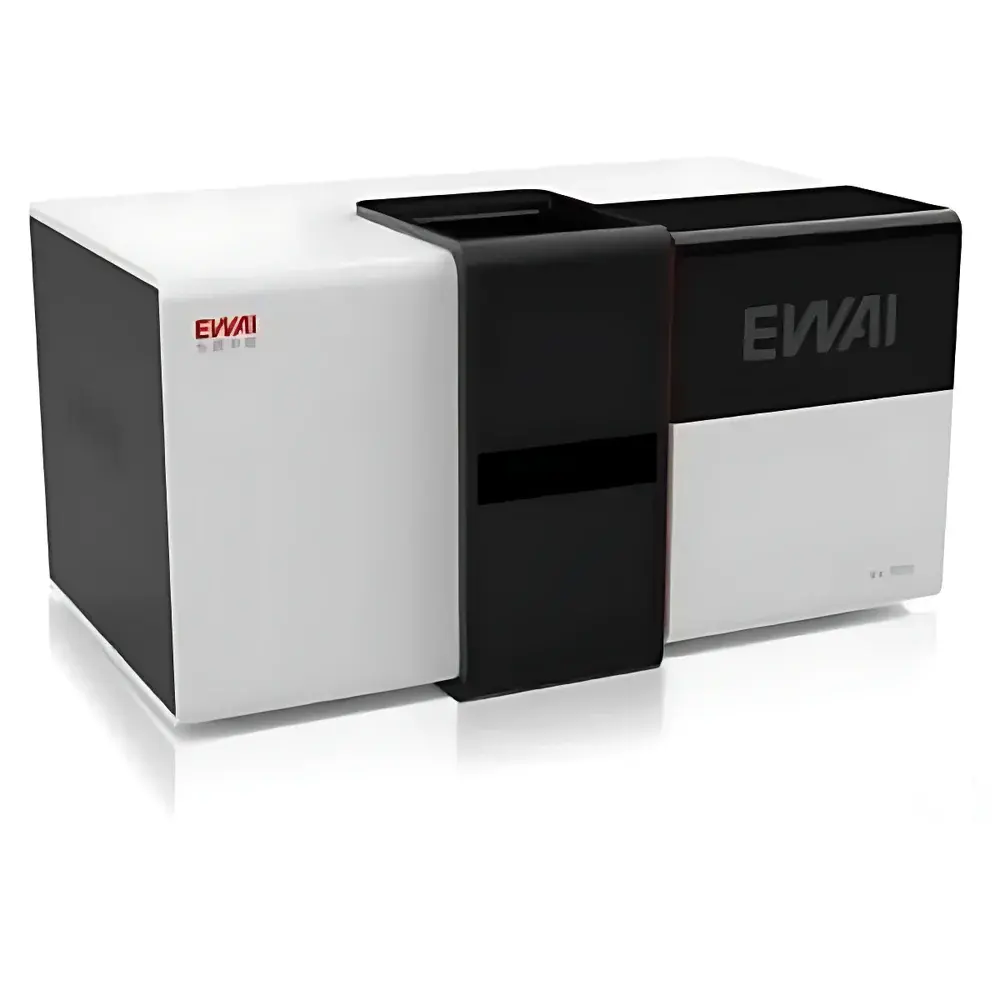
AA-7095 Atomic Absorption Spectrometer by East & West Analytical Instruments
| Brand | East & West Analytical Instruments |
|---|---|
| Origin | Beijing, China |
| Manufacturer Type | Direct Manufacturer |
| Product Origin | Domestic (China) |
| Model | AA-7095 Atomic Absorption Spectrometer |
| Pricing | Upon Request |
| Light Source Configuration | 8-lamp turret with simultaneous preheating |
| Spectral Bandwidth Options | 0.1, 0.2, 0.4, 0.7, 1.0, and 2.0 nm (6-step automated slit selection) |
| Background Correction | Dual-mode — longitudinal AC Zeeman effect + D₂ lamp |
| Auto-Optimization Functions | Automated zeroing, wavelength scanning, hollow cathode lamp positioning, mirror alignment, and energy balancing |
Overview
The AA-7095 Atomic Absorption Spectrometer is a benchtop flame and graphite furnace atomic absorption system engineered for precision trace metal analysis in environmental, pharmaceutical, clinical, food safety, and industrial quality control laboratories. It operates on the fundamental principle of atomic absorption spectroscopy (AAS), wherein ground-state free atoms in a gaseous state absorb light at element-specific wavelengths emitted by hollow cathode lamps (HCLs). Quantification is achieved via Beer-Lambert law-based calibration curves, enabling detection limits in the sub-ppt range for most elements when coupled with graphite furnace atomization. The instrument integrates a fixed 8-lamp turret architecture—eliminating manual lamp changes—and supports both flame and electrothermal atomization modes, offering flexibility across sample matrices and concentration ranges.
Key Features
- 8-Lamp Simultaneous Preheating Turret: Enables rapid method switching without lamp warm-up delays; each HCL is independently powered and thermally stabilized prior to measurement.
- Automated Spectral Slit Selection: Six discrete spectral bandwidths (0.1–2.0 nm) are selected under software control to optimize signal-to-noise ratio and spectral resolution per analytical requirement—critical for resolving adjacent lines in complex matrices.
- Intelligent Auto-Optimization Sequence: Fully automated alignment protocol performs baseline zeroing, spectral scanning, lamp positional fine-tuning, monochromator mirror adjustment, and photomultiplier tube (PMT) energy balancing—all triggered by method-defined elemental parameters.
- Dual Background Correction Architecture: Combines longitudinal alternating-current Zeeman background correction (for high-precision correction of structured background, e.g., in graphite furnace analysis) with deuterium (D₂) lamp correction (for broad-band, low-intensity background in flame mode), ensuring accuracy across diverse sample types and atomization conditions.
- Robust Optical Design: Double-beam optical path with real-time reference beam monitoring minimizes drift from source intensity fluctuations and environmental thermal effects.
- Modular Atomization System: Interchangeable flame and graphite furnace modules share common optics and electronics, simplifying validation, maintenance, and regulatory documentation.
Sample Compatibility & Compliance
The AA-7095 accommodates liquid samples (aqueous, acidic digests, organic extracts) and solid suspensions compatible with standard nebulizer systems or graphite furnace platforms. Flame AAS supports direct aspiration of solutions up to 25% v/v acid content; graphite furnace operation accepts 5–30 µL volumes with integrated platform temperature programming. The system complies with core international analytical standards including ASTM D1688 (copper in water), ISO 11885 (water quality – determination of elements by AAS), and USP for elemental impurities in pharmaceuticals. Its firmware architecture supports audit trail generation, user access levels, and electronic signature capability—aligning with GLP and GMP data integrity expectations under FDA 21 CFR Part 11 when deployed with validated software configurations.
Software & Data Management
Controlled via Windows-based AAWorkstation software, the AA-7095 provides method development wizards, multi-element sequential analysis scheduling, QC flagging (e.g., calibration drift >5%, blank exceedance), and raw data export in CSV and XML formats. All instrument parameter changes—including slit width, lamp current, burner height, and furnace temperature ramp profiles—are time-stamped and logged with operator ID. Data files include embedded metadata (instrument ID, method name, analyst, date/time, calibration curve statistics), facilitating traceability during internal audits or regulatory inspections. Optional LIMS integration is supported through ASTM E1384-compliant interface protocols.
Applications
- Environmental monitoring: Pb, Cd, As, Cr, and Ni quantification in drinking water, wastewater, and soil digests per EPA Method 200.7 and 7000B.
- Pharmaceutical quality control: Residual catalyst metals (Pd, Pt, Rh) in active pharmaceutical ingredients (APIs) per ICH Q2(R2) guidelines.
- Food and beverage testing: Na, K, Ca, Mg, Fe, Zn in fortified cereals, dairy, and infant formula per AOAC 984.27.
- Geochemical analysis: Rare earth elements (REEs) and transition metals in rock and sediment leachates using graphite furnace enhancement.
- Clinical toxicology: Blood lead level (BLL) screening in whole blood specimens following CLIA-waived protocols.
FAQ
Does the AA-7095 support hydride generation for arsenic or selenium analysis?
Yes—when equipped with optional hydride vapor generation (HVG) accessory, the system enables sub-ng/mL detection of As, Se, Sb, Bi, Te, and Sn via cold vapor atomic absorption principles.
Is the 8-lamp turret compatible with multi-element HCLs or only single-element lamps?
The turret accepts standard 1/2-inch diameter single-element hollow cathode lamps; multi-element lamps are not supported due to spectral interference constraints inherent to AAS methodology.
Can background correction modes be selected per element within a single multi-element method?
Yes—software allows independent assignment of Zeeman or D₂ correction for each analyte line, optimizing correction strategy based on matrix complexity and expected background profile.
What validation documentation is provided with the instrument?
Factory-installed IQ/OQ documentation, optical alignment verification reports, and wavelength accuracy certification (NIST-traceable holmium oxide filter) are included; PQ protocols are customizable per laboratory SOP requirements.
Is remote diagnostics or service support available?
Remote connection via secure TLS-encrypted VNC is supported for technical assistance; all firmware updates and method libraries are distributed through East & West’s authorized service portal.




