
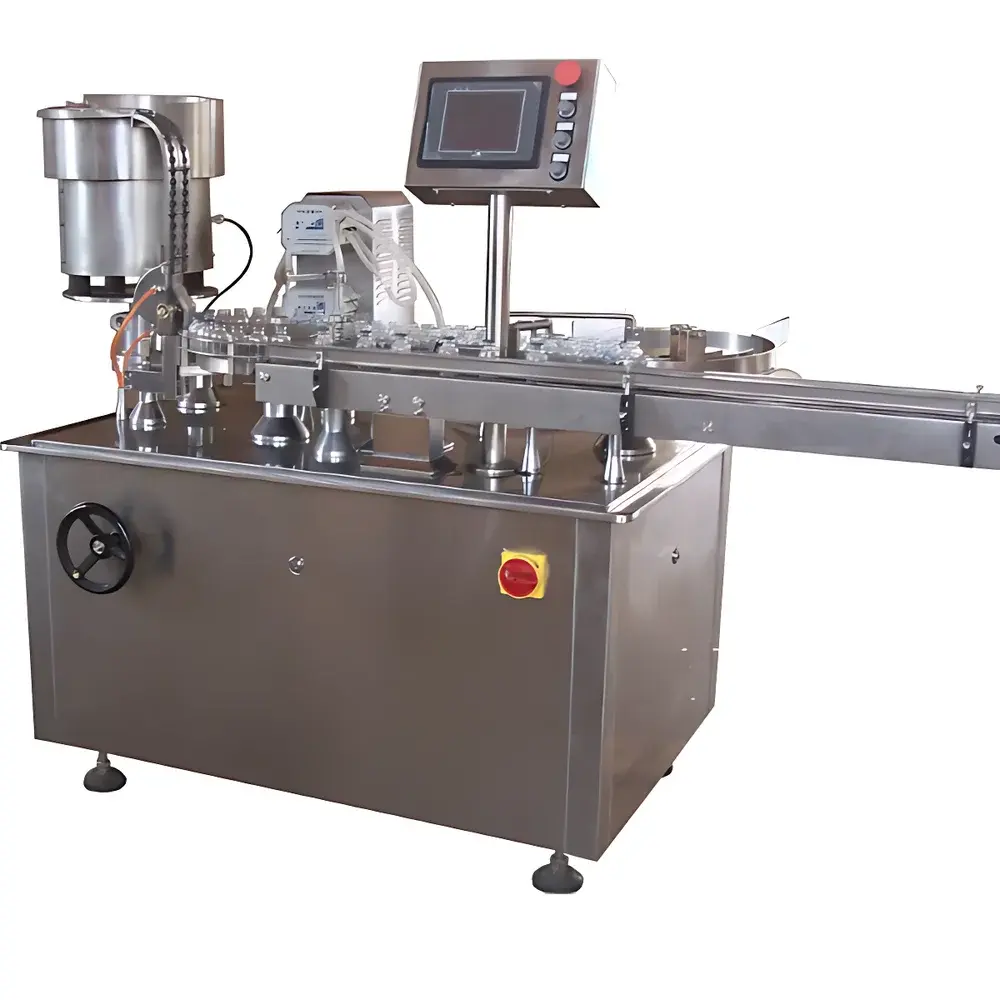
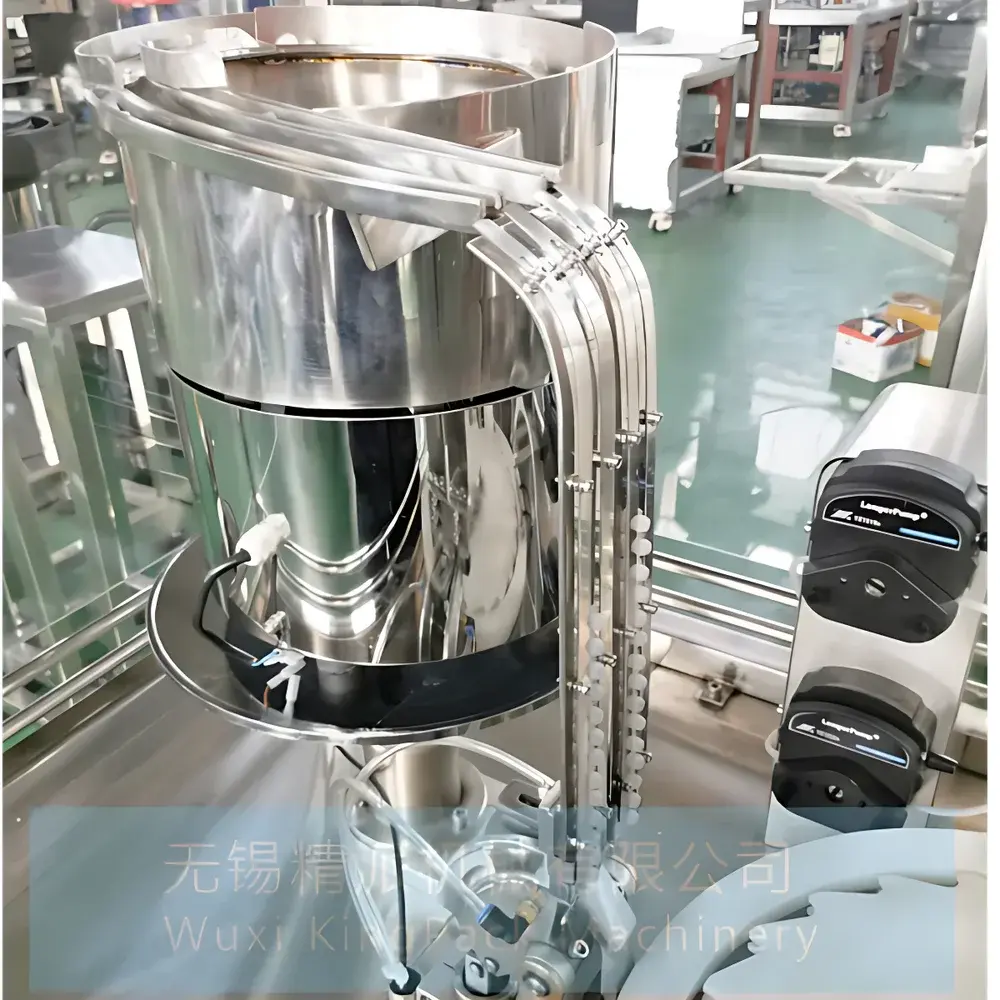
AA OPTO Electronic KPGZ-2 Dual-Head Vial Filling and Stoppering Machine for Lyophilization
| Brand | AA OPTO Electronic |
|---|---|
| Origin | China |
| Manufacturer Type | Authorized Distributor |
| Model | KPGZ-2 |
| Operating Speed | 30–60 vials/min |
| Filling Accuracy | ≤ ±1–3% |
| Motor Power | 0.37 kW |
| Total Power Consumption | 0.85 kW |
| Voltage/Frequency | 220 V / 50 Hz |
| Dimensions (L×W×H) | 1400 × 1000 × 1450 mm |
| Weight | ~300 kg |
| Construction Material | AISI 304 stainless steel |
| Control System | Custom microcomputer board with Weinview HMI touchscreen |
| Actuation | High-precision German stepper motors (step angle: 0.72°) |
| Critical Components | Siemens AC contactors, Omron miniature relays, Autonics photoelectric sensors, Danish silicone tubing |
| Compliance | Designed to meet core GMP requirements for aseptic pharmaceutical processing |
Overview
The AA OPTO Electronic KPGZ-2 Dual-Head Vial Filling and Stoppering Machine is an integrated, benchtop-scale automation system engineered specifically for the final aseptic processing stage of lyophilized (freeze-dried) pharmaceutical products. It performs synchronized liquid filling, rubber stopper orientation, and stopper insertion into glass vials—within a single pass through the machine’s linear processing zone. The system operates on volumetric peristaltic dispensing principles, where calibrated rotation of precision-engineered silicone tubing delivers consistent fluid displacement under controlled backpressure conditions. Its dual-head architecture enables parallel filling of two vial lanes, supporting throughput scalability without compromising fill uniformity or mechanical repeatability. Designed for integration into Grade A/B cleanroom environments (ISO 14644-1 Class 5/7), the KPGZ-2 maintains strict material compatibility with sterile-grade excipients, buffer solutions, and biologics—including monoclonal antibodies, vaccines, and peptide therapeutics.
Key Features
- Microprocessor-based motion control architecture featuring a proprietary embedded microcomputer board and Weinview 7-inch resistive touchscreen HMI for intuitive parameter navigation and real-time status monitoring.
- Dual independent peristaltic filling heads driven by high-torque German stepper motors (0.72° step angle), delivering precise volumetric delivery across adjustable ranges (typically 1–50 mL/vial, configurable via digital input).
- GMP-compliant wetted path constructed entirely from electropolished AISI 304 stainless steel and USP Class VI-certified Danish silicone tubing—fully autoclavable and compatible with CIP/SIP protocols.
- Tool-free pump head design using modular snap-fit clamping mechanisms; silicone tubing replacement requires no disassembly tools and can be completed in under 90 seconds per channel.
- Intelligent bottle presence detection using Autonics photoelectric sensors at inlet and transfer zones—automatically halts operation upon detection of missing, tilted, or jammed vials to prevent mechanical damage or cross-contamination.
- Persistent memory function retains all user-defined parameters (fill volume, dwell time, stopper compression force, cycle delay) across power cycles—eliminating reconfiguration during shift handovers or routine maintenance restarts.
- Elevated platform architecture with sealed gasketed base plates and splash-resistant vertical mounting—enabling full-surface aqueous cleaning with purified water or WFI without electrical hazard or corrosion risk.
Sample Compatibility & Compliance
The KPGZ-2 accommodates standard pharmaceutical vial formats including 2R, 4R, 6R, 10R, and 20R (ISO 8536-1), with optional change kits for custom neck geometries. It accepts both bromobutyl and chlorobutyl stoppers (diameter range: 13–32 mm), and supports crimp-cap post-stoppering workflows. All contact surfaces comply with ISO 10993-5 (cytotoxicity) and USP for plastic components. While not certified as standalone 21 CFR Part 11-compliant equipment, the system’s audit trail-ready firmware (with timestamped parameter logs and operator ID prompts) supports integration into validated manufacturing execution systems (MES) under FDA-aligned quality systems. Design documentation conforms to ICH Q5A(R2) and Q5C guidelines for biopharmaceutical process equipment qualification.
Software & Data Management
The onboard microcontroller records operational metadata—including cycle count, cumulative runtime, motor step deviation logs, and sensor event timestamps—in non-volatile flash memory. Data export is supported via USB 2.0 interface in CSV format for traceability linkage with LIMS or electronic batch records (EBR). The HMI provides password-protected access levels (Operator, Technician, Administrator) aligned with ALCOA+ data integrity principles. Firmware updates are performed offline using signed binary packages to ensure deterministic behavior and version control. Optional RS-485 Modbus RTU interface enables PLC-level integration for coordinated line synchronization in multi-unit production suites.
Applications
- Final fill-finish of clinical trial materials (Phase I–III) requiring rapid turnaround and flexible batch sizes (50–5,000 vials).
- Small-batch cGMP manufacturing of orphan drugs and personalized therapies where regulatory flexibility and equipment qualification efficiency are critical.
- Process development labs conducting formulation stability studies under variable fill volumes and stopper compression profiles.
- Contract development and manufacturing organizations (CDMOs) supporting tech transfer activities between R&D and commercial scale-up facilities.
- Academic and government research institutions performing lyophilization feasibility testing under GLP conditions.
FAQ
Is the KPGZ-2 suitable for sterile filling under laminar airflow hoods?
Yes—the machine’s low particulate generation, smooth surface finishes, and absence of internal recirculating air paths make it compatible with ISO Class 5 horizontal laminar flow workstations when installed with appropriate gowning and environmental monitoring protocols.
Can the system be qualified for use in commercial GMP manufacturing?
It supports IQ/OQ protocols per ASTM E2500 and ISPE Baseline Guide Vol. 4; PQ must be conducted using site-specific product and container-closure systems. Documentation packages include FAT/SAT reports, material certifications, and electrical schematics.
What maintenance intervals are recommended for the peristaltic pump tubing?
Silicone tubing should be replaced every 200–300 operating hours or after 10,000 cycles—whichever occurs first—to maintain volumetric accuracy within specification limits.
Does the controller support network connectivity for remote diagnostics?
Standard configuration includes only local HMI and USB export; Ethernet or Wi-Fi modules are available as factory-installed options subject to cybersecurity validation per IEC 62443-3-3.
Are spare parts and technical documentation available internationally?
AA OPTO Electronic maintains a global spare parts warehouse with 48-hour dispatch for critical wear items; English-language operation manuals, wiring diagrams, and calibration templates are provided with each unit.



