
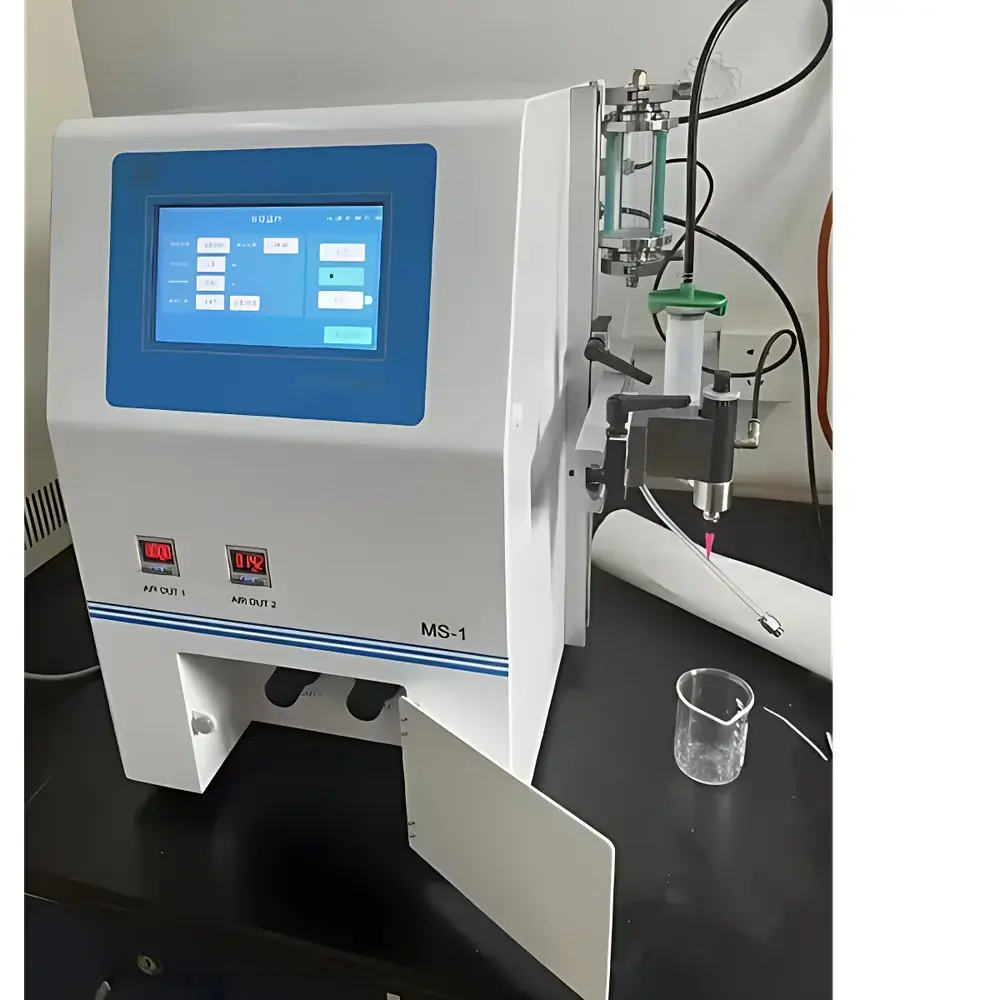
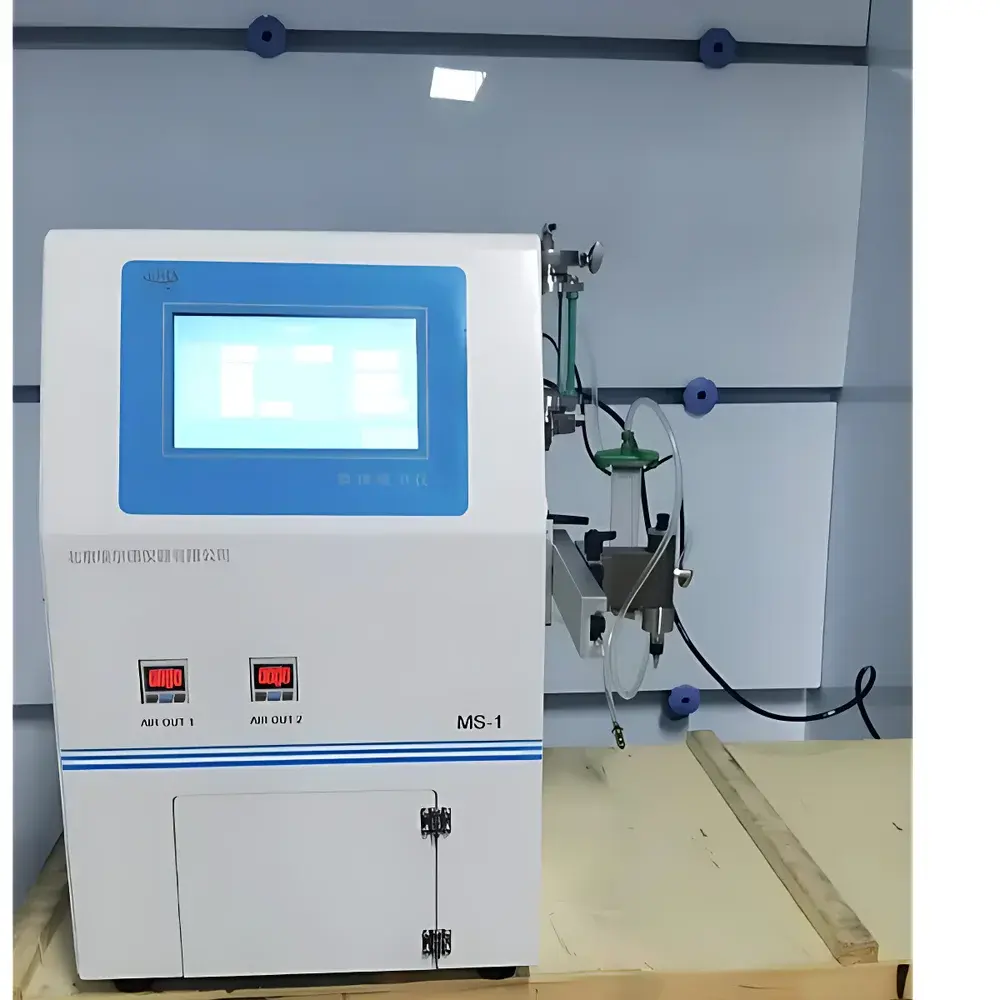
AA OPTO Electronic MS-1 Alumina Microsphere Forming Instrument
| Brand | AA OPTO Electronic |
|---|---|
| Origin | Beijing, China |
| Manufacturer Type | Authorized Distributor |
| Country of Origin | China |
| Model | MS-1 Alumina Microsphere Forming Instrument |
| Power Supply | 220 V AC, 50 Hz, 200 W |
| Compressed Air/N₂ Requirement | 0.5–0.7 MPa |
| Dispensing Volume Range | 1–100 µL (adjustable) |
| Dispensing Speed | up to 1080 pcs/h |
| Accuracy | ±0.3% |
| Stroke Range | 1–150 mm |
| Dimensions (L×W×H) | 500 × 320 × 520 mm |
| Control System | PLC + V1.1 firmware |
| Display | 7-inch high-resolution embedded color LCD touchscreen |
| Pump Type | Reciprocating diaphragm pump with stainless-steel pump core |
| Wetted Materials | Low-adsorption, chemically inert components |
| Operating Modes | Auto dispensing, cleaning, password-protected configuration |
| Safety Features | Overpressure protection, overload detection, real-time system monitoring |
Overview
The AA OPTO Electronic MS-1 Alumina Microsphere Forming Instrument is an engineered microfluidic dispensing platform specifically designed for the controlled, repeatable generation of monodisperse alumina (Al₂O₃) microspheres via drop-on-demand (DOD) liquid-phase precursor deposition. It operates on a precision reciprocating diaphragm pumping principle—distinct from peristaltic or syringe-based systems—enabling continuous, pulse-free fluid delivery without priming requirements. The instrument is optimized for sol-gel-derived alumina suspensions and precursor solutions (e.g., aluminum isopropoxide in ethanol/water mixtures), where consistent droplet volume, low surface adsorption, and inert wetted-path integrity are critical to minimizing particle agglomeration and ensuring spherical morphology during subsequent drying and calcination. Its compact, integrated architecture supports integration into glovebox environments or inline pilot-scale ceramic processing lines, particularly for catalyst support, refractory filler, and chromatographic stationary phase manufacturing.
Key Features
- Reciprocating stainless-steel diaphragm pump: Eliminates need for manual priming; ensures uninterrupted operation over extended cycles with corrosion resistance to common alumina precursors.
- Low-adsorption fluidic path: All wetted surfaces—including nozzle, tubing, and pump chamber—are fabricated from chemically inert, non-polar materials (e.g., PTFE-lined stainless steel and fluoropolymer elastomers) to prevent precursor retention and cross-contamination.
- Programmable volumetric dispensing: Precise 1–100 µL range adjustment with ±0.3% volumetric accuracy, validated using gravimetric calibration per ISO 8655-5 protocols.
- Dual-mode motion control: Adjustable vertical stroke (1–150 mm) and programmable dispensing frequency (up to 1080 drops/h) enable optimization for varying suspension viscosity (1–50 mPa·s) and target sphere diameter (10–500 µm).
- Industrial-grade PLC + V1.1 firmware: Provides deterministic timing, fault logging, and deterministic I/O response (<10 ms latency); supports deterministic sequence execution for multi-step protocols (e.g., dispense → pause → nitrogen purge → repeat).
- 7-inch embedded capacitive touchscreen interface: Displays real-time status including elapsed run time, cumulative drop count, remaining cycle time, and active alarm conditions; supports user-defined parameter profiles with timestamped version control.
- Comprehensive safety architecture: Integrated pressure transducers monitor backpressure in real time; hardware-enforced overpressure cutoff (0.75 MPa threshold); motor current sensing for mechanical overload detection; password-protected access to calibration and maintenance menus.
Sample Compatibility & Compliance
The MS-1 is validated for aqueous and alcoholic alumina sols, boehmite gels, and nitrate/alkoxide-based precursors with solids loading ≤30 wt%. It accommodates nozzle orifices from 150–800 µm, enabling tuning of final microsphere size post-drying. All fluid-contact materials comply with USP Class VI biocompatibility standards and meet ISO 10993-5 cytotoxicity requirements. The instrument’s operational design adheres to IEC 61000-6-2 (immunity) and IEC 61000-6-4 (emission) electromagnetic compatibility directives. For regulated environments, audit trail functionality (via optional SD card logging) supports GLP-compliant data integrity when configured with time-stamped event records per FDA 21 CFR Part 11 Annex 11 principles.
Software & Data Management
The embedded V1.1 control firmware stores up to 99 user-defined dispensing protocols locally, each containing volume, speed, stroke, dwell time, and purge parameters. All operational events—including start/stop timestamps, error codes, and manual overrides—are logged with millisecond resolution. Exportable CSV files include column headers compliant with ASTM E2500-22 for analytical instrument data traceability. No external PC dependency is required for routine operation; however, optional USB-C connectivity enables firmware updates and batch report extraction without interrupting production runs.
Applications
- Preparation of spherical alumina microspheres for catalytic support matrices (e.g., Pt/Al₂O₃ reforming catalysts).
- Production of uniform ceramic microbeads for HPLC stationary phases and solid-phase extraction cartridges.
- R&D-scale synthesis of doped alumina spheres (e.g., La-, Ce-, or Si-modified) for thermal barrier coatings.
- Controlled fabrication of hollow or core-shell microspheres via coaxial DOD configurations (with compatible dual-channel add-on modules).
- Process development for scalable sol-gel microsphere manufacturing under inert (N₂) or reducing (H₂/N₂) atmospheres.
FAQ
What types of alumina precursors are compatible with the MS-1?
Aqueous boehmite sols, aluminum nitrate nonahydrate solutions, and alkoxide-based systems (e.g., Al(OPr)₃ in isopropanol) have been validated. Viscosity should remain below 50 mPa·s at dispensing temperature.
Is the instrument suitable for use inside a nitrogen-filled glovebox?
Yes—the MS-1 operates on standard 220 V AC and requires only external compressed N₂ (0.5–0.7 MPa) for droplet detachment; all electronics are sealed to IP54 rating.
Can dispensing parameters be synchronized with external equipment (e.g., rotary dryer or furnace)?
The instrument provides opto-isolated TTL-level trigger I/O ports (start/stop/pause) and Modbus RTU over RS-485 for programmable interlock with third-party process controllers.
How is calibration verified and maintained?
Gravimetric verification is performed using certified analytical balances (±0.01 mg resolution); calibration coefficients are stored per protocol and can be reloaded without firmware update.
Does the system support GMP documentation requirements?
When paired with the optional SD logging module and time-server synchronization, the MS-1 meets baseline ALCOA+ criteria for attributable, legible, contemporaneous, original, accurate, and complete electronic records.



