
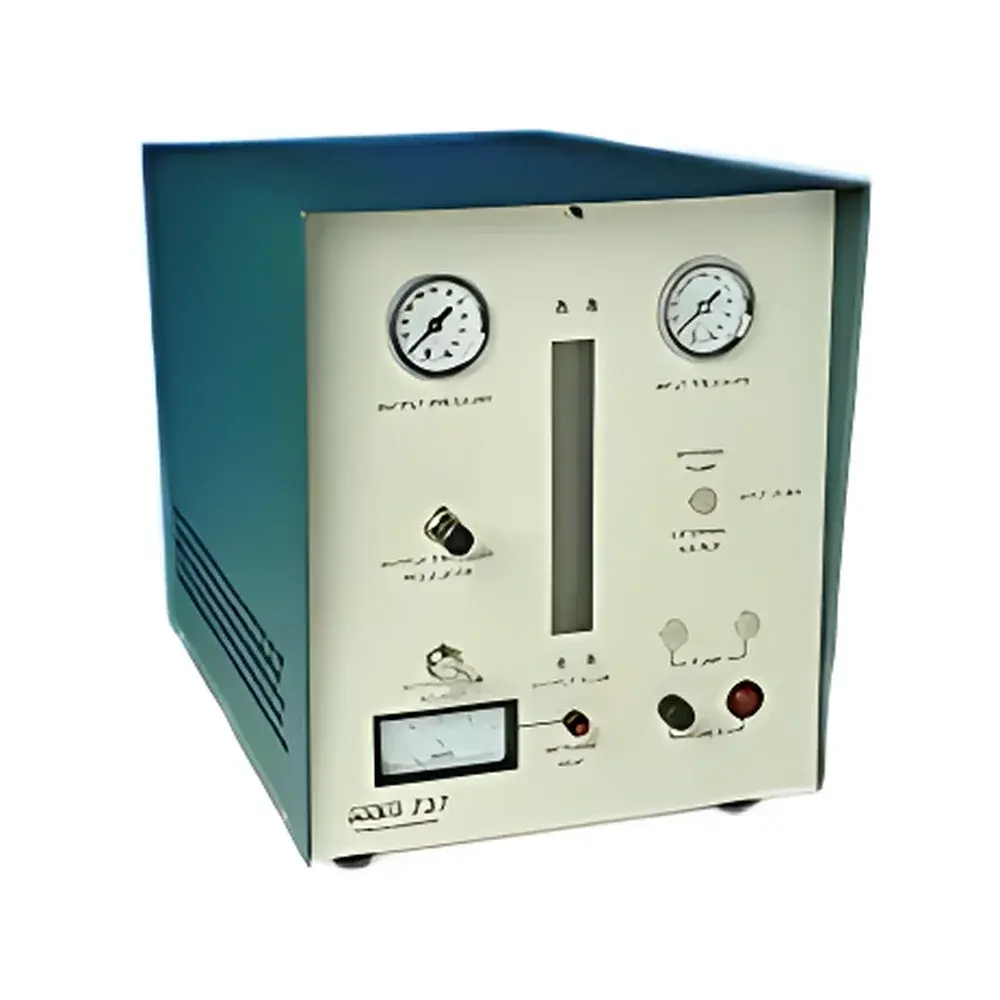
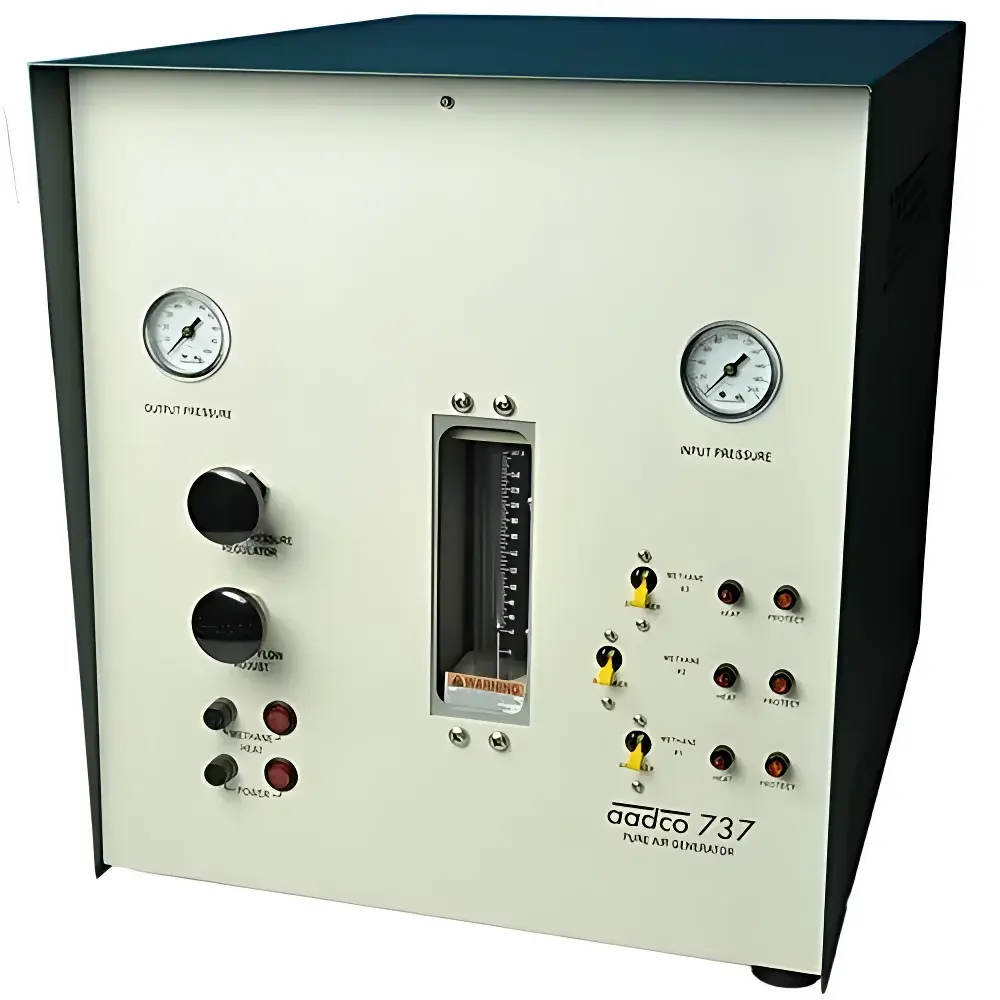
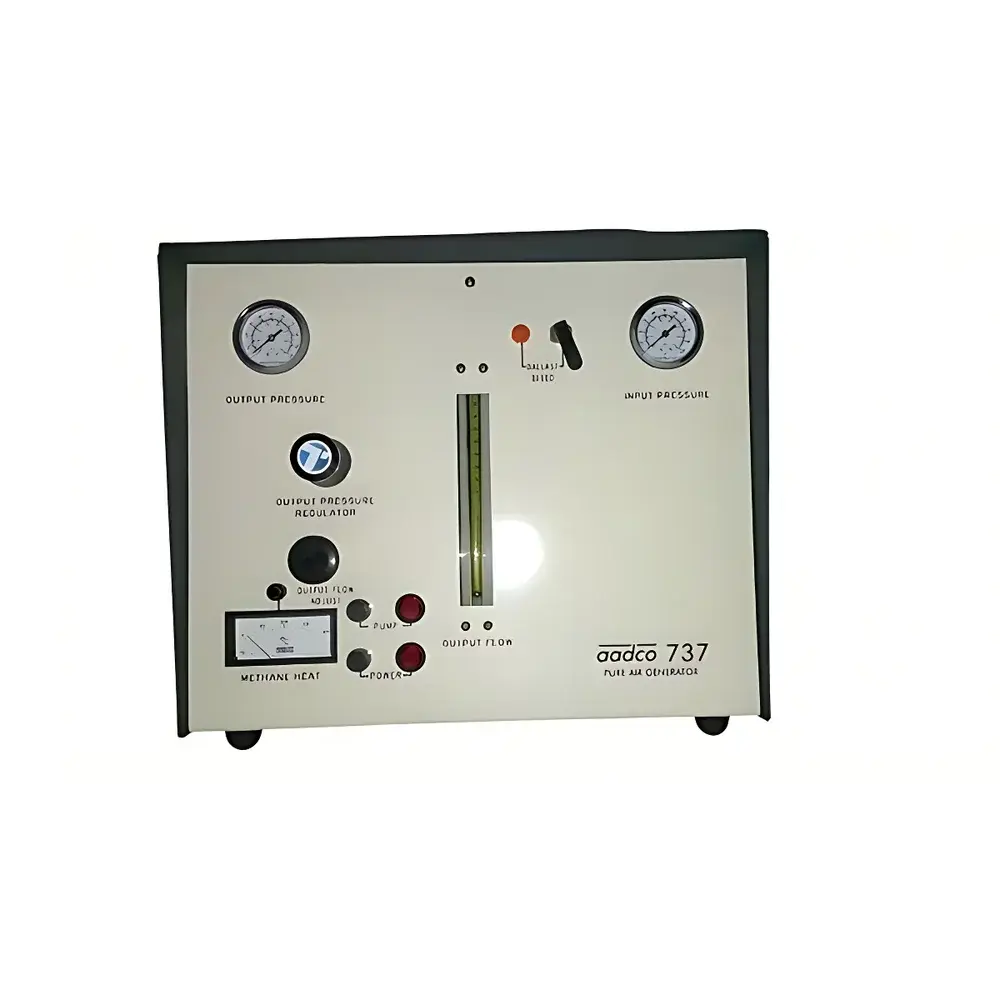
AADCO 737-11 Zero Air Generator
| Brand | AADCO |
|---|---|
| Origin | USA |
| Model | 737-11 |
| Zero Air Purity | <1 ppb (for O₃, CH₄, hydrocarbons, NO/NOₓ, H₂S, SO₂, COS, CO, CO₂, SF₆, fluorocarbons) |
| Flow Rate | 10 L/min (adjustable up to 20 L/min) |
| Output Pressure | 80 psi |
| Dew Point | -50°C |
Overview
The AADCO 737-11 Zero Air Generator is a precision-engineered source of ultra-purified compressed air designed for critical environmental monitoring, analytical calibration, and laboratory-grade gas-phase instrumentation. It operates on a multi-stage purification architecture—integrating catalytic oxidation, high-efficiency particulate adsorption, and deep desiccant drying—to remove trace contaminants including ozone (O₃), methane (CH₄), non-methane hydrocarbons (NMHC), nitrogen oxides (NO/NOₓ), hydrogen sulfide (H₂S), sulfur dioxide (SO₂), carbonyl sulfide (COS), carbon monoxide (CO), carbon dioxide (CO₂), sulfur hexafluoride (SF₆), and fluorocarbons to sub-part-per-trillion levels. Unlike bottled zero air—which risks batch-to-batch variability, pressure decay, and contamination during handling—the 737-11 delivers continuous, on-demand zero air with documented purity stability and traceability. Its design adheres to the fundamental requirements of EPA Method TO-14A, ASTM D6196, ISO 8573-1 Class 1 (for particles, water, and oil), and supports compliance with US EPA ambient air monitoring protocols (e.g., 40 CFR Part 58) and regulatory QA/QC procedures in federal, state, and industrial laboratories.
Key Features
- Ultra-low contaminant output: <1 ppb total hydrocarbon equivalent (THCE) and <1 ppb for individual target species including O₃, NOₓ, SO₂, H₂S, COS, CO, CO₂, SF₆, and fluorocarbons—verified via independent third-party certification per ISO/IEC 17025-accredited testing.
- Stable, adjustable flow delivery: 0–20 L/min range with fine-resolution needle valve control; factory-calibrated rotameter or optional digital LED flow meter for real-time monitoring.
- Robust pressure regulation: Maintains consistent 80 psi output pressure across variable inlet conditions (40–120 psi input), minimizing downstream regulator wear and ensuring compatibility with GC, chemiluminescence, UV photometry, and FTIR systems.
- Cryogenic-grade dew point performance: Integrated desiccant and refrigerated drying stages achieve ≤ –50°C dew point at full flow—critical for preventing condensation in sensitive optical paths and electrochemical sensors.
- Modular, service-intuitive construction: Front-access replaceable cartridges (catalyst, activated carbon, molecular sieve, desiccant) with color-coded indicators and documented replacement intervals aligned with ISO 17025 maintenance logs.
- Flexible deployment options: Available in benchtop configuration or rack-mountable chassis (19″ EIA standard); optional vibration-dampened feet and EMI-shielded power supply for integration into mobile labs or cleanroom environments.
Sample Compatibility & Compliance
The AADCO 737-11 is validated for use with EPA-certified ambient air analyzers (e.g., Thermo Fisher 42i, 43i, 48i; Teledyne T300U; Horiba APNA-370), continuous emission monitoring systems (CEMS), gas chromatographs (GC-FID, GC-ECD), and reference photometers requiring certified zero air for baseline drift correction and span validation. It meets the zero air specifications outlined in US EPA 40 CFR Part 53 (for PM and O₃ analyzer testing), ASTM D6196-22 (standard practice for selecting sorbent tubes), and ISO 14644-1 (cleanroom air quality). All units ship with a Certificate of Conformance, traceable to NIST standards, and support GLP/GMP audit readiness through documented calibration history, maintenance logs, and component lot traceability.
Software & Data Management
While the 737-11 is a hardware-only, analog-controlled generator (no embedded microprocessor or network interface), it integrates seamlessly into modern data acquisition ecosystems via optional analog 4–20 mA or 0–10 VDC output modules for flow and pressure telemetry. These signals feed directly into SCADA, LabVIEW, or DeltaV platforms for automated logging, alarm triggering (e.g., pressure drop >15 psi across filter bank), and preventive maintenance scheduling. AQC (Analytical Quality Control) workflows can incorporate its runtime hours and cartridge service dates into LIMS-based instrument qualification records. For FDA-regulated environments, optional 21 CFR Part 11-compliant electronic logbooks are available through third-party middleware integration.
Applications
- Ambient air quality monitoring: Zero air supply for ozone photometers, NOₓ chemiluminescence analyzers, and SO₂ UV fluorescence detectors in AQMD, EPA Region labs, and university atmospheric research stations.
- Calibration gas generation: Primary zero air stream for dynamic dilution calibrators (e.g., Environics 4000 series) used in VOC, CO, and NOₓ standard preparation per EPA Method TO-15 and ASTM D5466.
- Instrument zeroing and baseline verification: Critical for FTIR spectroscopy, cavity ring-down spectroscopy (CRDS), and laser-induced breakdown spectroscopy (LIBS) where background interference must be minimized.
- Industrial hygiene and occupational safety: Supporting real-time PID and FID-based workplace exposure monitors requiring stable, low-hydrocarbon zero references.
- Reference material production: Used by NIST-traceable calibration labs to generate matrix-matched zero air for certified reference materials (CRMs) under ISO Guide 34.
FAQ
What contaminants does the 737-11 remove—and to what level?
It reduces ozone, methane, non-methane hydrocarbons, NO/NOₓ, H₂S, SO₂, COS, CO, CO₂, SF₆, and fluorocarbons to <1 ppb each, as verified per ISO/IEC 17025 test reports.
Can the 737-11 be integrated into an existing CEMS stack system?
Yes—its 80 psi output pressure, 20 L/min max flow, and analog telemetry options ensure direct compatibility with most CEMS zero-air purge and calibration subsystems.
How often do consumables require replacement?
Catalyst cartridge: 12–18 months at 10 L/min continuous operation; carbon/molecular sieve: 6–12 months depending on inlet air quality; desiccant: 18–24 months. Replacement intervals are logged in the included maintenance tracker.
Is the unit compliant with FDA 21 CFR Part 11 for regulated pharmaceutical labs?
The base unit is not Part 11–enabled, but when paired with validated third-party data loggers and electronic maintenance records, it supports full Part 11 audit trails for instrument qualification.
Does AADCO provide installation support or field validation services?
Yes—factory-trained application engineers offer remote commissioning support, on-site IQ/OQ documentation assistance, and post-installation purity verification using portable GC-MS or FTIR analyzers.
Related Products







