
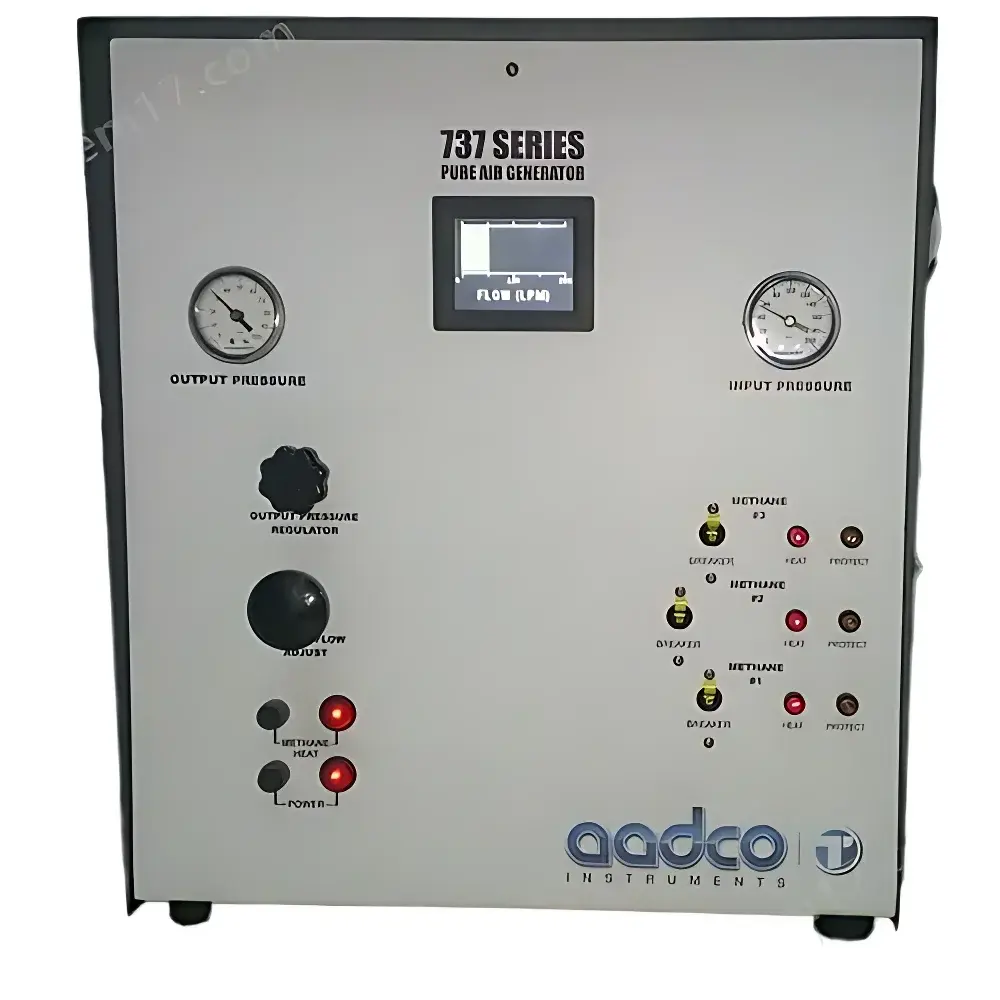
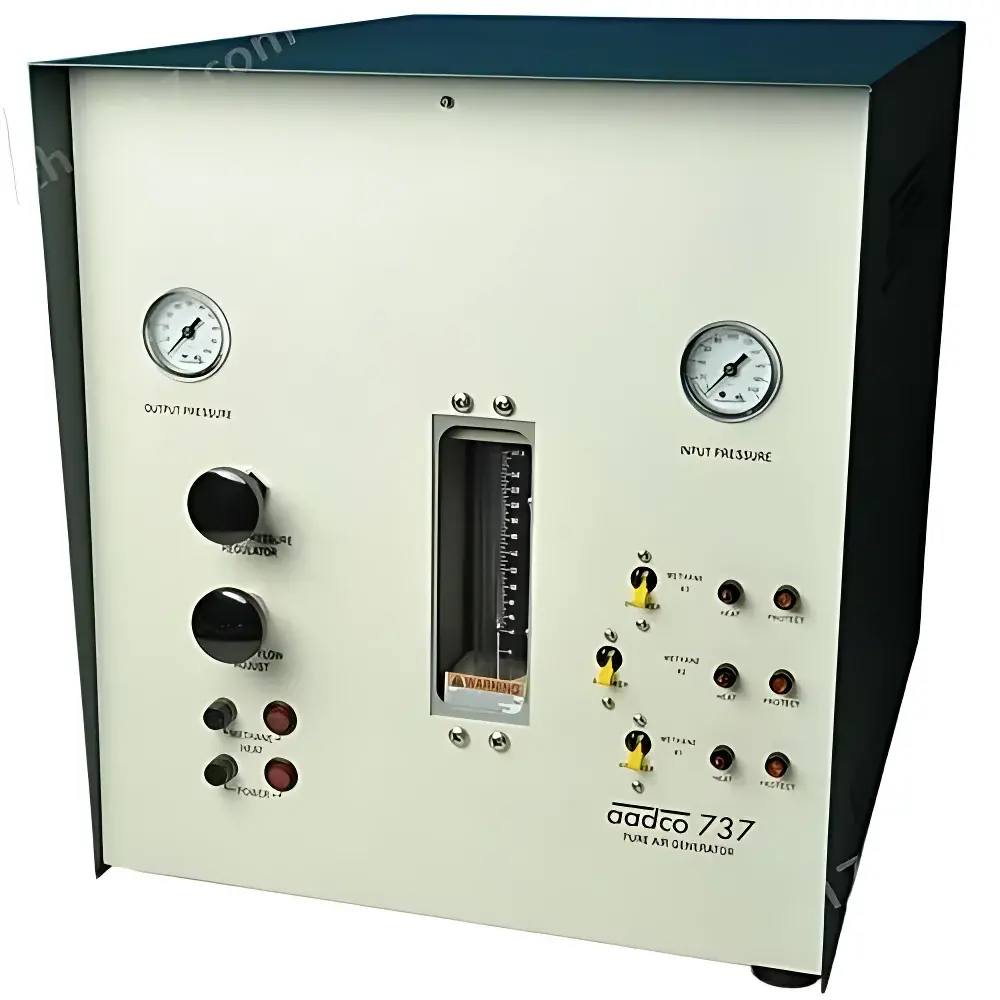
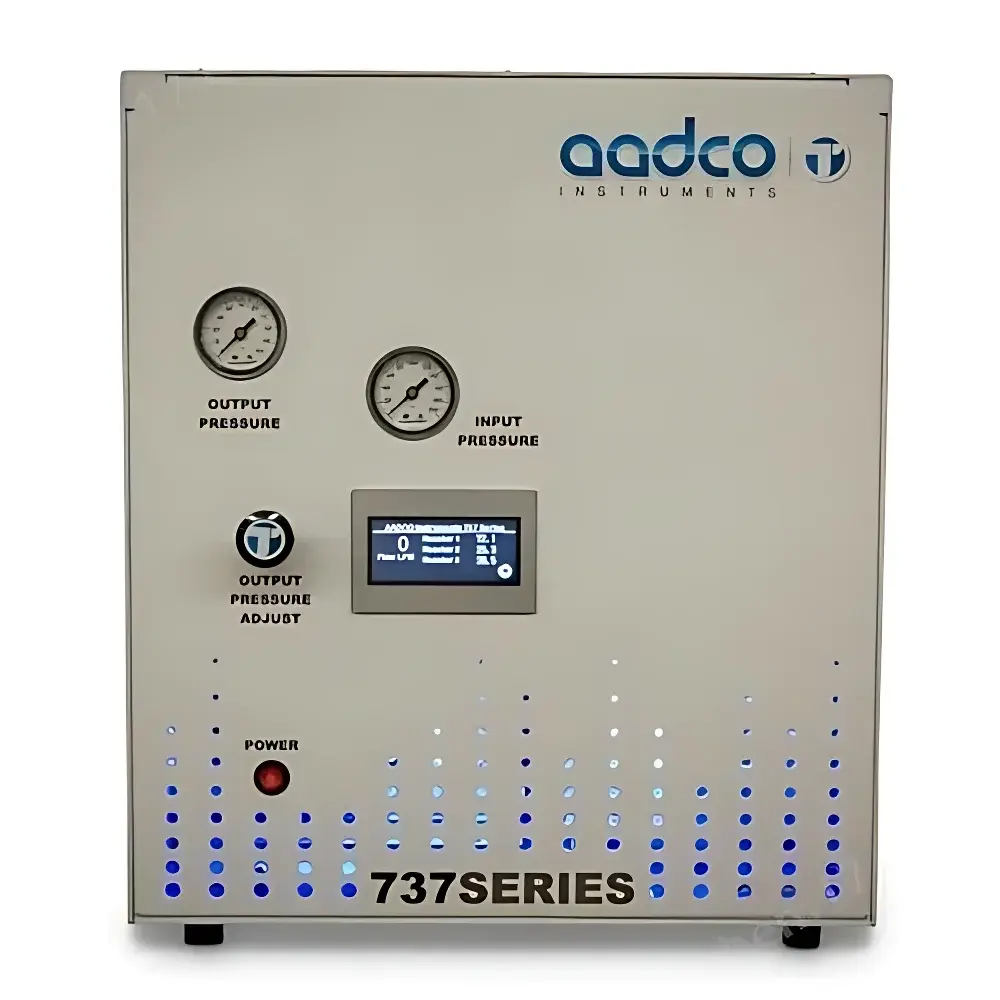
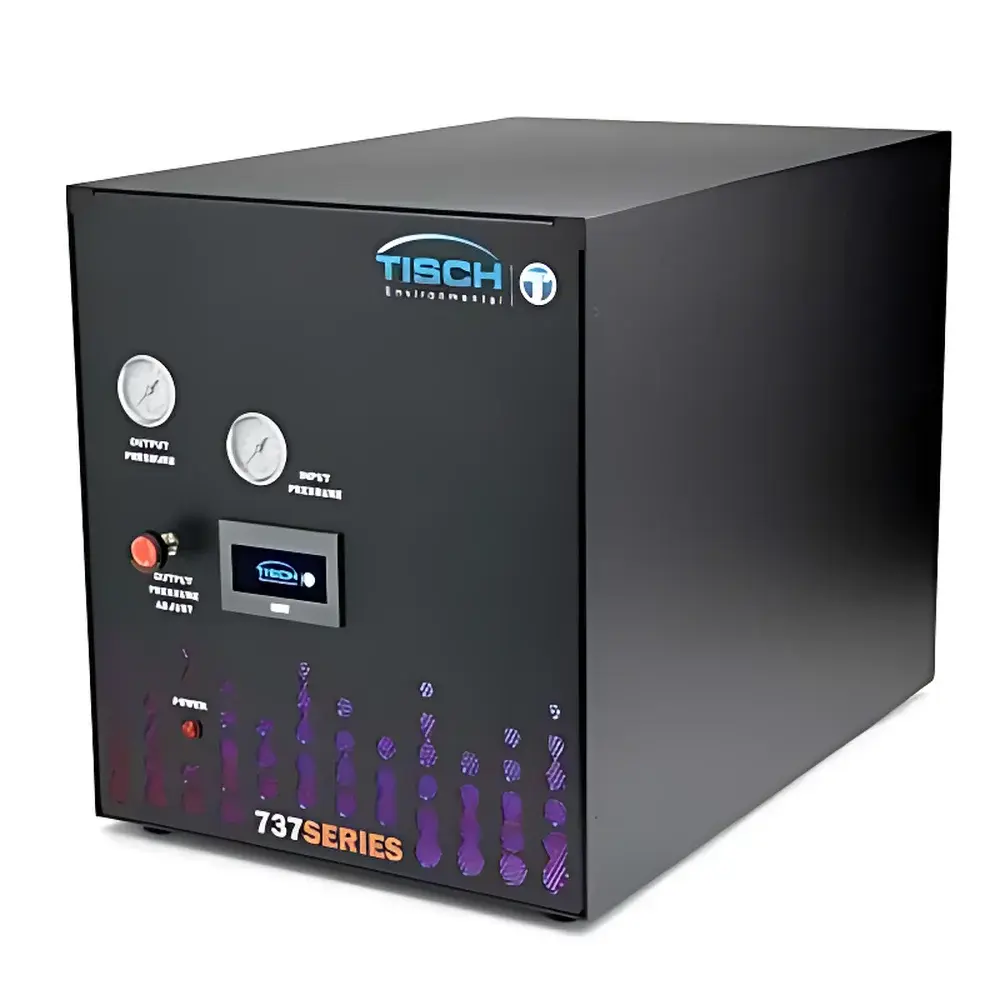
AADCO Model 737-14 Zero Air Generator
| Brand | AADCO |
|---|---|
| Origin | USA |
| Model | 737-14 |
| Zero Air Purity | <1 ppb (for O₃, CH₄, hydrocarbons, NO/NOₓ, H₂S, SO₂, COS, CO, CO₂, SF₆, fluorocarbons) |
| Flow Rate | 100 L/min |
| Output Pressure | 80 psi |
| Dew Point | −50 °C |
| Flow Measurement Accuracy | ±1 L/min |
Overview
The AADCO Model 737-14 Zero Air Generator is an engineered solution for laboratories and ambient air monitoring stations requiring ultra-pure, contaminant-free air as a calibration baseline or instrument purge gas. Based on catalytic oxidation and multi-stage adsorption purification architecture, the system removes reactive and condensable gaseous impurities—including ozone, methane, non-methane hydrocarbons, nitrogen oxides, hydrogen sulfide, sulfur dioxide, carbonyl sulfide, carbon monoxide, carbon dioxide, sulfur hexafluoride, and fluorocarbons—to sub-part-per-trillion detection thresholds. Its design conforms to U.S. EPA Method TO-14A, ASTM D6196-19 (for VOC analysis), and ISO 8573-1 Class 1 compressed air purity requirements for critical analytical applications. The 737-14 delivers continuous, stable zero air at 100 L/min nominal flow, supporting high-throughput calibration of chemiluminescence NOₓ analyzers, UV photometric ozone monitors, FTIR spectrometers, GC-FID systems, and other trace-gas detection platforms in regulatory, research, and industrial QA/QC environments.
Key Features
- Multi-stage purification train: Compressed air inlet conditioning, heated catalytic converter (oxidizing CO, hydrocarbons, and NO to CO₂ and NO₂), followed by dual-bed molecular sieve and activated carbon adsorption for removal of moisture, CO₂, residual oxidants, and halogenated compounds
- Stable output pressure regulation at 80 psi (5.5 bar) with integrated pressure gauges on both inlet and outlet manifolds
- Dew point control to −50 °C (−58 °F) via refrigerated drying and desiccant polishing, ensuring compliance with ISO 8573-1:2010 Class 2 for humidity
- Flow accuracy of ±1 L/min across full 0–100 L/min range, verified using NIST-traceable rotameter or optional digital LED mass flow display
- Modular chassis design supporting benchtop or rack-mount installation; compatible with standard 19-inch instrumentation racks or custom lab enclosures
- Low-maintenance architecture: Catalyst life rated for >20,000 hours under typical operation; replaceable adsorbent cartridges with visual saturation indicators
Sample Compatibility & Compliance
The Model 737-14 is validated for use with EPA-certified ambient air monitoring instruments, including Thermo Scientific 42i/43i series NOₓ analyzers, 49i ozone analyzers, and 146i CO analyzers. It meets the zero air specifications defined in U.S. EPA 40 CFR Part 53 (Appendix A) for reference method equivalency testing and in 40 CFR Part 58 Appendix E for network-level quality assurance. All internal wetted materials comply with ASTM F2237-21 (cleanliness of gas delivery components), and the system supports GLP-compliant audit trails when integrated with data acquisition software. No external bottled gases or cryogenic supplies are required—eliminating logistical overhead and cylinder-related contamination risks.
Software & Data Management
While the 737-14 operates as a standalone hardware system, its analog pressure and flow outputs (0–5 VDC or 4–20 mA) interface directly with SCADA, LabVIEW, or third-party DAQ systems for real-time monitoring and alarm logging. Optional Ethernet-enabled controller modules support Modbus TCP and SNMP protocols, enabling remote status polling, event-triggered notifications (e.g., low catalyst efficiency, dew point excursion), and integration into centralized environmental data management platforms compliant with FDA 21 CFR Part 11 and ISO/IEC 17025 documentation requirements.
Applications
- Zero air supply for calibration and span verification of regulatory-grade air quality analyzers (NOₓ, O₃, CO, SO₂)
- Purge gas for Fourier-transform infrared (FTIR) spectroscopy and cavity ring-down spectroscopy (CRDS) systems
- Carrier and combustion air in gas chromatography–flame ionization detection (GC-FID) and GC–electron capture detection (GC-ECD)
- Baseline gas for laser-induced fluorescence (LIF) and differential optical absorption spectroscopy (DOAS) field deployments
- Reference air source in cleanroom environmental monitoring and semiconductor fab process validation
- Research-grade zero air for atmospheric chemistry simulation chambers and oxidation flow reactor (OFR) studies
FAQ
What contaminants does the 737-14 remove to <1 ppb?
It achieves sub-ppb levels for ozone, methane, total hydrocarbons, NO/NOₓ, H₂S, SO₂, COS, CO, CO₂, SF₆, and fluorocarbons through sequential catalytic oxidation and high-efficiency adsorption.
Can the 737-14 be integrated into an existing air monitoring station’s PLC network?
Yes—via analog I/O or optional Modbus TCP/Ethernet module, enabling remote diagnostics, flow/pressure trending, and automated fault reporting.
Is routine maintenance documented per ISO/IEC 17025 requirements?
Maintenance logs, calibration certificates for flow sensors, and catalyst replacement records are retained per user-defined retention policies and support GLP/GMP audit readiness.
Does the system require external cooling water or external power beyond 115/230 VAC?
No—it is self-contained, air-cooled, and requires only single-phase AC power; no chilled water, liquid nitrogen, or auxiliary vacuum sources are needed.
How does the 737-14 compare to membrane-based zero air generators?
Unlike passive membrane systems, the 737-14 employs active thermal catalysis and regenerable adsorption beds, delivering higher purity consistency across variable ambient temperatures and inlet air conditions—critical for regulatory compliance.
Related Products







