
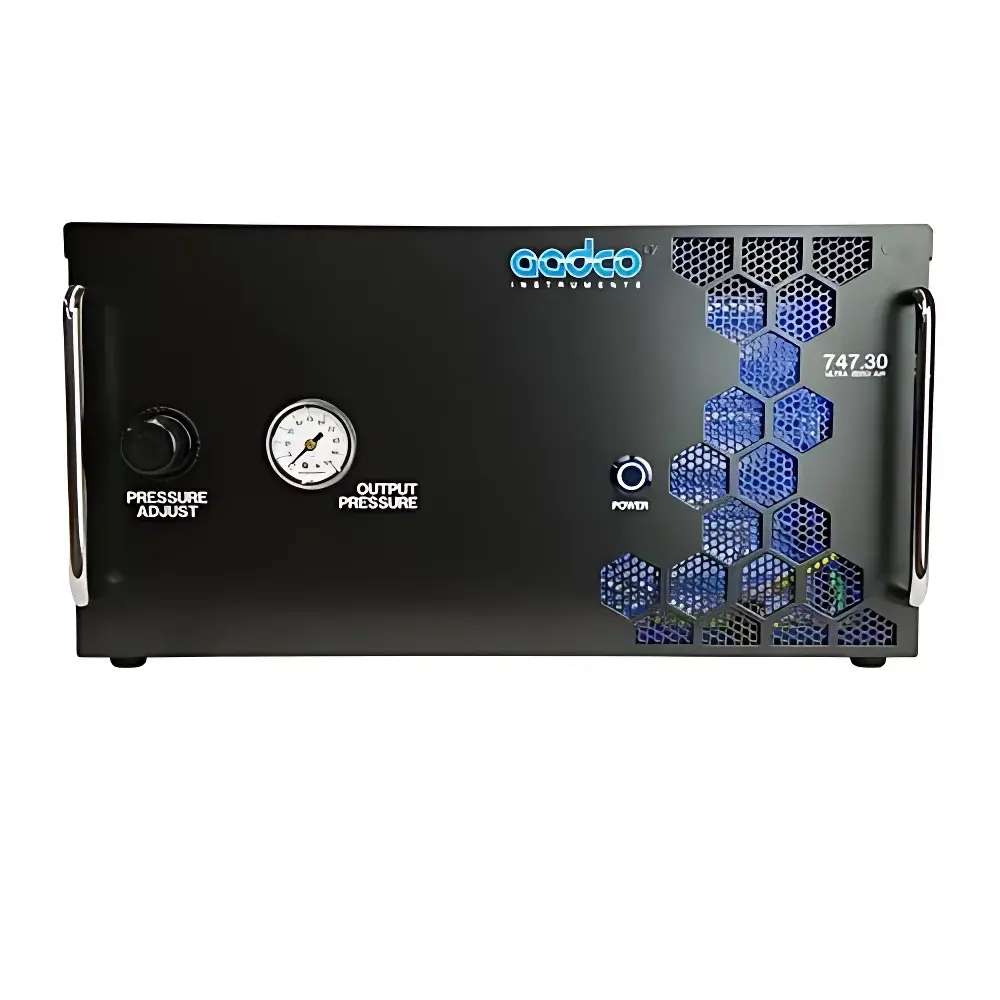
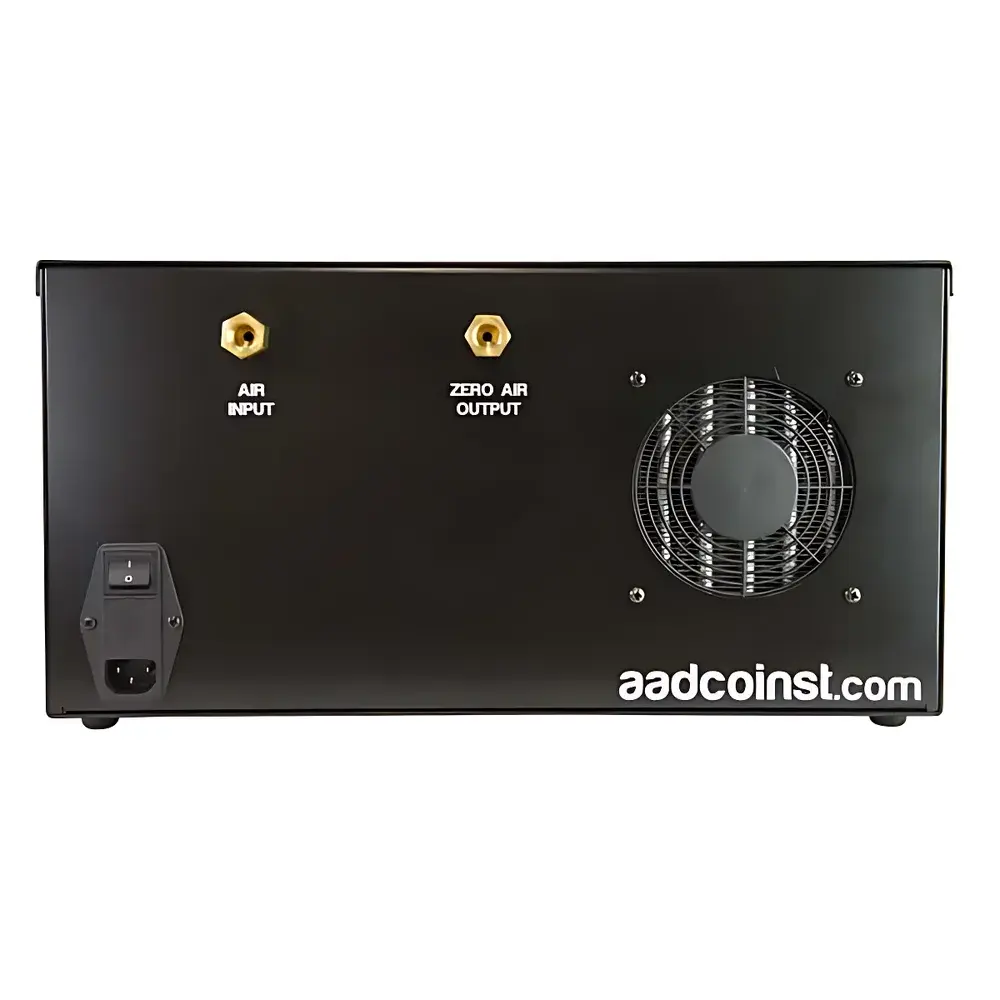
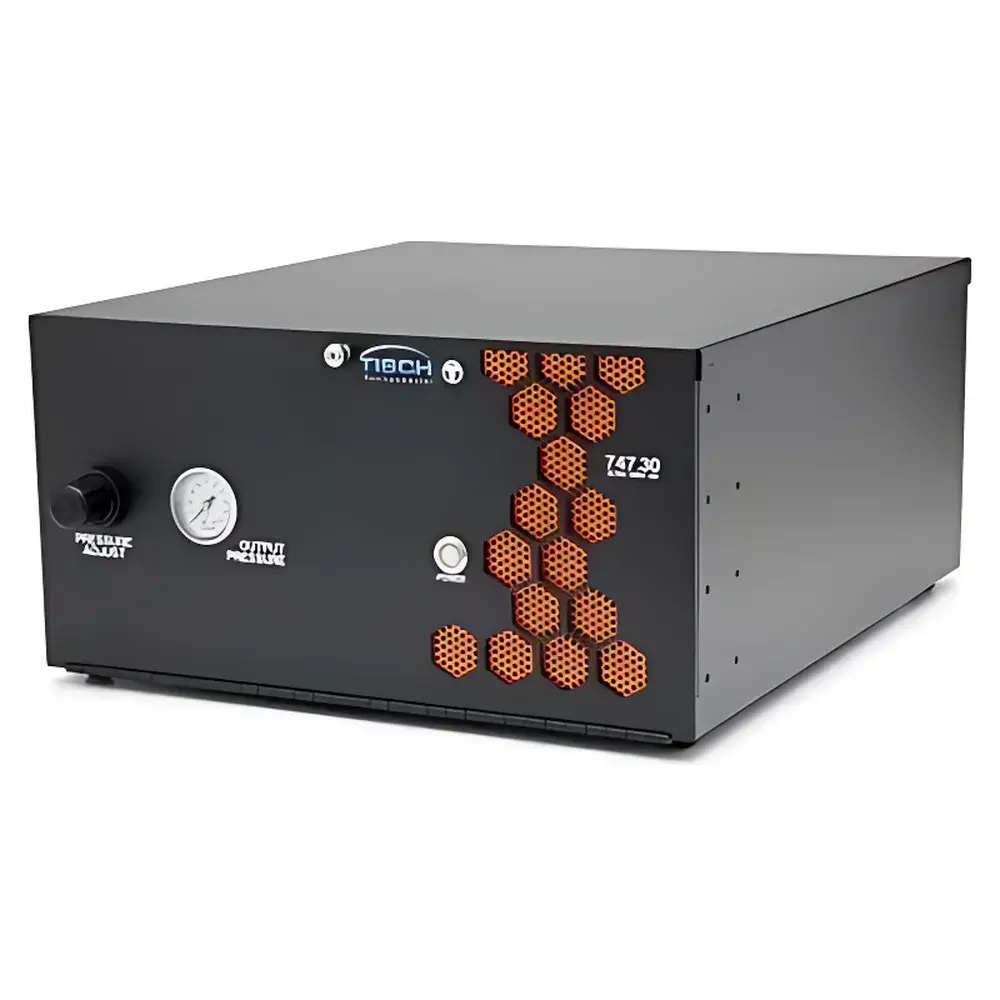
AADCO Model 747-10 Zero Air Generator
| Brand | AADCO |
|---|---|
| Origin | USA |
| Model | 747-10 |
| Zero Air Purity | <1 ppb hydrocarbons and methane |
| Flow Rate | 10 L/min |
| Output Pressure | 90 psig |
| Dew Point | −50 °C |
| Installation | Rack-mountable or benchtop |
Overview
The AADCO Model 747-10 Zero Air Generator is an engineered solution for laboratories and monitoring facilities requiring continuous, ultra-high-purity zero air compliant with stringent analytical standards. It employs a dual-stage catalytic oxidation process—first removing CO and CO₂ via heated platinum catalysts, then eliminating residual hydrocarbons and methane through high-efficiency thermal oxidation—followed by precision desiccant drying to achieve a certified dew point of −50 °C. Unlike compressed-air-fed systems relying on passive filtration alone, the 747-10 actively destroys organic contaminants rather than trapping them, ensuring long-term stability and eliminating filter saturation risks. Designed for integration into ambient air quality monitoring networks, gas chromatography (GC) carrier gas supply chains, and calibration gas generation systems, it delivers trace-level inert background gas essential for photometric ozone analyzers, chemiluminescent NOx detectors, FTIR spectroscopy, and EPA Method 25A-compliant hydrocarbon analysis.
Key Features
- Ultra-low hydrocarbon and methane output: <1 ppb (measured by GC-FID per ASTM D6866 and ISO 8573-5)
- Stable flow delivery at 10 L/min with pressure regulation up to 90 psig, compatible with standard NPT 1/4″ fittings
- Integrated desiccant dryer and stainless-steel condensate trap ensure consistent −50 °C dew point performance under varying ambient humidity conditions
- Rack-mount (19″ EIA) or benchtop configuration with UL-listed enclosure; includes thermal insulation and forced-air cooling to maintain safe external surface temperatures (<45 °C)
- No consumable filters—catalyst lifetime exceeds 20,000 operating hours under typical lab conditions (per AADCO Technical Bulletin TB-747-Rev.D)
- Compliant with EPA 40 CFR Part 53 requirements for zero air used in reference method analyzer calibration
Sample Compatibility & Compliance
The 747-10 accepts clean, oil-free, dry compressed air (ISO 8573-1 Class 1.2.1 or better) as input—no internal compressor required. It is validated for use with all major environmental analyzers requiring zero air per U.S. EPA equivalency protocols, including Thermo Fisher Scientific 42i/43i series, Teledyne API 200/400 series, and Horiba APNA-370. The unit meets mechanical safety requirements per UL 61010-1 and electromagnetic compatibility per FCC Part 15 Subpart B. Its zero air output satisfies ISO 8573-1:2010 Class 0 for hydrocarbons and Class 2 for moisture, supporting GLP/GMP-aligned calibration workflows where audit-trail documentation of gas purity is mandated.
Software & Data Management
While the 747-10 operates as a standalone hardware system without embedded firmware or network connectivity, its analog status outputs (0–5 VDC) interface directly with facility building management systems (BMS) or SCADA platforms for real-time monitoring of catalyst temperature, inlet pressure, and fault conditions. Optional analog-to-digital signal modules enable logging of operational parameters—including runtime hours, thermal cycle count, and pressure differentials—into LIMS or ELN environments. All calibration records, maintenance logs, and certificate-of-conformance documentation adhere to FDA 21 CFR Part 11 principles when stored electronically using validated document control procedures.
Applications
- Primary and transfer standard calibration of ambient air pollutant monitors (O3, NO, NO2, SO2) per EPA 40 CFR Part 58 Appendix A
- Carrier and makeup gas source for GC-FID, GC-MS, and PTR-MS instrumentation in petrochemical and atmospheric research labs
- Zero gas supply for laser-based cavity ring-down spectrometers (CRDS) and quantum cascade laser absorption spectrometers (QCLAS)
- Reference gas generation in automotive emissions testing per ISO 16183 and SAE J1149
- Baseline stabilization in UV photometric ozone generators and chemiluminescence reaction chambers
- Replacement for high-pressure cylinder-based zero air in continuous emission monitoring systems (CEMS), reducing logistical overhead and cylinder change frequency by >92% annually
FAQ
What inlet air quality is required for optimal 747-10 performance?
Clean, oil-free, desiccated compressed air meeting ISO 8573-1 Class 1.2.1 (≤0.01 mg/m³ oil aerosol, ≤0.1 ppm oil vapor, dew point ≤−40 °C) is mandatory. Use of non-desiccated or oil-lubricated air will degrade catalyst life and compromise purity specifications.
Can the 747-10 be integrated into an existing gas distribution manifold?
Yes—its regulated 90 psig output and 1/4″ NPT male outlet allow direct connection to stainless-steel or electropolished tubing manifolds. A back-pressure regulator is recommended if downstream instruments require lower pressure.
How often does the catalyst require replacement?
Under nominal operation (10 L/min, 23 °C ambient, ISO-compliant inlet air), the dual-bed catalyst assembly is rated for ≥20,000 hours. APM-based catalyst health monitoring is available via optional thermocouple readout kits.
Is the 747-10 suitable for Class 100 cleanroom environments?
Yes—the unit emits no particulates or volatile organics; its sealed, insulated enclosure prevents thermal or acoustic interference. It complies with ISO 14644-1 airborne particle limits when installed outside the cleanroom with gas delivered via pass-through fittings.
Does AADCO provide factory calibration certificates with each unit?
Each 747-10 ships with a NIST-traceable Certificate of Conformance documenting hydrocarbon/methane purity (<1 ppb), dew point (−50 °C), and flow rate accuracy (±2% of reading) verified per ISO/IEC 17025-accredited test procedures.
Related Products







