
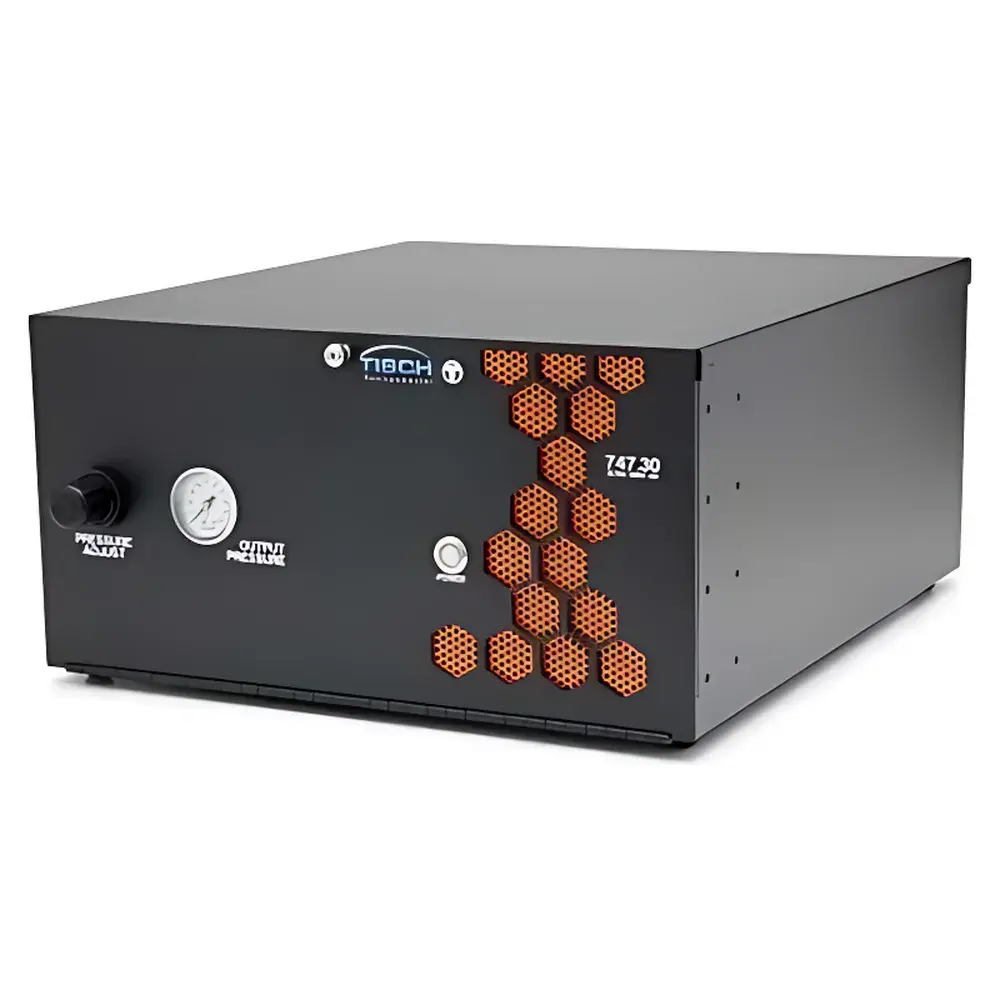
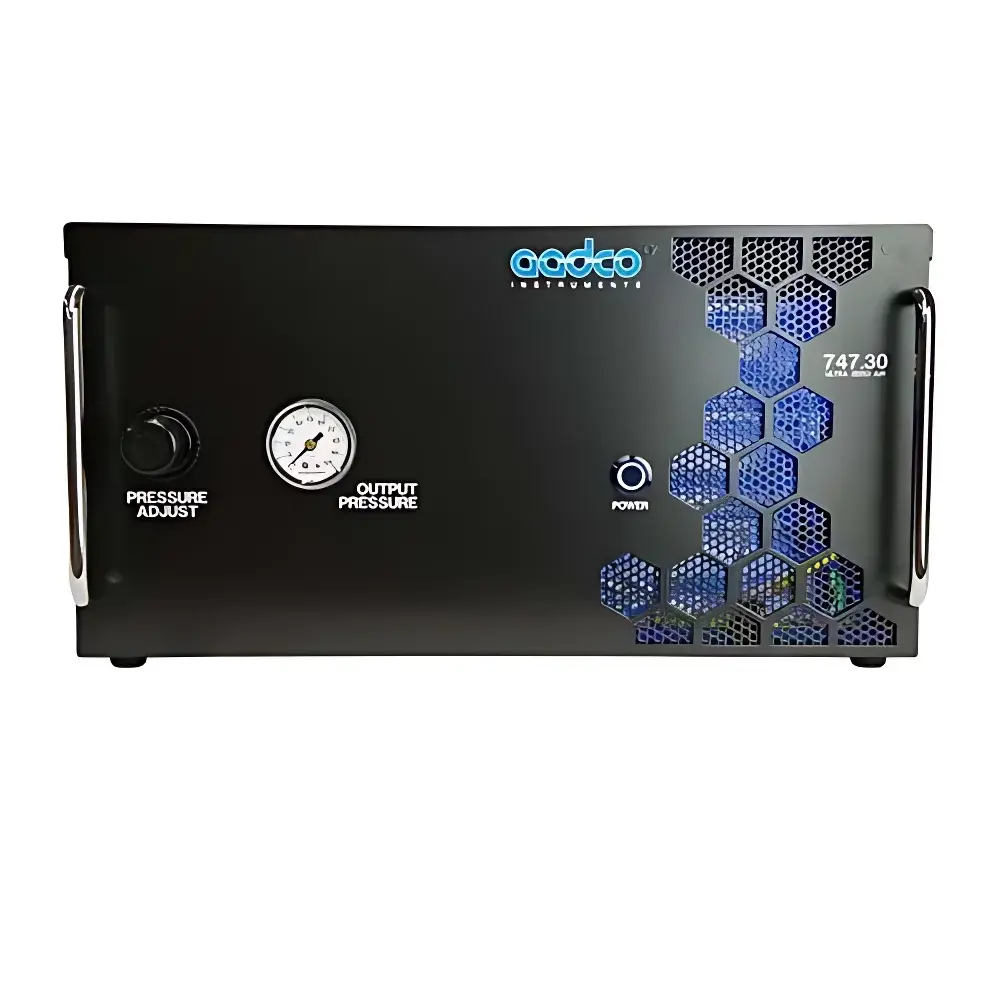
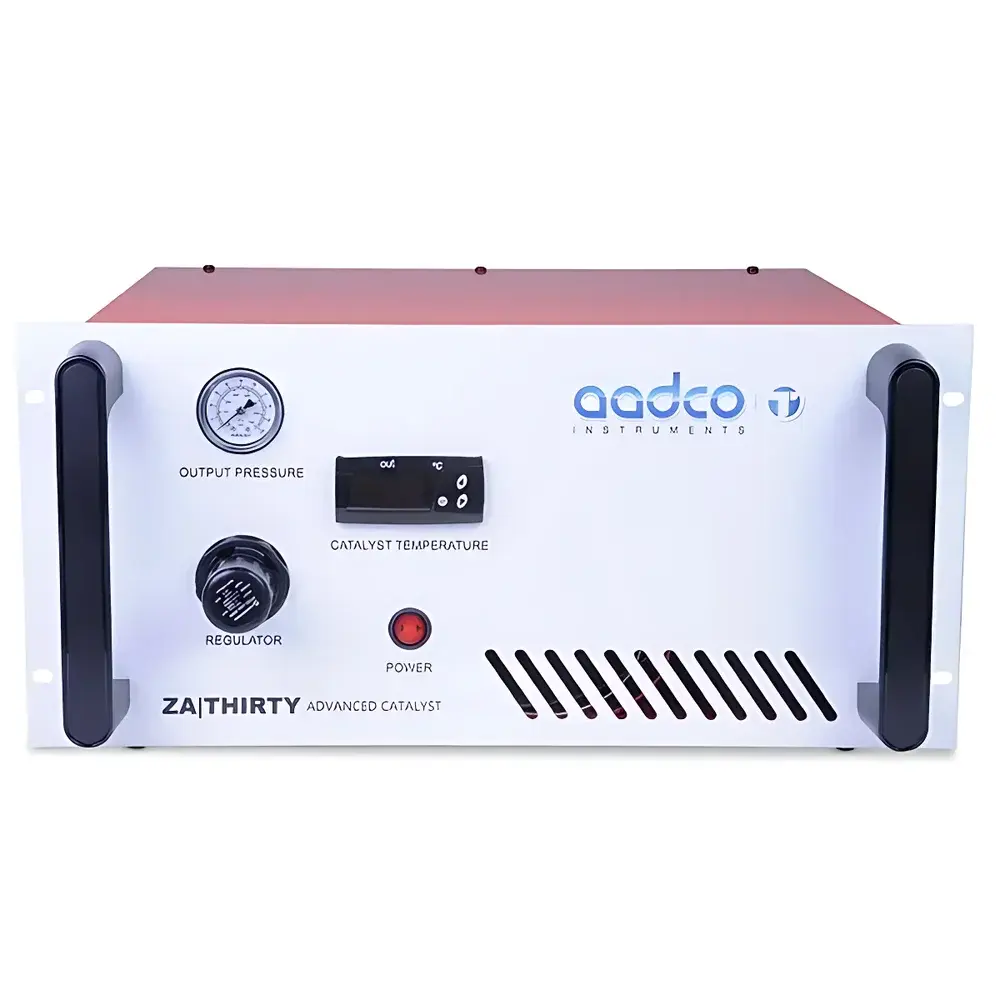
AADCO Model 747-30 Zero Air Generator
| Brand | AADCO |
|---|---|
| Origin | USA |
| Model | 747-30 |
| Zero Air Purity | <1 ppb hydrocarbons & methane |
| Flow Rate | 30 L/min |
| Output Pressure | 90 psi |
| Dew Point | −50 °C |
Overview
The AADCO Model 747-30 Zero Air Generator is an engineered solution for laboratories and monitoring facilities requiring continuous, ultra-pure zero air compliant with stringent analytical standards. It operates on catalytic oxidation technology: ambient air—supplied via a clean, oil-free, desiccated compressed air source—is passed through high-efficiency particulate and coalescing filters, then over a heated noble-metal catalyst bed that oxidizes residual hydrocarbons (including methane) to CO₂ and H₂O. Subsequent moisture removal via a refrigerated dryer and desiccant polishing stage achieves a certified dew point of −50 °C and total hydrocarbon content below 1 ppb (as methane equivalent), meeting or exceeding EPA Method TO-14/TO-15, ASTM D6168, and ISO 8573-1 Class 1 specifications for zero air used in trace gas analysis.
Key Features
- Continuous on-demand zero air generation at 30 L/min nominal flow, eliminating dependency on high-pressure cylinder logistics and associated safety, storage, and calibration drift risks.
- Catalytic purification architecture optimized for long-term stability: proprietary high-surface-area platinum/palladium catalyst maintains consistent <1 ppb hydrocarbon removal performance over extended operational cycles (typical catalyst life >12 months under recommended inlet air quality).
- Integrated dual-stage drying system: refrigerated pre-dryer followed by regenerative desiccant polishing ensures sustained −50 °C dew point output, critical for FTIR, GC-FID, and chemiluminescence NOₓ analyzers.
- Rack-mountable (19″ EIA) or benchtop configuration with thermally insulated, fan-cooled enclosure—designed for safe operation in controlled laboratory environments without requiring external ventilation.
- No consumables beyond routine filter replacements (particulate, coalescing, and desiccant); no liquid chemicals, ozone generators, or UV lamps—reducing maintenance complexity and regulatory reporting burden.
Sample Compatibility & Compliance
The 747-30 delivers zero air compatible with all major gas-phase analytical platforms requiring ultra-low background interference, including but not limited to: gas chromatography (GC-FID, GC-ECD, GC-MS), Fourier-transform infrared spectroscopy (FTIR), cavity ring-down spectroscopy (CRDS), and chemiluminescent NO/NO₂ analyzers. Its output meets the zero air specification requirements of U.S. EPA Methods 25A, 25B, TO-14A, TO-15, and ASTM D6168 for ambient air monitoring and emissions testing. The unit is constructed and tested in accordance with UL 61010-1 and IEC 61000-6-3 for electromagnetic compatibility, and its pressure-rated components conform to ASME B31.1 piping design criteria for compressed gas systems.
Software & Data Management
The 747-30 is a standalone hardware system with no embedded microprocessor or digital interface. Operational status is monitored via front-panel LED indicators (power, catalyst temperature, flow, and fault). For integration into automated laboratory environments, optional analog 4–20 mA outputs are available for catalyst temperature and outlet pressure monitoring, enabling connection to building management systems (BMS) or SCADA platforms. While the unit itself does not store data or support audit trails, its deterministic mechanical-electrical design supports full GLP/GMP traceability when paired with external loggers compliant with FDA 21 CFR Part 11 requirements.
Applications
- Calibration and span verification of ambient air quality monitors (O₃, NOₓ, SO₂, CO) per U.S. EPA Performance Evaluation Protocols.
- Carrier and makeup gas supply for gas chromatographic analysis in environmental, petrochemical, and pharmaceutical QC labs.
- Zero air source for photometric and electrochemical sensor validation in automotive emissions testing (e.g., chassis dynamometer exhaust analyzers).
- Baseline stabilization in high-sensitivity detection systems—including laser-based trace gas analyzers—where sub-ppb hydrocarbon interference degrades signal-to-noise ratio and quantitation limits.
- Replacement of bottled zero air in aerospace propulsion test stands and cleanroom environmental monitoring networks where logistical continuity and purity consistency are mission-critical.
FAQ
What inlet air quality is required for optimal 747-30 performance?
The generator requires oil-free, desiccated compressed air at 90–120 psi with ≤−40 °C dew point and ≤0.01 µm particulate filtration. Use of a dedicated oil-free scroll or diaphragm compressor with coalescing and desiccant pre-filtration is strongly recommended.
Does the 747-30 require periodic catalyst regeneration or replacement?
No regeneration is required. Catalyst replacement is typically needed every 12–18 months depending on inlet air quality and duty cycle; AADCO provides certified replacement kits with pre-validated activity testing.
Can the 747-30 be used with portable analyzers in field deployments?
Yes—when mounted in a shock-damped, climate-controlled transport enclosure and supplied with a compatible mobile oil-free air source, the unit has been deployed successfully in mobile emission measurement laboratories (MEMS) and ambient monitoring vans.
Is the output pressure adjustable?
Output pressure is fixed at 90 psi ±5 psi; external pressure regulators may be added downstream if lower pressures are required for specific instrument interfaces.
How is compliance with ISO 8573-1 Class 1 verified?
AADCO provides factory-certified test reports per ISO 8573-1:2010 Annex C, including third-party hydrocarbon analyzer validation (GC-FID) and chilled-mirror dew point verification—available upon request with each unit shipment.
Related Products







