
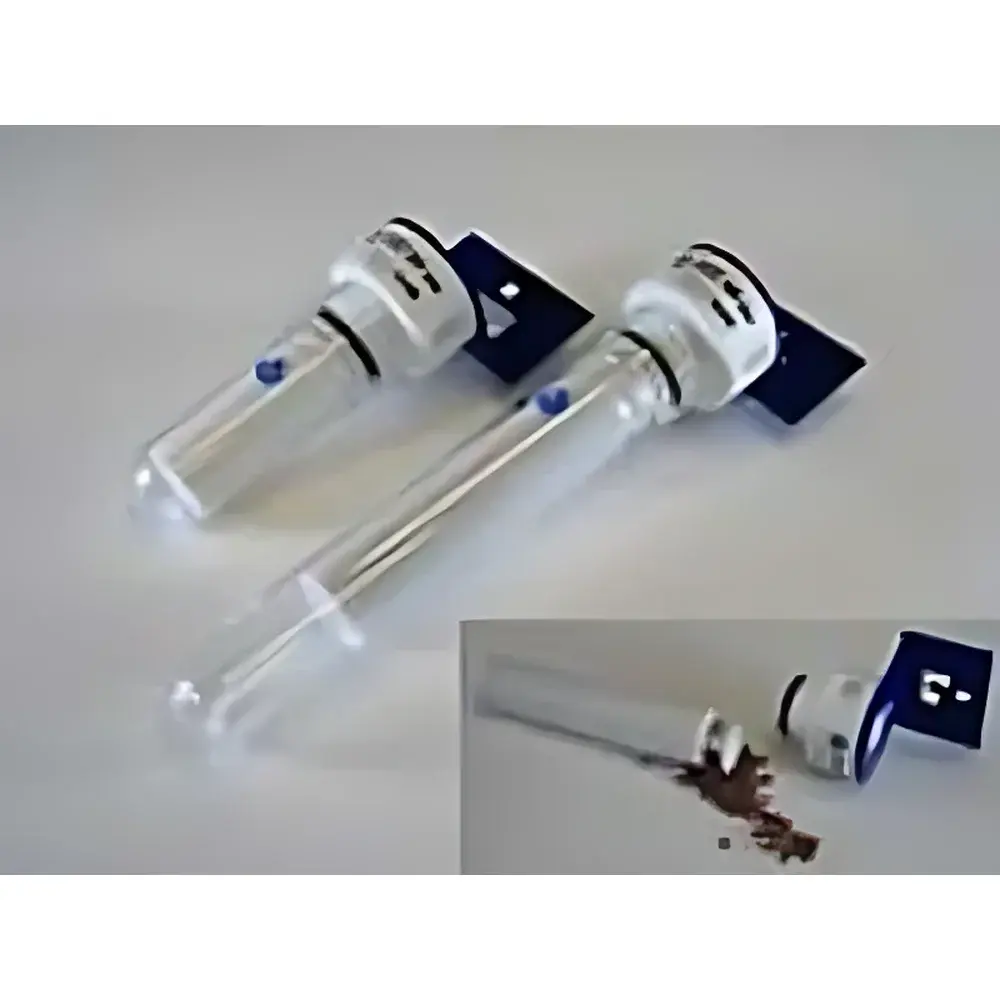
AAM Adsorbent Material Filter for Gas Sampling Systems
| Origin | Netherlands |
|---|---|
| Manufacturer Type | Distributor |
| Origin Category | Imported |
| Model | AAM Adsorbent Material Filter |
| Price | Upon Request |
Overview
The AAM Adsorbent Material Filter is a modular, field-serviceable gas conditioning component designed for integration into continuous or grab-sampling gas monitoring systems. Engineered for precision environmental and industrial hygiene applications, it operates on the principle of selective adsorption—leveraging high-surface-area solid-phase media to remove interfering volatile organic compounds (VOCs), acidic gases (e.g., SO₂, H₂S, NOₓ), moisture, particulates, and metallic vapors prior to instrumental analysis. Unlike fixed-cartridge filters, the AAM system features a standardized cylindrical housing with a removable core assembly, enabling rapid in-field replacement of adsorbent media without system disassembly or recalibration. It is commonly deployed upstream of analyzers such as FTIR spectrometers, PID sensors, electrochemical cells, and GC-based gas chromatographs to ensure sample integrity, extend sensor lifetime, and reduce baseline drift.
Key Features
- Modular core design allows tool-free replacement of adsorbent cartridges in under 90 seconds—minimizing downtime during routine maintenance or method switching.
- Compatible with industry-standard adsorbent materials including granular activated carbon (GAC), Purafil® chemisorbent pellets (for acid gas removal), Silicagel® desiccant (for moisture control), and stainless-steel metal shavings (for mercury vapor capture).
- Housing constructed from anodized aluminum with EPDM O-ring seals, rated for continuous operation at temperatures from −20 °C to +60 °C and pressures up to 150 kPa (gauge).
- Pressure drop across the filter remains below 1.2 kPa at nominal flow rates of 0.5–2.0 L/min, ensuring compatibility with low-flow sampling pumps and regulatory-compliant methods (e.g., EPA Method TO-17, ISO 16017-1).
- No internal electronics or power requirements—fully passive operation ensures intrinsic safety in Class I, Division 1 hazardous locations when used with approved enclosures.
Sample Compatibility & Compliance
The AAM filter supports sampling of ambient air, stack emissions, indoor workplace air, and landfill/soil-gas extracts. Its media selection enables compliance with multiple international standards: Purafil®-filled units meet ASTM D5197 for formaldehyde removal; Silicagel® configurations align with ISO 8573-3 for compressed air dew point conditioning; GAC cores are validated per EN 14662 for benzene/toluene/ethylbenzene/xylene (BTEX) preconcentration. All assemblies are supplied with traceable lot documentation and material safety data sheets (MSDS/SDS). The device itself carries CE marking for EMC Directive 2014/30/EU and RoHS 2011/65/EU compliance. For GLP/GMP environments, serial-numbered housings support audit-ready calibration and maintenance logs.
Software & Data Management
As a hardware-only conditioning component, the AAM Adsorbent Material Filter does not incorporate embedded firmware or digital interfaces. However, its operational status is fully trackable within integrated gas monitoring platforms via external flow/pressure sensors and scheduled maintenance modules. When deployed with compliant data acquisition systems (e.g., those adhering to FDA 21 CFR Part 11), usage history—including cartridge installation date, cumulative runtime, and replacement event timestamps—can be logged with electronic signatures and immutable audit trails. Optional RFID-tagged cartridges (available upon request) enable automatic media-type recognition and expiry alerts in SCADA or LIMS-integrated workflows.
Applications
- Ambient air quality networks requiring speciated VOC removal before real-time PTR-MS or SIFT-MS analysis.
- Occupational health monitoring in semiconductor fabrication cleanrooms where siloxane and amine interference must be eliminated prior to photoionization detection.
- Landfill gas monitoring systems utilizing methane analyzers sensitive to hydrogen sulfide-induced catalyst poisoning.
- Calibration gas delivery lines for reference standard generators, where moisture and hydrocarbon contamination compromise NIST-traceable accuracy.
- Mobile emission testing vans performing remote RDE (Real Driving Emissions) measurements under UN-ECE Regulation No. 83 and EU 2017/1151.
FAQ
What adsorbent media options are certified for use with the AAM filter?
The AAM housing accepts any commercially available adsorbent in 10–12 mm granular or pellet form that meets ASTM D3803 specifications for particle size distribution and attrition resistance. Certified configurations include Purafil® PF-200 (for Cl₂, HCl, H₂S), Silicagel® Type 622 (for RH <5% control), and Calgon Filtrasorb 400 (for aromatic VOCs).
Can the AAM filter be used in high-humidity environments without condensation risk?
Yes—when loaded with Silicagel® or dual-layer GAC/Silicagel® cartridges, the unit maintains effective water vapor removal at relative humidity levels up to 95% at 25 °C. Condensate collection is prevented by maintaining flow velocity above 0.3 m/s and avoiding abrupt temperature gradients.
Is the AAM filter suitable for EPA Method TO-15 sampling?
It is compatible as a pre-filter only—not as a primary sorbent tube. Per TO-15 Section 6.2.3, it may be installed upstream of the sampling train to protect analytical instrumentation, provided breakthrough testing confirms no analyte retention or catalytic degradation occurs for target compounds (C₂–C₁₂ hydrocarbons, halocarbons, carbonyls).
Related Products







