
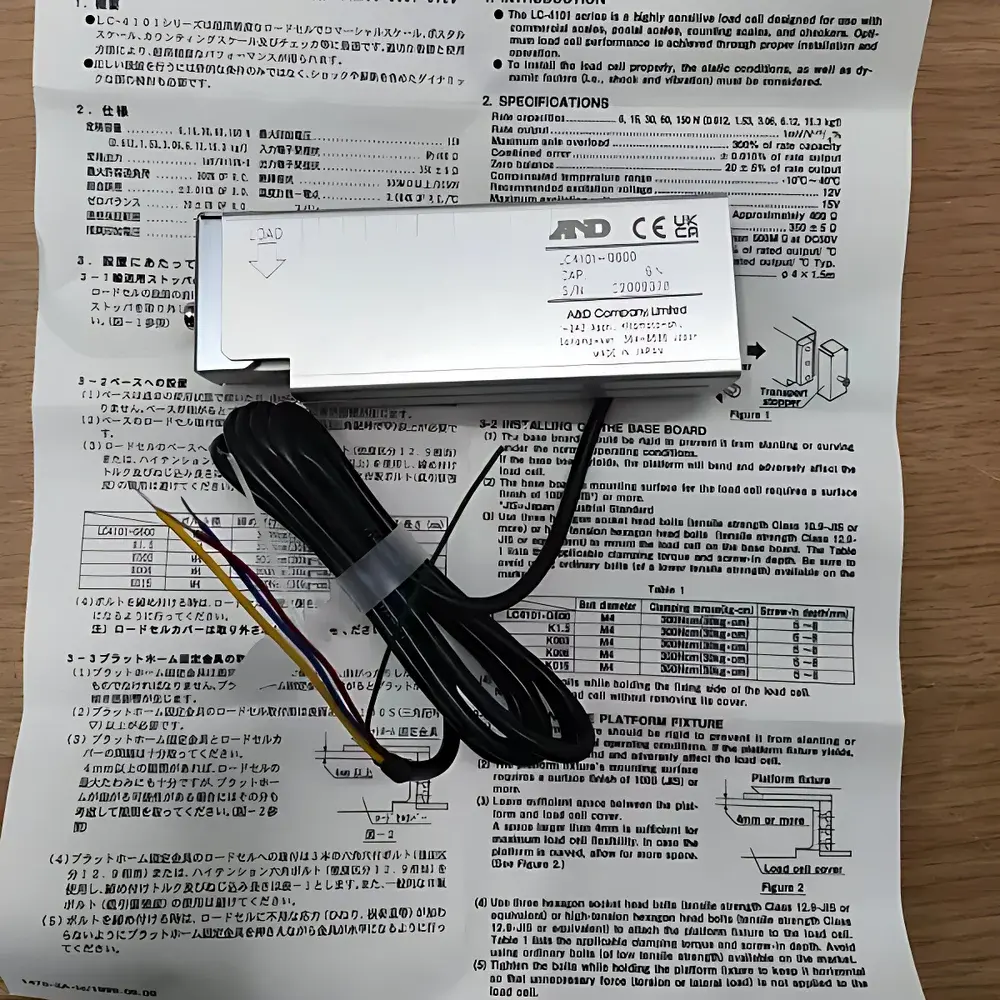
AANDD LC4101-G600 Precision Load Cell for Printed Electronics Manufacturing
| Brand | AANDD |
|---|---|
| Model | LC4101-G600 |
| Rated Capacity | 6 N (611.8 g) |
| Deflection | 0.24 mm |
| Natural Frequency | 100 Hz |
| Allowable Moment | 0.212 N·m |
| Rated Output | 1.0197 mV/V (+15% / –0%) |
| Zero Balance | ±20% of RO |
| Input Resistance | ~400 Ω |
| Output Resistance | 350 ±5 Ω |
| Insulation Resistance | >500 MΩ @ DC 50 V |
| Temp. Compensation Range | –10 °C to +40 °C |
| Zero Temp. Effect | ±0.04 %RO / 10 °C |
| Output Temp. Effect | ±0.014 %FS / 10 °C (typ.) |
| Recommended Excitation | DC 5–12 V |
| Max. Excitation | DC 15 V |
| Overload Limit (Safe) | 300 %RC |
| Ultimate Overload | 400 %RC |
| Total Error | ±0.015 %RO |
| IP Rating | IP22 |
| Cable | Ø4 mm × 1.5 m (Red: +Exc, White: –Exc, Green: +Sig, Blue: –Sig, Yellow: Shield) |
| Housing Material | Aluminum |
| Dimensions | 300 × 300 mm |
| Mass | 0.12 kg |
Overview
The AANDD LC4101-G600 is a high-precision, temperature-compensated load cell engineered specifically for integration into precision weighing subsystems used in printed electronics manufacturing environments. Designed using proven bending-beam strain gauge architecture, it delivers stable and repeatable force measurement under both tension and compression loading conditions—critical for inline process control during semiconductor component printing, conductive ink deposition, and fine-pitch substrate handling. Its compact aluminum housing (300 × 300 mm footprint), low mass (0.12 kg), and four-corner adjustment capability make it ideal for mounting on lightweight platform scales or custom-built dispensing rigs where mechanical symmetry and thermal stability are essential. With a rated capacity of 6 N (equivalent to 611.8 g), the LC4101-G600 operates within a narrow deflection range (0.24 mm) and exhibits a natural frequency of 100 Hz—enabling reliable dynamic response in semi-automated printing workflows without signal resonance artifacts.
Key Features
- Bi-directional force measurement: Validated for both tensile and compressive loading, supporting dual-mode integration in adaptive tooling fixtures.
- Integrated temperature compensation: Zero point and span are compensated across –10 °C to +40 °C, minimizing drift in non-climate-controlled cleanroom or lab settings typical of printed electronics fabrication.
- Hermetic moisture resistance: Surface-treated aluminum body meets IP22 ingress protection standards, safeguarding internal strain gauges against ambient humidity and particulate exposure during inkjet or aerosol jet printing operations.
- High electrical stability: Output resistance tightly controlled at 350 ±5 Ω; input resistance ~400 Ω; insulation resistance >500 MΩ at 50 V DC ensures long-term signal integrity and noise immunity in EMI-prone production floors.
- Robust overload tolerance: Rated for safe overloads up to 300 % of rated capacity (RC), with ultimate mechanical survival at 400 % RC—reducing downtime risk during calibration or misalignment events.
- Standardized analog interface: Delivers 1.0197 mV/V nominal output with ±15 %/0 % tolerance, compatible with industry-standard signal conditioners and data acquisition systems compliant with ASTM E74 and ISO 376 traceability requirements.
Sample Compatibility & Compliance
The LC4101-G600 is optimized for use with thin-film substrates, silicon wafers, flexible PCBs, and ceramic carriers commonly handled in printed electronics lines. Its low-profile design and symmetrical mounting geometry ensure uniform load distribution across small-area samples (≤100 mm × 100 mm), eliminating edge-induced error common in micro-weighing applications. The load cell complies with JIS B 7721 (Japanese Industrial Standard for load cells) and conforms to electromagnetic compatibility (EMC) requirements per IEC 61326-1 for industrial measurement equipment. While not certified to FDA 21 CFR Part 11, its analog output architecture supports integration into validated systems where audit trails and electronic signature controls are implemented at the DAQ or PLC layer—fully aligning with GLP/GMP documentation practices in R&D and pilot-line environments.
Software & Data Management
As a passive analog transducer, the LC4101-G600 interfaces seamlessly with third-party signal conditioning hardware (e.g., HBM PMX, Omega DP25B, or National Instruments USB-4431) and associated software platforms including LabVIEW, MATLAB Data Acquisition Toolbox, and custom Python-based control suites using NI-DAQmx or libusb drivers. When integrated into closed-loop dispensing systems, real-time force feedback enables adaptive pressure modulation during ink transfer—critical for maintaining consistent film thickness in gravure or flexographic printing processes. All calibration coefficients (including zero offset, sensitivity, and thermal coefficients) are documented per ISO/IEC 17025-accredited procedures and may be embedded in system firmware for automated sensor identification and linearization.
Applications
- Real-time mass monitoring during roll-to-roll conductive ink coating and drying stages.
- Force feedback control in precision pick-and-place units handling fragile semiconductor die or MEMS sensors.
- In-process verification of solder paste volume consistency in stencil-printed PCB assemblies.
- Dynamic load characterization of stretchable electrode arrays during mechanical cycling tests.
- Calibration reference standard for benchtop microbalances used in nanomaterial formulation labs.
FAQ
What is the recommended excitation voltage for optimal linearity and thermal stability?
DC 10 V is recommended for maximum signal-to-noise ratio and minimal self-heating effect; operation between 5–12 V DC is supported per specification.
Can this load cell be used in vacuum or inert-gas glovebox environments?
Not without modification—the IP22 rating indicates limited environmental sealing; for inert-atmosphere use, consult AANDD for optional hermetic encapsulation or O-ring retrofit kits.
Is the LC4101-G600 compatible with digital bus protocols such as EtherCAT or CANopen?
No—it is an analog-only device; digital communication requires external signal conditioning modules with protocol conversion capabilities.
How frequently should recalibration be performed in a production setting?
Annual recalibration is advised per ISO 9001 guidelines; however, daily zero checks and weekly span verification are recommended for Class III metrological applications per OIML R60.
Does the 0.24 mm deflection limit constrain dynamic response in high-speed printing?
No—the 100 Hz natural frequency supports sampling rates up to 200 Hz with <5 % amplitude attenuation, sufficient for most gravure and screen-printing cycle times.






