
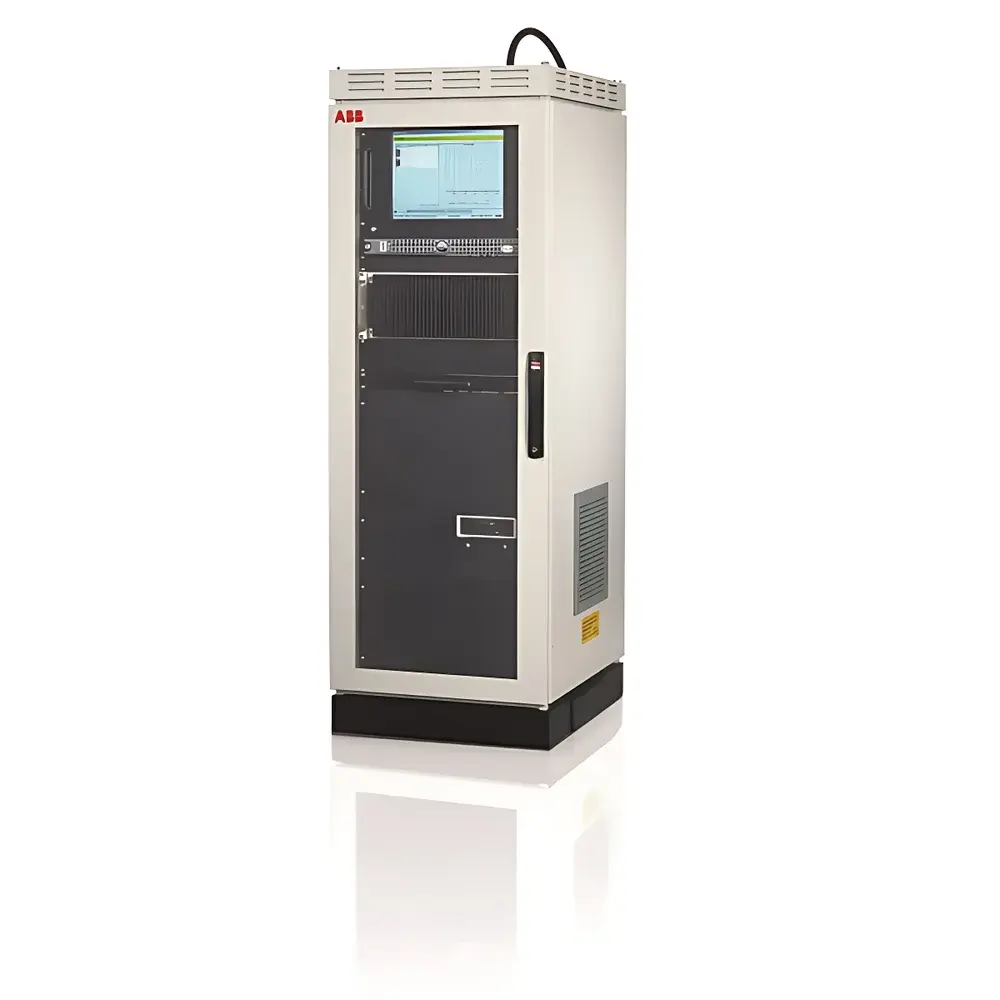
ABB FTPA2000-PH40 AnalyzeIT Dryer Monitor – Fourier Transform Near-Infrared (FT-NIR) Online Process Analyzer
| Brand | ABB |
|---|---|
| Origin | Canada |
| Model | FTPA2000-PH40 |
| Instrument Type | Online |
| Principle | Fourier Transform (FT) |
| Wavelength Range | 3800–14000 cm⁻¹ |
| Spectral Sampling Interval | < 0.7 cm⁻¹ |
| Measurement Mode | Diffuse Reflectance |
| Chemometrics Software | FTSW100, Horizon MB |
| Optical Path Difference (OPD) Scan Speed | 1 cm/s |
| Resolution Options | 1–128 cm⁻¹ (in powers of two) |
| Wavenumber Repeatability | 0.002 cm⁻¹ RMS @ 7300 cm⁻¹ |
| Wavenumber Reproducibility | 0.04 cm⁻¹ RMS @ 7300 cm⁻¹ |
| Absorbance Linearity | ±0.1% of peak response |
| SNR (1 scan, 16 cm⁻¹, room temp) | ≥15,000:1 (extended InGaAs detector) |
| Long-term Spectral Stability | ≤2%/°C drift (4000–10000 cm⁻¹) |
| Beam Splitter Material | BK7 optical glass |
Overview
The ABB FTPA2000-PH40 AnalyzeIT Dryer Monitor is a purpose-built, Fourier Transform near-infrared (FT-NIR) online process analyzer engineered for real-time, non-invasive quantification of moisture and solvent content in pharmaceutical drying operations. Operating on the principle of FT-NIR spectroscopy, it captures high-fidelity spectral data across a broad wavenumber range (3800–14,000 cm⁻¹), enabling robust multivariate calibration models for primary and secondary solvents—including water, ethanol, isopropanol, acetone, and ethyl acetate—within solid dosage forms and granules. Designed explicitly to support FDA’s Process Analytical Technology (PAT) framework, the system delivers continuous, traceable measurements directly inside fluidized bed dryers, tray dryers, or vacuum ovens—without interrupting production or requiring manual sampling. Its fully automated architecture eliminates operator exposure to potent compounds, mitigates cross-contamination risks associated with offline lab analysis, and removes delays introduced by sample transport and preparation.
Key Features
- Multi-point remote monitoring capability—up to eight fiber-optic probe locations controlled from a single analyzer unit
- Diffuse reflectance measurement via ruggedized, temperature-rated sapphire-tipped probes, inserted directly into dryer beds or product streams
- Zero-moving-parts interferometer design based on electronic signal multiplexing—ensuring mechanical reliability and minimal maintenance over extended operational cycles
- Integrated self-diagnostic routines compliant with USP Chapter 1119 (Near-Infrared Spectroscopy) for optical alignment verification, source intensity monitoring, and detector response validation
- High-precision FT optics with BK7 beam splitter and extended-range InGaAs detector, delivering SNR ≥15,000:1 at 16 cm⁻¹ resolution under ambient conditions
- Configurable spectral resolution (1–128 cm⁻¹ in powers of two) and sub-0.7 cm⁻¹ spectral sampling interval for optimal balance between throughput and chemometric model fidelity
- Real-time wavenumber repeatability of 0.002 cm⁻¹ RMS and reproducibility of 0.04 cm⁻¹ RMS at 7300 cm⁻¹—critical for long-term calibration transferability across instruments and sites
Sample Compatibility & Compliance
The FTPA2000-PH40 is validated for use with heterogeneous, particulate pharmaceutical materials—including wet granules, agglomerates, and coated tablets—under dynamic drying conditions. Probe insertion depth, angle, and pressure are configurable to minimize signal variability from packing density and surface morphology. All hardware and software components conform to current Good Manufacturing Practice (cGMP) requirements per 21 CFR Part 211. The system includes prequalified Installation Qualification (IQ) and Operational Qualification (OQ) documentation packages, aligned with Annex 15 of the EU GMP Guide. Full compliance with 21 CFR Part 11 is achieved through FTSW100 software, which provides audit-trail-enabled user authentication, electronic signatures, secure data archiving, and immutable record retention for all calibration updates, method changes, and measurement events.
Software & Data Management
Data acquisition, preprocessing, and quantitative modeling are executed within the ABB FTSW100 process control platform—a validated, Windows-based application supporting PAT-driven workflows. FTSW100 integrates native chemometric engines for PLS regression, PCA, and outlier detection, and supports import/export of models developed in Horizon MB (ABB’s advanced multivariate analytics suite). Real-time spectra and derived parameters—including residual moisture %w/w, solvent concentration (g/kg), and drying rate—are visualized via customizable dashboards and trend plots synchronized with PLC timestamps. The system exports time-stamped CSV and HDF5 files, and communicates seamlessly with DCS/SCADA systems via Modbus TCP, CANbus, and OPC UA protocols. All raw spectral data, preprocessing steps, and model metadata are stored in a relational database with full version control and rollback capability.
Applications
- Real-time endpoint determination in fluidized-bed and tray drying of active pharmaceutical ingredients (APIs) and excipients
- Continuous monitoring of solvent removal during lyophilization cycle optimization and stopper seating verification
- Batch release support through correlation of NIR-derived moisture profiles with Karl Fischer titration reference methods (validated per ICH Q2(R2))
- Process understanding and root-cause analysis of drying inconsistencies—e.g., channeling, uneven heat distribution, or binder migration
- Supporting Quality-by-Design (QbD) initiatives by establishing Design Space boundaries for drying temperature, airflow, and residence time
- Cross-site method transfer for harmonized global manufacturing, leveraging spectral standardization and instrument-specific correction algorithms
FAQ
What regulatory standards does the FTPA2000-PH40 support?
It meets 21 CFR Part 11, USP Chapter 1119, ASTM E1655 (standard practices for NIR quantitative analysis), and ISO 12099 (spectroscopic analysis of agricultural and food products), with IQ/OQ documentation aligned to EU GMP Annex 15.
Can the system be integrated into existing MES or SCADA infrastructure?
Yes—via native Modbus TCP, CANbus, and OPC UA drivers; no middleware or third-party gateways required.
Is calibration transfer between multiple FTPA2000-PH40 units possible?
Yes—using ABB’s Spectral Standardization Protocol (SSP), which corrects for detector response drift, source aging, and optical path differences across instruments.
How is probe fouling addressed during continuous operation?
Probes feature sapphire windows with optional purge gas ports (N₂ or compressed air) and are compatible with CIP/SIP cycles; spectral diagnostics automatically flag signal attenuation exceeding user-defined thresholds.
Does the system support predictive maintenance alerts?
FTSW100 logs interferogram quality metrics, laser stability, and detector dark-current trends—feeding into configurable alarms for preemptive service scheduling.
Related Products




