
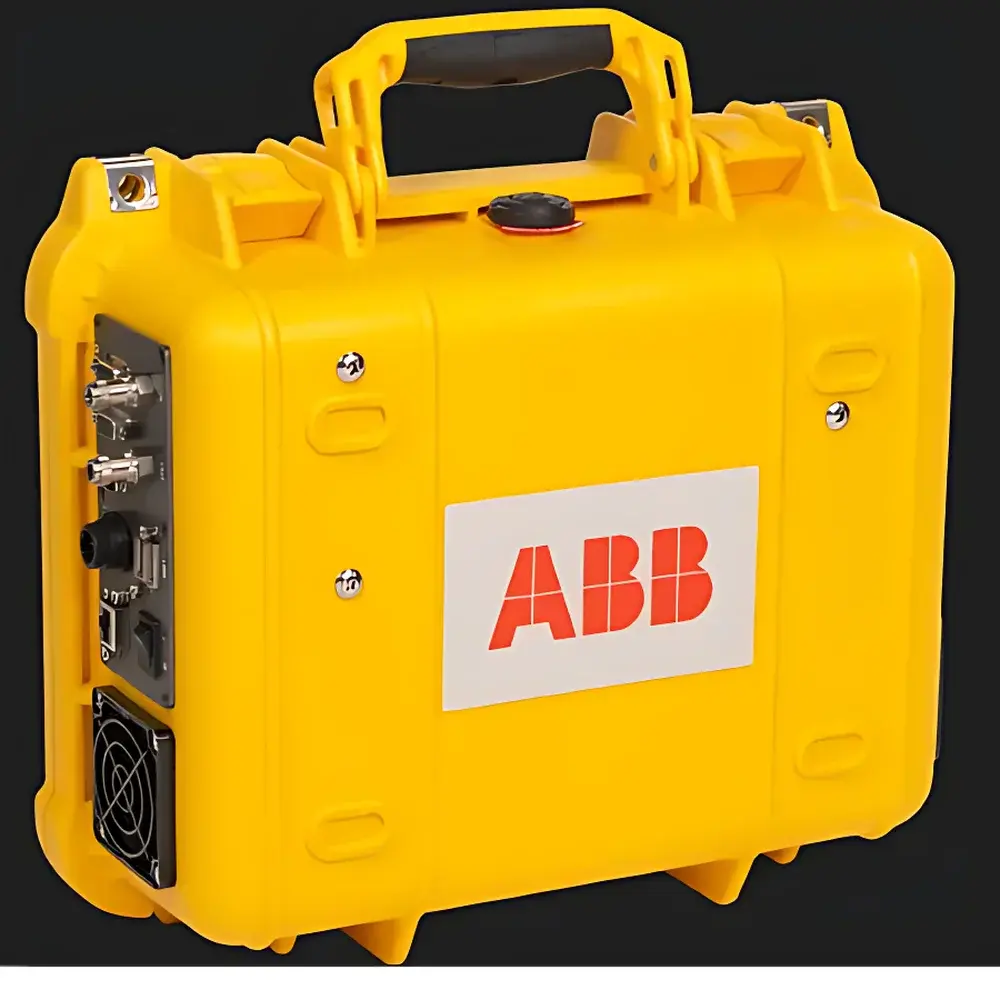
ABB GLA131-GGA Portable Greenhouse Gas Analyzer with OA-ICOS Technology
| Brand | ABB |
|---|---|
| Origin | Canada |
| Model | GLA131-GGA |
| Detection Gases | CH₄ (0–100 ppm, optional 0–5%), CO₂ (0–20,000 ppm), H₂O (0–30,000 ppm) |
| Response Time | 3 s (1/e) |
| Warm-up to Data Logging | ≤20 s |
| Dimensions | 12 cm H × 34 cm W × 29.5 cm D |
| Weight (incl. battery) | <5.5 kg |
| Power Consumption | <35 W |
| Precision (1σ, 1s/10s/100s) | CH₄: 1 ppb / 0.4 ppb / 0.2 ppb |
| CO₂ | 0.4 ppm / 0.2 ppm / 0.1 ppm |
| H₂O | 200 ppm / 60 ppm / 30 ppm |
| Operating Temperature | 5–45 °C |
| Sample Temperature Range | −40–50 °C |
| Relative Humidity | 0–98% RH (non-condensing) |
| Data Output | SD card storage, Wi-Fi, USB, Ethernet, analog outputs |
Overview
The ABB GLA131-GGA is a field-deployable, ultra-portable greenhouse gas analyzer engineered for high-fidelity, real-time quantification of methane (CH₄), carbon dioxide (CO₂), and water vapor (H₂O) in ambient and eddy-covariance applications. It employs Off-Axis Integrated Cavity Output Spectroscopy (OA-ICOS), ABB’s fourth-generation cavity-enhanced absorption technique, which delivers superior signal-to-noise ratio, long-term optical stability, and immunity to mechanical vibration—critical advantages over conventional CRDS (cavity ring-down spectroscopy) and direct absorption systems. Unlike traditional analyzers requiring thermal equilibration or complex alignment, the GLA131-GGA achieves operational readiness within 20 seconds of power-on, enabling immediate deployment in dynamic field conditions such as soil flux chambers, mobile monitoring platforms, and remote atmospheric observatories. Its compact form factor (12 × 34 × 29.5 cm), sub-5.5 kg mass (including integrated Li-ion battery), and low power draw (<35 W) support battery-powered operation for >6 hours and compatibility with UAV-mounted, backpack, or vehicle-integrated configurations.
Key Features
- Ultra-rapid response: 3-second time constant (1/e) for gas-phase concentration changes, ensuring fidelity in turbulent flux measurements.
- Simultaneous, interference-free detection of CH₄, CO₂, and H₂O using wavelength-scanned OA-ICOS at near-infrared absorption lines—no cross-sensitivity between target species.
- Extended linear dynamic range: CH₄ measurement up to 5% v/v (explosive limit), supporting both trace-level environmental monitoring and high-concentration industrial leak detection.
- Onboard embedded computer with SD card logging (multi-year capacity at 1 Hz), real-time Wi-Fi streaming to tablets/smartphones, and configurable analog (0–5 V, 4–20 mA) and digital (Ethernet, USB) outputs.
- Ruggedized enclosure rated for field use: IP54 ingress protection, shock-absorbing housing, and temperature-compensated optics for stable performance across −40 to +50 °C sample streams and 5–45 °C ambient environments.
- No consumables or calibration gases required during routine operation; factory-calibrated traceability to NIST-traceable standards.
Sample Compatibility & Compliance
The GLA131-GGA accepts unfiltered, humidified sample streams without condensation (0–98% RH, non-condensing), eliminating the need for external dryers or permeation dryers that introduce memory effects or flow artifacts. Its pressure-tolerant inlet accommodates sampling from static chambers, dynamic flow-through systems, and open-path configurations via standard ¼″ Swagelok fittings. The analyzer complies with ISO 14064-3 requirements for GHG quantification uncertainty reporting and supports audit-ready data provenance through timestamped, tamper-evident SD card logs. Firmware includes configurable metadata tagging (location, operator ID, chamber ID) and optional 21 CFR Part 11-compliant electronic signature modules for regulated environmental compliance programs.
Software & Data Management
ABB’s proprietary Analyze software provides intuitive instrument control, spectral diagnostics, and real-time concentration visualization. Raw absorbance spectra, calibrated mole fractions, and diagnostic parameters (cavity pressure, laser current, temperature drift) are logged at user-selectable intervals (10 ms to 10 s). Export formats include CSV, NetCDF4, and CF-compliant files compatible with EddyPro®, TK3, and FluxNet processing pipelines. Remote firmware updates, over-the-air configuration changes, and automated QC flagging (e.g., water saturation alerts, laser mode instability) reduce field maintenance frequency. All data archives include embedded GPS coordinates (when connected to external GNSS) and hardware-generated cryptographic hashes for chain-of-custody integrity.
Applications
- Soil-atmosphere CH₄ and CO₂ flux quantification using static or dynamic closed-chamber methodologies (ASTM D5972, ISO 16635).
- Mobile emissions monitoring along roadways, landfills, and agricultural operations via vehicle-mounted or drone-deployed platforms.
- Background atmospheric monitoring at remote stations where power, space, and transport logistics constrain equipment selection.
- Validation of satellite-based GHG retrievals (e.g., TROPOMI, OCO-2/3) through ground-truth point measurements with documented uncertainty budgets.
- Industrial fugitive emission surveys compliant with EPA Method 21 and LDAR (Leak Detection and Repair) protocols.
- Calibration transfer and intercomparison studies among research-grade analyzers under GLP/GMP-aligned workflows.
FAQ
What is the minimum detectable concentration for CH₄ at 1-second integration?
The 1σ noise-equivalent detection limit is 1 part per trillion (1 ppt) for CH₄ at 1 Hz, verified per ISO 13528 proficiency testing guidelines.
Can the GLA131-GGA operate continuously on battery power?
Yes—integrated 96 Wh Li-ion battery supports ≥6.5 hours of continuous operation at 1 Hz logging; external 12–24 V DC input enables indefinite field deployment.
Is factory calibration traceable to international standards?
All factory calibrations are NIST-traceable, with certificate of analysis documenting uncertainty contributions from reference gas purity, pressure transducers, and temperature sensors.
Does the analyzer require periodic zero/span verification in the field?
While not mandatory for routine operation, ABB recommends quarterly span checks using certified CH₄/N₂ and CO₂/N₂ standards to maintain ISO 17025-compliant measurement confidence.
How is data security handled during wireless transmission?
Wi-Fi communication uses WPA2-Enterprise encryption; local SD card writes employ AES-256 full-disk encryption when enabled via firmware configuration.
Related Products







