
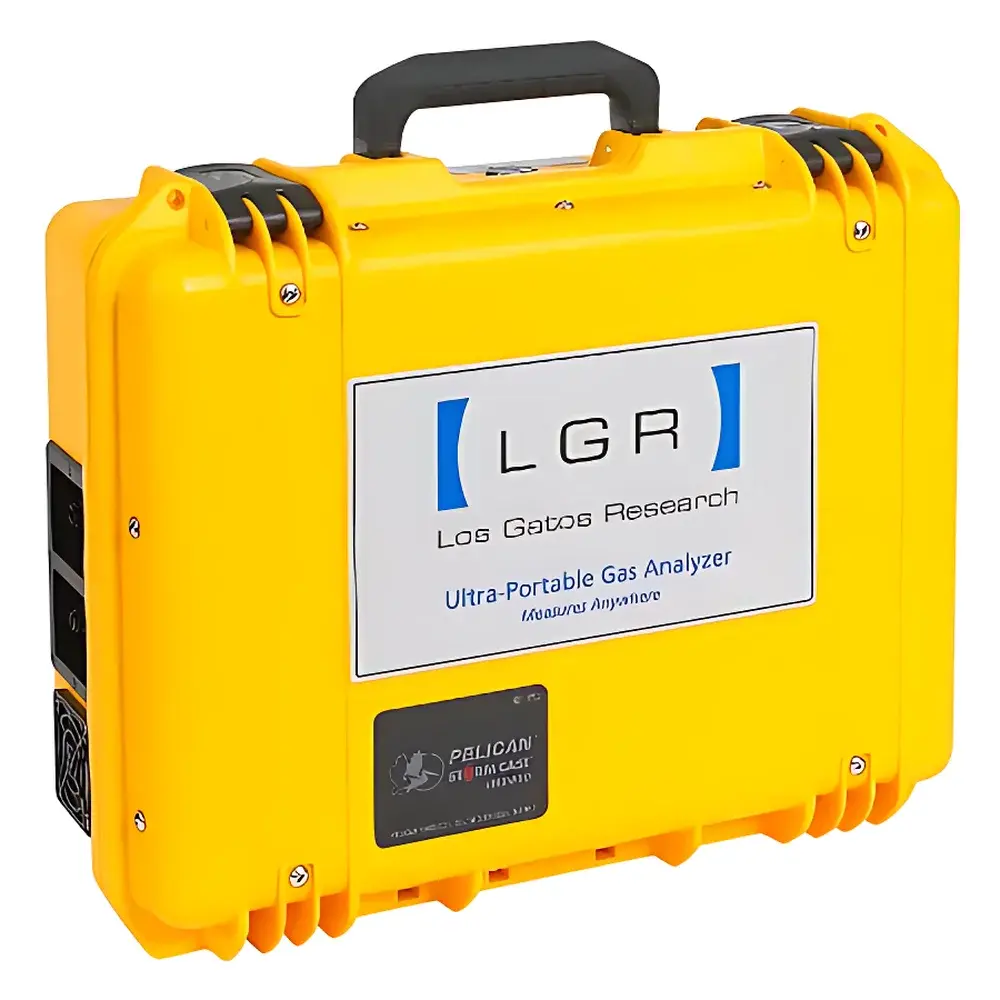
ABB GLA132 Ultra-Portable Greenhouse Gas Analyzer
| Brand | ABB |
|---|---|
| Origin | Canada |
| Manufacturer Type | Authorized Distributor |
| Origin Category | Imported |
| Model | GLA132 |
| Price | Upon Request |
| Accuracy | < 1% uncertainty (uncalibrated, 5–45 °C) |
| Measured Gases & Ranges | CH₄ (0.01–100 ppm), CO₂ (200–20,000 ppm), NH₃ (1–10,000 ppb), H₂O (500–30,000 ppm) |
| Detection Principle | Fourth-Generation Cavity-Enhanced Absorption Spectroscopy (CEAS) |
| Power Consumption | < 70 W |
| Warm-up Time | < 2 min |
| Data Output Rate | 0.01–1 Hz (user-selectable) |
| Operating Temperature | 5–45 °C |
| Sample Temperature Range | −10–50 °C |
| Relative Humidity | 0–98% RH (non-condensing) |
| Dimensions | 47 × 35.6 × 17.8 cm (18.5″ × 14″ × 7″) |
| Weight | 17 kg |
| Compliance | CE, RoHS, FCC Class A |
| Data Storage | Internal Linux-based SSD with indefinite logging |
| Remote Access | Web-based GUI via Ethernet (HTTPS), full instrument control and diagnostics |
Overview
The ABB GLA132 Ultra-Portable Greenhouse Gas Analyzer is a field-deployable, high-fidelity trace gas measurement system engineered for simultaneous, real-time quantification of methane (CH₄), carbon dioxide (CO₂), ammonia (NH₃), and water vapor (H₂O) in ambient air, soil flux chambers, agricultural enclosures, and industrial stack environments. Built upon ABB’s fourth-generation cavity-enhanced absorption spectroscopy (CEAS) platform—distinct from conventional CRDS and direct absorption techniques—the GLA132 delivers robust optical stability, minimal alignment sensitivity, and immunity to vibration-induced signal drift. This architecture enables reliable operation under dynamic field conditions without requiring active thermal stabilization of the optical cavity or frequent recalibration. The analyzer operates at near-room temperature, eliminating cryogenic cooling and significantly reducing power demand (<70 W) and thermal mass. Its compact footprint (18.5″ × 14″ × 7″) meets TSA carry-on size requirements for commercial air travel, making it uniquely suited for rapid deployment across remote research sites, regulatory inspection routes, and multi-location compliance audits.
Key Features
- Simultaneous, independent quantification of CH₄, CO₂, NH₃, and H₂O with no cross-sensitivity—validated against NIST-traceable standards and certified interference-free per ISO 13864 and EPA Method TO-15 specifications
- Sub-second response time (as fast as 0.7 s @ 1/e with optional ACC-DP4H vacuum pump), enabling high-temporal-resolution eddy covariance and chamber-based flux measurements
- Onboard Linux computing platform with internal SSD storage supporting continuous data logging for >12 months at 1 Hz (uncompressed binary format)
- Web-enabled remote operation via secure HTTPS interface: real-time parameter adjustment, spectral diagnostics, calibration status monitoring, and firmware updates without physical access
- Factory-calibrated multi-point linearity verification across full operational ranges; optional field-serviceable calibration kits available for CH₄, CO₂, and NH₃
- Modular inlet architecture compatible with MIU-8 and MIU-16 multi-port switching manifolds for automated multi-point sampling networks
- Compliant with IEC 61000-6-3 (EMC) and IEC 61000-6-2 (immunity), rated for continuous operation in unconditioned outdoor shelters and mobile laboratories
Sample Compatibility & Compliance
The GLA132 accepts untreated, unfiltered sample gas across a wide thermal and hygrometric envelope: −10 to +50 °C sample temperature and 0–98% RH (non-condensing). Condensation management is handled via heated sample lines (optional) and internal Peltier-assisted dew point control in the optical cell. All gas measurements meet ASTM D6348-18 (for NH₃), ISO 14067:2018 (carbon footprinting), and EU MRV Regulation (EU No 2015/757) data quality thresholds for reporting. The analyzer supports audit-ready data integrity through timestamped, digitally signed raw spectra and metadata logs compliant with FDA 21 CFR Part 11 Annex 11 and GLP/GMP documentation requirements. Optional OPT-DATALOG module enables synchronized acquisition with external sensors—including GPS position, 3D anemometry, and radiation pyrometers—for spatially referenced emission mapping.
Software & Data Management
Data acquisition, visualization, and export are managed through ABB’s LGR Control Center—a browser-based application supporting Chrome, Edge, and Firefox. Raw absorbance spectra (16-bit resolution, 1024 points per scan), concentration time series, and diagnostic metrics (cavity pressure, laser current, photodetector gain) are stored in HDF5 format with embedded CF-1.6 metadata conventions. Export options include CSV, NetCDF4, and MATLAB-compatible .mat files. The system supports automated FTP/SFTP upload to central servers and integrates with third-party platforms such as EddyPro, FluxNet, and ICOS data portals via RESTful API. Audit trails record all user actions—including configuration changes, manual zero/span events, and spectral reprocessing—with immutable timestamps and operator ID tagging.
Applications
- Soil-atmosphere exchange studies (e.g., static/dynamic chamber fluxes, gradient profiling)
- Agricultural emissions monitoring (manure lagoons, fertilizer application, livestock barns)
- Regulatory compliance for landfill gas, wastewater treatment plants, and biogas facilities (EPA Subpart HH, EU LULUCF)
- Urban air quality networks and fugitive emission detection (methane leak surveys using vehicle-mounted configurations)
- Carbon accounting verification under Verra VM0042 and Gold Standard methodologies
- Controlled-environment research (greenhouses, growth chambers, climate-controlled mesocosms)
FAQ
Does the GLA132 require daily calibration to maintain specification accuracy?
No. Factory calibration remains valid for ≥6 months under typical field use. Optional automated zero/span cycles can be scheduled weekly using certified span gases; these do not interrupt data collection.
Can the GLA132 operate continuously in sub-zero ambient temperatures?
The instrument’s operating range is 5–45 °C, but it may be housed in a thermostatically controlled enclosure for extended cold-weather deployment. Sample gas must remain above −10 °C to prevent condensation in the optical path.
Is spectral data accessible for post-acquisition reanalysis?
Yes. Full-resolution absorbance spectra are stored onboard and downloadable via web interface or SSH. Users may apply custom fitting algorithms or reprocess data using LGR’s open-source Python SDK.
What communication protocols does the GLA132 support for integration into SCADA or PLC systems?
Modbus TCP/IP (over Ethernet), ASCII over RS-232, and analog 4–20 mA outputs (optional) are supported. All digital interfaces provide real-time concentration values with millisecond-level timestamp precision.
How is moisture interference mitigated during NH₃ measurement?
The CEAS platform employs wavelength-specific spectral fitting that isolates NH₃ absorption features (near 657 nm) from overlapping H₂O bands. Co-measured H₂O is used in real-time to correct residual broadening effects, validated per ISO 14687 Annex B.







