
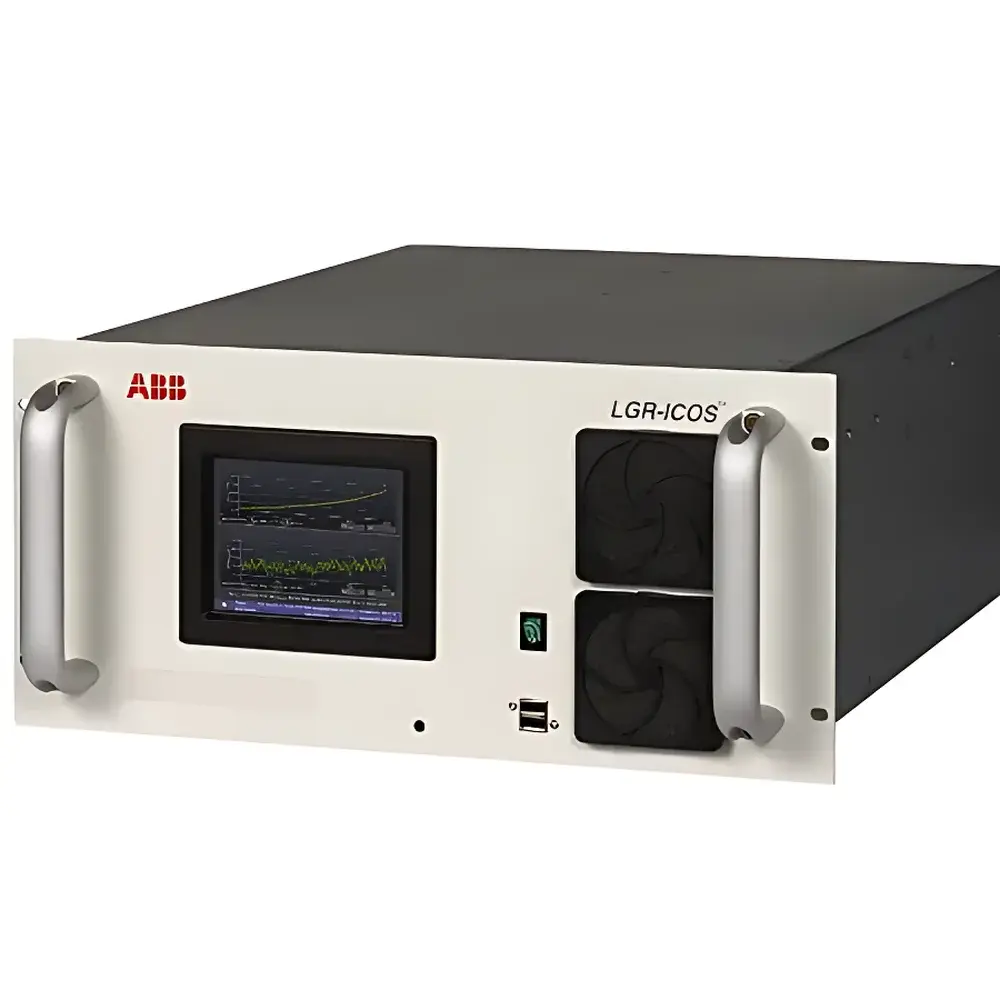
ABB GLA231 Industrial Trace Gas Analyzer
| Brand | ABB |
|---|---|
| Origin | Canada |
| Model | GLA231 |
| Detection Gases | H₂O, NH₃, HCl, HF |
| Detection Range | Sub-ppb to % level (gas-dependent) |
| Output Options | 0–5 V DC, 4–20 mA, Modbus TCP (optional) |
| Operating System | Embedded Linux |
| Data Storage | Internal HDD with full spectral logging |
| Remote Access | Web-based GUI via Ethernet/IP |
| Calibration | Factory-certified, field-zero capable |
| Display | Integrated touchscreen interface |
| Security | Password-protected configuration and data access |
| Compliance | Designed for industrial process safety and AMC monitoring per SEMI F21, ISO 14644-8, and EPA Method TO-15 context |
Overview
The ABB GLA231 Industrial Trace Gas Analyzer is a high-performance, cavity-enhanced absorption spectrometer engineered for continuous, real-time quantification of trace-level corrosive and reactive gases—including hydrogen fluoride (HF), hydrogen chloride (HCl), ammonia (NH₃), and water vapor (H₂O)—in demanding semiconductor manufacturing environments. Built upon ABB’s patented Off-Axis Integrated Cavity Output Spectroscopy (Off-Axis ICOS™) platform—the fourth-generation evolution of cavity-enhanced laser absorption—this analyzer delivers exceptional sensitivity (sub-parts-per-quadrillion, sub-pptv, for select gases), high reproducibility (<1% RSD over 24 h), and rapid response times (6 months between maintenance cycles, and meets the stringent metrological demands of air molecular contamination (AMC) monitoring in Class 1–10 cleanrooms per SEMI F21-0712 and ISO 14644-8.
Key Features
- Multi-gas capability: Simultaneous or configurable single-gas detection of HF, HCl, NH₃, and H₂O across overlapping dynamic ranges—from sub-ppb (e.g., 0.1 ppb HF) up to percent-level H₂O—with independent calibration traceability.
- Robust optical architecture: Off-Axis ICOS cavity with ultra-low-loss high-reflectivity mirrors (>99.998%) and thermally stabilized quantum cascade lasers (QCLs) or interband cascade lasers (ICLs), optimized for mid-infrared absorption features.
- Digital-native operation: Embedded Linux computing platform records full high-resolution absorption spectra (≥4 cm⁻¹ resolution) alongside concentration time-series; all data timestamped with NTP-synchronized UTC.
- Industrial I/O suite: Standard analog outputs (0–5 V, 4–20 mA) with 16-bit DAC resolution; optional Modbus TCP/Ethernet/IP for PLC/SCADA integration; RS232 serial for local diagnostics.
- Secure human-machine interface: 7-inch capacitive touchscreen with intuitive navigation, real-time concentration trend plots, alarm status visualization, and user-access control (admin/operator roles with password enforcement).
- Zero-gas stability: Onboard zero-air management system (electrochemical or catalytic scrubber option) ensures <0.05 ppb baseline drift over 72 h—critical for detecting transient process excursions in FOUP purge lines or CVD chamber exhaust.
Sample Compatibility & Compliance
The GLA231 is designed for direct sampling of ambient cleanroom air, nitrogen/purge gas streams (≥99.999% purity), and low-flow (<1 L/min) effluent from semiconductor tool interfaces (e.g., FOUP load ports, etch chamber vents, wet bench exhaust). It accommodates inlet pressures from 50–150 kPa and operates continuously at temperatures from 15–35°C with <80% non-condensing RH. All gas-path wetted materials are electropolished 316L stainless steel or PFA-lined to prevent adsorption/desorption artifacts—validated per ASTM E2858-13 for AMC measurement uncertainty. The instrument complies with electromagnetic compatibility (IEC 61326-1), safety (UL 61010-1), and functional safety (IEC 61508 SIL2-ready architecture) standards. Its data integrity framework supports audit trails, electronic signatures, and export logs compatible with FDA 21 CFR Part 11 and EU Annex 11 requirements when deployed in GMP-aligned facilities.
Software & Data Management
ABB’s proprietary LGR Control Software provides web-hosted configuration, remote diagnostics, and spectral analysis via HTTPS-secured HTML5 interface—accessible from any modern browser without client installation. Raw spectral files (HDF5 format) and processed concentration CSVs are stored on internal SSD with configurable retention policies (default: 12 months). Automated report generation includes daily calibration verification summaries, zero/span drift logs, and alarm event chronologies. Optional ABB Insight Cloud connectivity enables encrypted TLS 1.3 telemetry upload for fleet-wide health monitoring and predictive maintenance alerts. All software updates undergo rigorous regression testing and are qualified per IEC 62304 Class B medical device software lifecycle principles.
Applications
- Semiconductor front-end process control: Real-time HF/HCl monitoring in plasma etch tool exhaust, NH₃ leak detection in ALD precursors, and H₂O tracking in lithography track dry zones.
- FOUP and mini-environment monitoring: Sub-ppb HF detection during wafer transfer to prevent gate oxide corrosion; integrated into SMIF pod purge loops with automated alarm-triggered nitrogen flush.
- Gas delivery system QC: Verification of impurity levels in bulk NF₃, ClF₃, and SiH₄ supply lines per SEMI C37 specifications.
- Environmental compliance: Stack emission monitoring for regulated acid gases under EPA Method TO-15 protocols (with appropriate dilution and conditioning).
- Research & development: Kinetic studies of surface reaction byproducts in atomic layer processing reactors using time-resolved spectral deconvolution.
FAQ
What calibration standards are provided with the GLA231?
Each unit ships with NIST-traceable multi-point calibration certificates for all configured gases, including zero-air validation data and span gas uncertainty budgets per ISO/IEC 17025.
Can the GLA231 be integrated into a Fab-wide SECS/GEM host system?
Yes—via Modbus TCP or custom API integration; ABB provides SECS/GEM message mapping documentation and conformance test support.
Is field service required for routine maintenance?
No scheduled field service is needed within the first 12 months; only quarterly zero-check verification and annual mirror inspection (user-performed with included optical toolkit) are recommended.
How does the GLA231 handle cross-interference between NH₃ and H₂O in humid samples?
The multivariate spectral fitting algorithm applies physics-based line-shape modeling (Voigt profiles with pressure-broadening coefficients) and simultaneous multi-component least-squares regression to decouple overlapping absorptions with <0.3% cross-sensitivity.
Does the analyzer meet cybersecurity requirements for Industry 4.0 deployments?
Yes—it supports TLS 1.2/1.3 encryption, role-based access control, firmware signing, and disabled default credentials out-of-box, aligned with ISA/IEC 62443-3-3 SL2.
Related Products







