
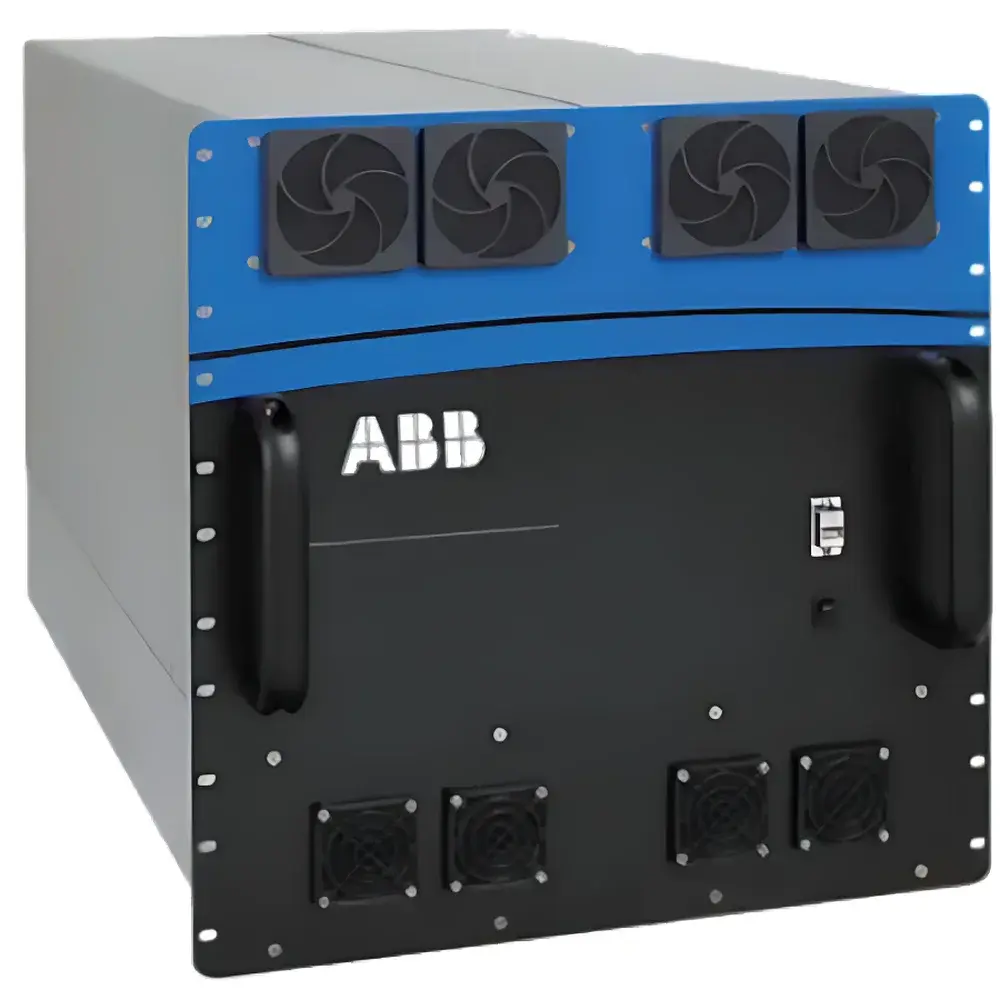
ABB GLA351 Enhanced Performance Quantum Cascade Laser Isotope Ratio Spectrometer for CO₂
| Brand | ABB |
|---|---|
| Origin | Canada |
| Manufacturer Type | Authorized Distributor |
| Origin Category | Imported |
| Model | GLA351 |
| Measurement Range | δ¹³C, δ¹⁷O, δ¹⁸O, and CO₂ mole fraction (150–2500 ppm, full-spec range) |
| Precision (1σ) | δ¹³C = 0.7‰/0.25‰/0.07‰ (1 s/10 s/100 s) |
| Max Drift (peak-to-peak, 15-min avg, 24 h) | δ¹³C < 0.5‰ |
| Response Time (95% step) | 10 s (with external pump, flow response < 5 s) |
| Operating Range | CO₂: 0–3000 ppm |
| H₂O | 0–70,000 ppm (non-condensing) |
| Data Output | RS232, analog (0–5 V / 4–20 mA) |
| Measurement Rate | Up to 1 Hz (user-selectable) |
Overview
The ABB GLA351 Enhanced Performance Quantum Cascade Laser Isotope Ratio Spectrometer is a high-precision, real-time gas analyzer engineered for quantitative isotopic characterization of carbon dioxide in environmental, biogeochemical, and industrial research applications. It employs Off-Axis Integrated Cavity Output Spectroscopy (OA-ICOS)—a fourth-generation cavity-enhanced absorption technique—based on quantum cascade laser (QCL) technology operating in the mid-infrared region. Unlike conventional CRDS systems, OA-ICOS eliminates stringent optical alignment requirements, relaxes cavity pressure and temperature control constraints, and delivers superior robustness in field-deployable or long-term unattended operation. The instrument simultaneously quantifies δ¹³C, δ¹⁷O, δ¹⁸O, and absolute CO₂ mole fraction with metrological traceability to international isotope reference materials (e.g., VPDB, VSMOW). Its design addresses core scientific needs: high accuracy across wide dynamic concentration ranges (150–2500 ppm CO₂), sub-permil precision at integration times ≥10 s, minimal instrumental drift (<0.5‰ peak-to-peak for δ¹³C over 24 h), and immunity to common interferents including H₂S, CH₄, other hydrocarbons, NH₃, and variable water vapor (4000–60,000 ppm).
Key Features
- Simultaneous, real-time measurement of δ¹³C, δ¹⁷O, δ¹⁸O, and CO₂ mole fraction in a single optical path
- Enhanced Performance (EP) thermal management architecture ensuring ultra-stable cavity temperature control and minimizing thermal-induced spectral baseline drift
- Quantum cascade laser source with narrow linewidth (<0.001 cm⁻¹) and wavelength stability <10 MHz/hour, optimized for overlapping rovibrational transitions of multiple CO₂ isotopologues
- No moving parts in the optical detection module—no choppers, no modulators—enabling high reliability and >5-year mean time between failures (MTBF)
- Integrated industrial-grade embedded computer with 500 GB SSD for autonomous data logging (timestamped, metadata-rich binary + CSV export)
- User-configurable measurement rate up to 1 Hz, with programmable averaging windows (1–100 s) and automatic gain scaling for optimal signal-to-noise ratio across concentration gradients
- Patented optical design insensitive to vibration, particulate contamination, and ambient pressure fluctuations (operational from 50–105 kPa)
Sample Compatibility & Compliance
The GLA351 accepts continuous gas streams via standardized 1/4″ Swagelok fittings (stainless steel or electropolished tubing recommended). It is compatible with discrete sample introduction via syringe injection (optional heated manifold), Tedlar® bags, and glass exetainers pre-equilibrated under controlled humidity. Water vapor is measured concurrently and used for real-time spectroscopic correction—no external drying or chemical scrubbing required. The system complies with ISO 17025 calibration traceability requirements when operated with certified reference gases (e.g., NIST SRM 1610, USGS40/41). For regulated environments, its firmware supports audit-trail-enabled operation aligned with FDA 21 CFR Part 11 principles (electronic signatures, user access levels, immutable logs), and raw spectral data files retain full Wavelength-Intensity-Time metadata for GLP/GMP reprocessing.
Software & Data Management
Control and visualization are managed through LGR’s proprietary Isotopic Analysis Suite (IAS) v4.x, a Windows-based application supporting remote SSH/TLS access, script-driven batch analysis (Python API available), and automated calibration sequence scheduling. All spectra are stored in HDF5 format with embedded calibration coefficients, cavity length history, and laser current/voltage telemetry. Export options include NIST-compliant .csv with δ-value uncertainty propagation (type-A and type-B components), as well as direct integration with LabArchives ELN and Thermo Fisher SampleManager LIMS via OPC UA. Internal diagnostics continuously monitor laser power stability, cavity mirror reflectivity decay (>99.998% per bounce), and etalon-free spectral residuals—triggering alerts if deviation exceeds IEC 61508 SIL-2 thresholds.
Applications
- Soil respiration flux partitioning using dual-isotope (δ¹³C + δ¹⁸O) tracer studies in ecosystem carbon cycling
- Volcanic CO₂ monitoring for early eruption forecasting via temporal δ¹³C/δ¹⁸O decoupling analysis
- Fossil fuel emission attribution in urban airsheds using atmospheric δ¹³C signatures
- Carbon sequestration verification at geological storage sites via repeated downhole CO₂ isotopic profiling
- Metabolic flux analysis in plant physiology chambers with sub-second isotopic transient resolution
- Industrial process control in bioethanol fermentation, where real-time δ¹³C tracks substrate utilization efficiency
FAQ
Does the GLA351 require daily calibration with reference gases?
No—its EP thermal stabilization and OA-ICOS intrinsic linearity enable stable operation for ≥7 days between reference gas validations. Daily zero/span checks are optional but not mandatory for research-grade data.
Can it measure δ¹⁷O independently of δ¹⁸O in low-abundance samples?
Yes—the QCL’s high spectral resolution (0.0005 cm⁻¹) resolves the ¹⁶O¹²C¹⁷O and ¹⁶O¹²C¹⁸O absorption features with <0.5‰ precision even at 200 ppm CO₂.
Is external pumping necessary for all configurations?
An external diaphragm pump is required only when achieving <5 s flow response time or when sampling from low-pressure sources (e.g., soil probes, vacuum flasks). Ambient-pressure inlet operation is fully supported.
How is water vapor interference corrected without drying?
The instrument co-measures H₂O absorption bands at 2.7 µm and applies physics-based multivariate spectral fitting to deconvolve isotopic CO₂ signals—no empirical correction tables or hardware dryers needed.
What cybersecurity protocols are implemented for remote access?
SSHv2 with RSA-2048 key authentication, TLS 1.3 for web interface, and configurable firewall rules via embedded Linux iptables—certified compliant with NIST SP 800-53 Rev. 5 AC-17 and IA-2 controls.





