
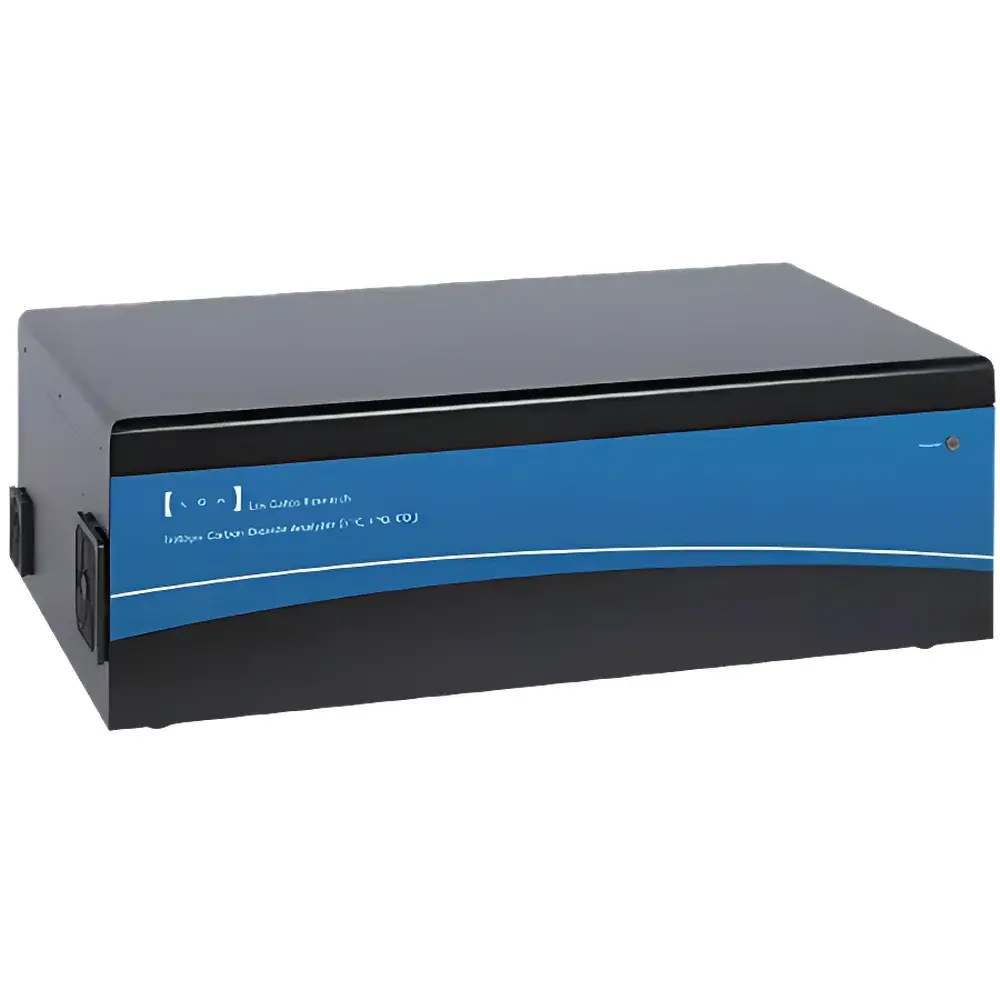
ABB GLA431 Rack-Mount High-Precision Carbon Dioxide Isotope Ratio Analyzer
| Brand | ABB |
|---|---|
| Origin | Canada |
| Model | GLA431 |
| Measurement Parameters | δ¹³C, δ¹⁸O, CO₂ (380–25,000 ppm), H₂O (4,000–60,000 ppm) |
| Precision (1σ) | δ¹³C = 0.15‰ (100 s), δ¹⁸O = 1‰ (100 s), CO₂ = 0.05 ppm (100 s), H₂O = 50 ppm (300 s) |
| Drift (24 h, peak-to-peak) | δ¹³C < 0.5‰ |
| Max. Measurement Rate | 1 Hz |
| Form Factor | Rack-Mount (68 kg) |
| Technology | Off-Axis Integrated Cavity Output Spectroscopy (OA-ICOS) |
Overview
The ABB GLA431 Rack-Mount High-Precision Carbon Dioxide Isotope Ratio Analyzer is a laboratory-grade, continuous-flow isotope ratio measurement system engineered for high-fidelity, real-time quantification of stable carbon and oxygen isotopic ratios (δ¹³C and δ¹⁸O) in carbon dioxide, alongside concurrent absolute concentration measurements of CO₂ and H₂O vapor. Built upon ABB’s proprietary Off-Axis Integrated Cavity Output Spectroscopy (OA-ICOS) platform—third-generation evolution of tunable diode laser absorption spectroscopy (TDLAS)—the GLA431 delivers metrologically traceable isotope data without reliance on calibration gases or offline preparation. Unlike conventional isotope ratio mass spectrometry (IRMS), which requires cryogenic trapping, chemical conversion, and vacuum operation, the GLA431 operates at ambient pressure with no consumables, enabling direct, continuous analysis of gas-phase samples with sub-second temporal resolution. Its optical architecture eliminates sensitivity to cavity alignment drift, thermal expansion artifacts, and pressure fluctuations—critical for long-term unattended deployment in field laboratories, eddy covariance towers, or industrial monitoring stations. The instrument is specifically optimized for applications demanding robust performance across wide dynamic ranges (CO₂: 380–25,000 ppm; H₂O: 4,000–60,000 ppm), including atmospheric carbon cycle studies, ecosystem flux partitioning, fossil fuel emission attribution, and geological sequestration verification.
Key Features
- Rack-mount form factor (68 kg) designed for integration into centralized analytical suites, mobile lab containers, or ISO-classified cleanrooms.
- Simultaneous, fully resolved measurement of δ¹³C, δ¹⁸O, CO₂ mole fraction, and H₂O vapor concentration—all within a single optical path and acquisition cycle.
- Patented OA-ICOS detection technology providing immunity to hydrocarbon interference (e.g., CH₄, C₂H₆), H₂S, NH₃, and other common combustion byproducts—eliminating need for pre-scrubbing or catalytic oxidation.
- Enhanced Performance Series with active internal thermal stabilization ensuring <0.5‰ peak-to-peak δ¹³C drift over 24 hours (1-hr averaging), meeting stringent requirements for multi-day intercomparison campaigns.
- User-selectable measurement rate up to 1 Hz, with 95% step response time of 10 s (flow-limited; external pump required for <5 s response).
- Built-in industrial-grade computer with SSD storage supporting >1 year of continuous 1-Hz data logging—fully compliant with GLP/GMP audit trail requirements.
- Dual analog (0–10 V, 4–20 mA) and digital (RS-232, Ethernet) I/O interfaces for seamless integration into SCADA, DAQ, or LIMS environments.
Sample Compatibility & Compliance
The GLA431 accepts dry or humid gas streams directly from ambient air intakes, soil flux chambers, stack emissions ducts, or custom sample introduction modules (e.g., injection-loop autosamplers, bag samplers, or cryo-trapped discrete vials). Its optical path is insensitive to particulate load and condensable organics when operated within specified dew point limits (non-condensing H₂O range: 0–70,000 ppm). The analyzer complies with ISO 17025 calibration traceability frameworks when used with NIST-traceable reference gases (e.g., USGS-40, USGS-41, NBS-19). Data output formats adhere to CF Metadata conventions and support ASTM D7907 (standard practice for stable isotope analysis of CO₂ in air) and ISO 13877 (environmental isotope analysis). Firmware includes configurable audit logs recording operator actions, calibration events, and environmental metadata—enabling full compliance with FDA 21 CFR Part 11 for regulated environmental monitoring applications.
Software & Data Management
ABB’s proprietary LGR-ICOS Control Software (v5.x) provides intuitive GUI-based instrument control, real-time spectral visualization, automated baseline correction, and on-the-fly isotope ratio calculation using dual-wavelength referencing and water-vapor cross-talk compensation algorithms. All raw absorbance spectra and processed results are stored in HDF5 format with embedded timestamps, instrument configuration hashes, and QC flags. Remote access is supported via secure SSH or HTTPS web interface, allowing firmware updates, diagnostic queries, and live data streaming without physical access. Export options include CSV, NetCDF, and XML—compatible with MATLAB, Python (xarray, pandas), and commercial platforms such as LabVIEW and DIAdem. Optional ABB DataLink module enables automated synchronization with meteorological stations, eddy covariance systems, or chromatographic front-ends.
Applications
- Atmospheric science: Long-term δ¹³C/δ¹⁸O monitoring at NOAA/AGAGE sites and ICOS observatories for source–sink partitioning and biospheric feedback modeling.
- Carbon capture and storage (CCS): Real-time isotopic fingerprinting of injected CO₂ plumes to verify containment integrity and detect leakage pathways.
- Petroleum geochemistry: Downhole CO₂ isotope profiling during well testing and enhanced oil recovery (EOR) operations.
- Agricultural research: Chamber-based ¹³C discrimination assays for photosynthetic efficiency screening in crop breeding programs.
- Forensic environmental analysis: Attribution of CO₂ sources in urban airsheds using isotopic end-member mixing models.
- Biomedical tracer studies: Breath-test applications requiring rapid, precise δ¹³C tracking following ¹³C-urea or ¹³C-octanoic acid administration.
FAQ
Does the GLA431 require daily calibration with reference gases?
No. OA-ICOS is an absolute absorption technique; calibration is performed during factory commissioning using primary standards. Field validation is recommended every 30–90 days depending on application criticality.
Can it operate unattended for extended periods?
Yes. With its embedded SSD, thermal management system, and watchdog timer, the GLA431 supports >6 months of continuous operation without intervention—validated under IEC 60068-2 environmental stress testing.
Is H₂O interference corrected in real time?
Yes. The instrument applies physics-based spectral fitting that simultaneously retrieves CO₂, H₂O, and isotopic signatures—no post-processing correction is needed.
What is the minimum detectable CO₂ concentration for isotopic analysis?
The specification guarantees full accuracy from 380 ppm upward; below this, signal-to-noise degrades but usable data may still be obtained down to ~100 ppm with extended averaging.
How does OA-ICOS differ from CRDS for isotope work?
OA-ICOS avoids cavity length locking, eliminates ring-down timing electronics, tolerates moderate pressure/temperature variation, and achieves higher effective pathlength (>20 km) without vacuum pumps—reducing cost of ownership and operational complexity.





