
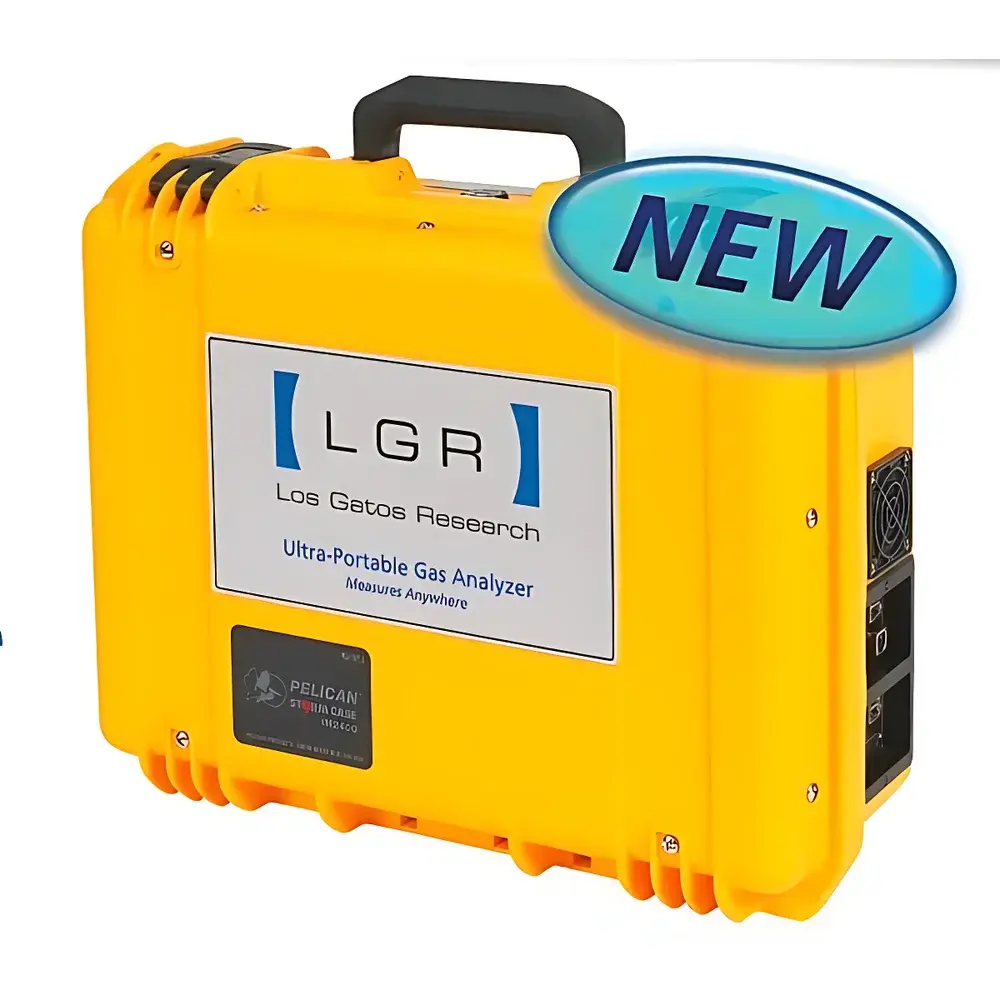
ABB LGR H2S/NH3 Portable Cavity Ring-Down Spectroscopy (CRDS) Gas Analyzer
| Brand | ABB |
|---|---|
| Origin | USA |
| Model | LGR H2S/NH3 |
| Measurement Principle | Cavity Ring-Down Spectroscopy (CRDS) |
| Detection Limits (1σ, 1 s) | NH₃: 1.5 ppb, H₂S: 30 ppb |
| Measurement Ranges | NH₃: 2–10,000 ppb (operational up to 200 ppm), H₂S: 30 ppb–50 ppm (operational up to 1,000 ppm), H₂O: 100–70,000 ppm (condensation-free) |
| Response Time | <1 s (T₉₀) |
| Power Consumption | ≤60 W |
| Weight | 15 kg |
| Power Options | AC 100–240 V or DC 12–28 V |
| Environmental Operating Range | −10 to +45 °C, 0–95% RH (non-condensing) |
| Compliance | Designed for field-deployable GLP-compliant operation |
Overview
The ABB LGR H2S/NH3 Portable Cavity Ring-Down Spectroscopy (CRDS) Gas Analyzer is a field-deployable, dual-species trace gas measurement system engineered for high-fidelity quantification of ammonia (NH₃) and hydrogen sulfide (H₂S) in ambient air, stack emissions, biogas streams, and industrial process gases. Leveraging ultra-stable near-infrared CRDS technology, the instrument achieves sub-second time resolution with parts-per-quadrillion (ppq)-level effective noise-equivalent absorption sensitivity. Unlike electrochemical or metal-oxide semiconductor sensors, CRDS provides absolute concentration measurements traceable to fundamental spectroscopic line strengths—eliminating calibration drift from sensor aging or cross-interference. The analyzer operates without consumables, zero-gas requirements, or optical alignment maintenance, making it suitable for unattended deployment in remote or hazardous locations. Its compact architecture integrates thermoelectrically stabilized laser sources, high-finesse optical cavities (>100,000 round trips), and real-time spectral fitting algorithms to resolve overlapping NH₃ and H₂S rovibrational transitions at 653.5 nm and 657.2 nm, respectively.
Key Features
- Sub-second response time (T₉₀ < 1 s) enables detection of transient plumes, fugitive emissions events, and dynamic process fluctuations.
- Dual-species simultaneous quantification with independent spectral deconvolution—no cross-sensitivity between NH₃ and H₂S under typical environmental matrices.
- Real-time, high-resolution absorption spectra displayed onboard for immediate spectral validation and interference diagnostics.
- Low-power design (≤60 W) supports extended battery operation and integration into vehicle-mounted or drone-based monitoring platforms.
- Ruggedized chassis with IP54-rated enclosure, shock-absorbing mounting interface, and wide thermal operating range (−10 to +45 °C).
- Fully field-serviceable optics and electronics—no return-to-factory requirement for routine maintenance or component replacement.
- Remote operation via secure Ethernet/Wi-Fi interface with TLS-encrypted API for integration into SCADA, EMS, or cloud-based environmental dashboards.
Sample Compatibility & Compliance
The analyzer accepts sample gas flows from 0.1 to 2.0 L/min across a broad humidity range (100–70,000 ppm H₂O, non-condensing), with built-in water vapor correction applied to dry-basis concentration reporting. It accommodates particulate-laden streams when paired with optional heated Nafion™ or stainless-steel particulate filters (not included). All firmware and data handling routines are architected to support Good Laboratory Practice (GLP) and Good Manufacturing Practice (GMP) workflows: timestamped raw spectra, metadata-rich measurement logs, user-accessible audit trails, and configurable data retention policies align with FDA 21 CFR Part 11 electronic record requirements when deployed with validated third-party data acquisition software. While not intrinsically rated for Class I Division 1 environments, the unit meets IEC 61000-6-2/6-4 immunity/emission standards for industrial electromagnetic compatibility.
Software & Data Management
Instrument control, spectral visualization, and data export are managed through ABB’s LGR Control Suite—a Windows-based application supporting real-time parameter adjustment, automated calibration sequence scheduling, and spectral library management. Raw ring-down decay curves and fitted absorbance spectra are stored in HDF5 format with embedded SI-traceable units and ISO 8601 timestamps. Export options include CSV (with configurable metadata headers), NetCDF4 (CF-1.8 compliant), and direct SQL insertion via ODBC drivers. For enterprise integration, RESTful API endpoints enable programmatic access to live concentration values, diagnostic status flags, and system health metrics—including cavity mirror reflectivity decay rate, laser wavelength stability, and pressure/temperature compensation residuals.
Applications
- Ambient air quality monitoring networks targeting agricultural NH₃ emissions and urban H₂S hotspots.
- Fugitive emission detection during LDAR (Leak Detection and Repair) surveys in refineries, chemical plants, and wastewater treatment facilities.
- Biogas upgrading process control—real-time NH₃ and H₂S monitoring upstream of amine scrubbers or membrane separation units.
- Mobile monitoring campaigns using vehicle-mounted configurations for spatial mapping of odorant dispersion plumes.
- Research applications in atmospheric chemistry, including eddy covariance flux measurements when synchronized with ultrasonic anemometers.
- Regulatory compliance verification against EPA Method TO-15 derivatives and ISO 14662 for reactive nitrogen/sulfur compounds.
FAQ
Does the analyzer require daily calibration with standard gases?
No—CRDS is an absolute spectroscopic technique. Calibration is performed once during factory acceptance testing using NIST-traceable reference cells. Field verification uses internal cavity length stabilization and water vapor cross-checks; periodic span checks (e.g., quarterly) are recommended but not mandatory for routine operation.
Can the instrument operate continuously for 30 days without intervention?
Yes—when powered by a 12 V, 100 Ah deep-cycle battery with solar charge controller, the analyzer maintains stable performance over >720 hours of unattended operation, assuming ambient temperature remains within specification and inlet filtration is maintained.
Is wet-basis reporting supported for both NH₃ and H₂S?
Yes—the system calculates and outputs both dry-mole-fraction and wet-mole-fraction concentrations in real time, applying temperature-, pressure-, and humidity-compensated spectroscopic line broadening models derived from HITRAN2020.
What is the minimum detectable concentration for H₂S in high-humidity biogas (60% RH, 40 °C)?
The effective detection limit remains ≤30 ppb (1σ, 1 s) under those conditions due to active water vapor spectral subtraction and cavity pressure normalization—verified per ASTM D6348-18 Annex A4 protocols.
Are firmware updates provided free of charge for the lifetime of the instrument?
ABB offers complimentary firmware updates for security patches and minor feature enhancements for five years post-purchase. Extended support contracts are available for long-term maintenance and regulatory update alignment (e.g., new EPA method revisions).
Related Products







