
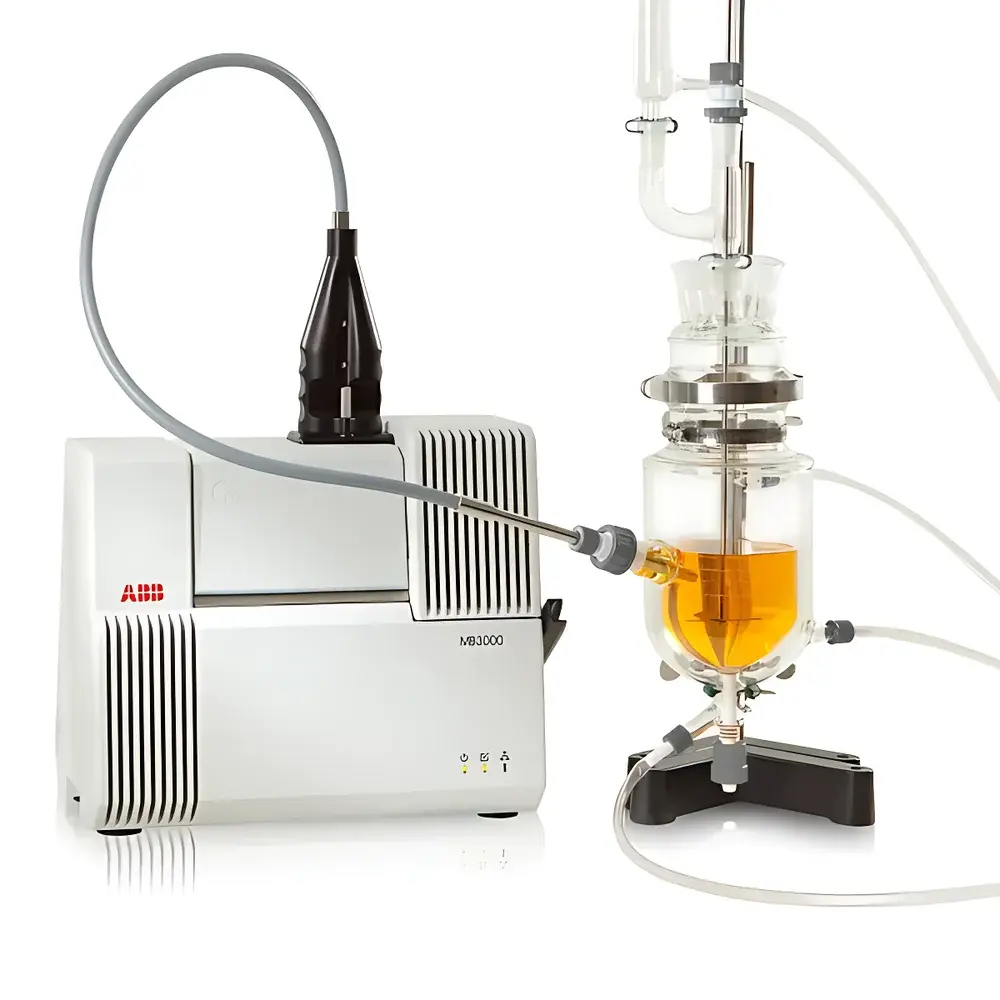
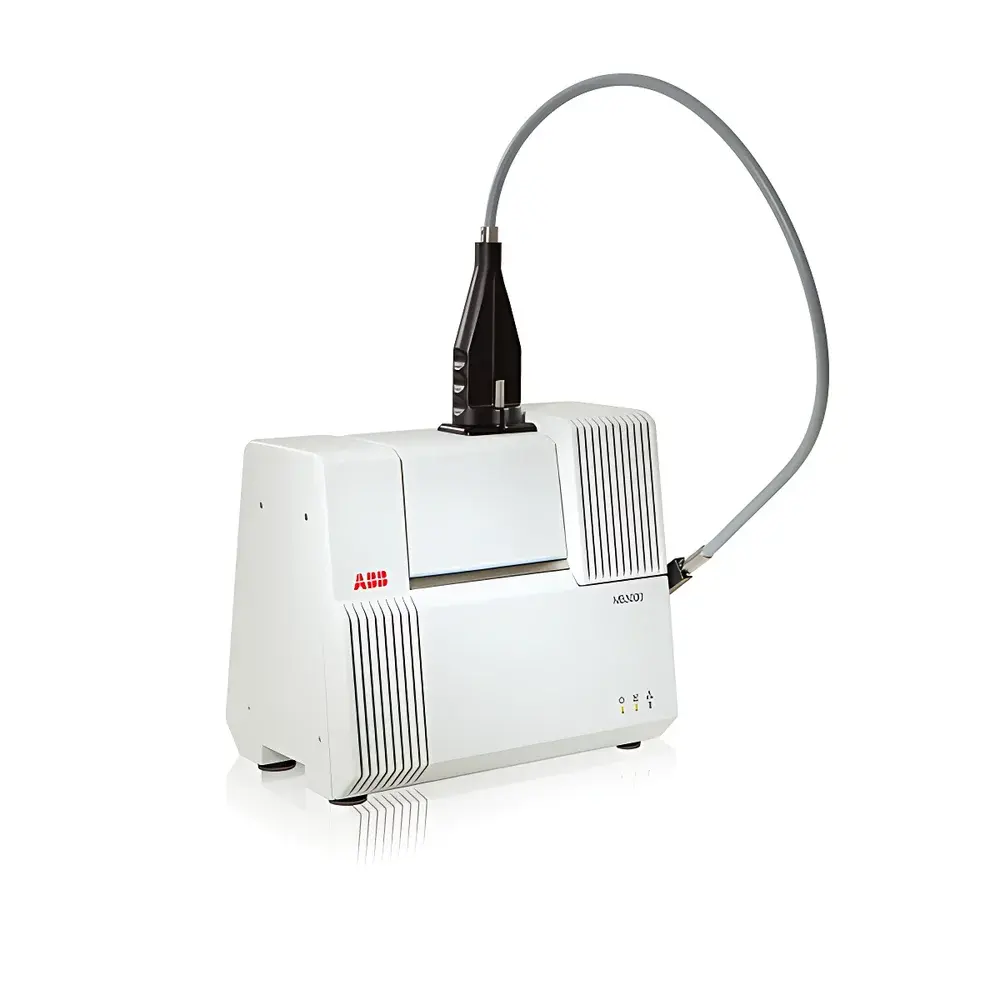
ABB MB-Rx Online Reaction Monitoring System
| Brand | ABB |
|---|---|
| Origin | Canada |
| Model | MB-Rx |
| Instrument Type | In-situ, Real-time FTIR Spectrometer |
| Spectral Range | 600–8000 cm⁻¹ (configurable by probe/fiber combination) |
| Resolution | Adjustable from 1 cm⁻¹ to 64 cm⁻¹ (in 2 cm⁻¹ increments) |
| Scan Speed | Variable, dependent on resolution and scan count |
| Signal-to-Noise Ratio | 50,000:1 (60 s acquisition, 4 cm⁻¹ resolution) |
| Detector | Uncooled Room-Temperature Pyroelectric (DTGS) |
| ATR Probe Materials | Hastelloy® C-276, ZnSe, Diamond, ZrO₂ |
| Fiber Types | Silver Halide (AgClBr), Sulfide Glass |
| Spectral Digitization | 24-bit ADC |
| Detection Limit | 0.1% w/w acetone in toluene (60 s, 4 cm⁻¹) |
Overview
The ABB MB-Rx Online Reaction Monitoring System is a purpose-built, in-situ Fourier Transform Infrared (FTIR) spectrometer engineered for real-time, non-invasive chemical reaction monitoring in R&D laboratories and pilot-scale chemical process environments. Unlike traditional offline or grab-sample analytical methods, the MB-Rx employs attenuated total reflectance (ATR) spectroscopy coupled with robust fiber-optic transmission to deliver continuous, quantitative spectral data directly from the reactor vessel—without sampling, dilution, or system interruption. Its core architecture follows the Michelson interferometer principle, ensuring high wavelength accuracy, long-term spectral stability, and compliance with fundamental metrological requirements for quantitative chemometrics. Designed for operational resilience in demanding chemical environments, the MB-Rx integrates a permanently aligned optical bench, solid-state light source (globar), and maintenance-free room-temperature detector—eliminating cryogenic cooling logistics and minimizing calibration drift over time.
Key Features
- True plug-and-play deployment: No optical purging, desiccant replacement, or detector cooldown required; operates continuously at ambient laboratory or plant-floor temperatures.
- Modular ATR probe platform: Interchangeable probe tips (ZnSe, diamond, ZrO₂) and fiber types (silver halide, sulfide glass) enable optimized spectral coverage across 600–8000 cm⁻¹, supporting diverse chemistries including C–H, O–H, N–H, C=O, C≡N, and S–H vibrational bands.
- Engineered for industrial reliability: Hastelloy® C-276 wetted probe body, armored fiber conduit with IP67-rated connectors, and die-cast aluminum housing rated for long-term exposure in Class I Div 2 hazardous locations.
- Patented signal processing algorithms: Enhance spectral sensitivity and baseline stability without compromising acquisition speed—enabling robust multivariate modeling (e.g., PLS, PCA) directly on streaming data streams.
- Self-diagnostic health monitoring: Real-time validation of interferogram quality, laser alignment status, detector response, and fiber coupling efficiency—logged with timestamped event records for GLP/GMP traceability.
Sample Compatibility & Compliance
The MB-Rx is compatible with homogeneous liquid-phase reactions, slurry systems, and viscous media under moderate pressure (<10 bar) and temperature (–10 °C to +150 °C), depending on probe configuration. It meets ISO/IEC 17025 foundational requirements for analytical instrument performance verification and supports audit-ready documentation per FDA 21 CFR Part 11 when deployed with validated software configurations. The system’s spectral fidelity and repeatability align with ASTM E1421 and ASTM E1655 standards for quantitative IR spectroscopy. All optical components are factory-aligned and sealed—no field recalibration is required, and measurement uncertainty remains within ±0.02 cm⁻¹ wavenumber accuracy over 12 months under typical operating conditions.
Software & Data Management
The MB-Rx is supplied with ABB’s ReactionAnalyzer™ software suite—a validated, Windows-based platform designed for seamless integration into existing process data infrastructure (OPC UA, Modbus TCP). The interface includes a guided experiment setup wizard, real-time spectral overlay, multi-parameter trend visualization (e.g., concentration, conversion, selectivity), and automated endpoint detection. All raw interferograms and processed spectra are stored in HDF5 format with embedded metadata (time stamp, probe ID, temperature, pressure). Offline reprocessing supports Savitzky-Golay smoothing, vector normalization, derivative transformation, and batch-wise model updating—ensuring full traceability from raw acquisition to final kinetic report. Audit trails, user access controls, and electronic signature capability comply with GxP data integrity principles.
Applications
- Reaction kinetics profiling: Quantification of reagent depletion, intermediate formation, and product accumulation in hydrogenations, esterifications, amidations, and Grignard reactions.
- Crystallization endpoint detection: Monitoring solute concentration and polymorphic transitions via characteristic band intensity shifts in the 1500–1700 cm⁻¹ region.
- Catalyst deactivation studies: Tracking surface-bound species and coke formation through time-resolved carbonyl and hydrocarbon region analysis.
- Process safety support: Early detection of exothermic runaway precursors (e.g., peroxide accumulation, nitration intermediates) via functional group surveillance.
- Technology transfer acceleration: Harmonized spectral datasets across lab, pilot, and manufacturing scales—reducing method translation risk and enabling first-time-right scale-up.
FAQ
Does the MB-Rx require periodic optical recalibration?
No. The interferometer and source are factory-aligned and hermetically sealed. Long-term wavenumber stability is maintained via internal HeNe laser referencing, eliminating routine recalibration.
Can the MB-Rx be integrated with DCS or MES systems?
Yes. Native OPC UA server functionality enables secure, bidirectional data exchange with distributed control systems, historian platforms (e.g., OSIsoft PI, AspenTech IP.21), and LIMS.
What is the expected lifetime of the light source and detector?
The globar source and DTGS detector are rated for ≥10 years of continuous operation under standard environmental conditions, with no scheduled replacement intervals.
Is method validation support available for regulated environments?
ABB provides IQ/OQ documentation templates, performance qualification protocols, and on-site validation assistance aligned with ICH Q2(R2) and USP <1058> guidelines.
How does the MB-Rx handle signal degradation from fouling or coating on the ATR crystal?
The system includes real-time spectral quality metrics (e.g., interferogram symmetry, peak sharpness) and optional auto-compensation algorithms that flag reduced transmission—triggering operator alerts or initiating cleaning cycles via integrated purge interfaces.
Related Products




