
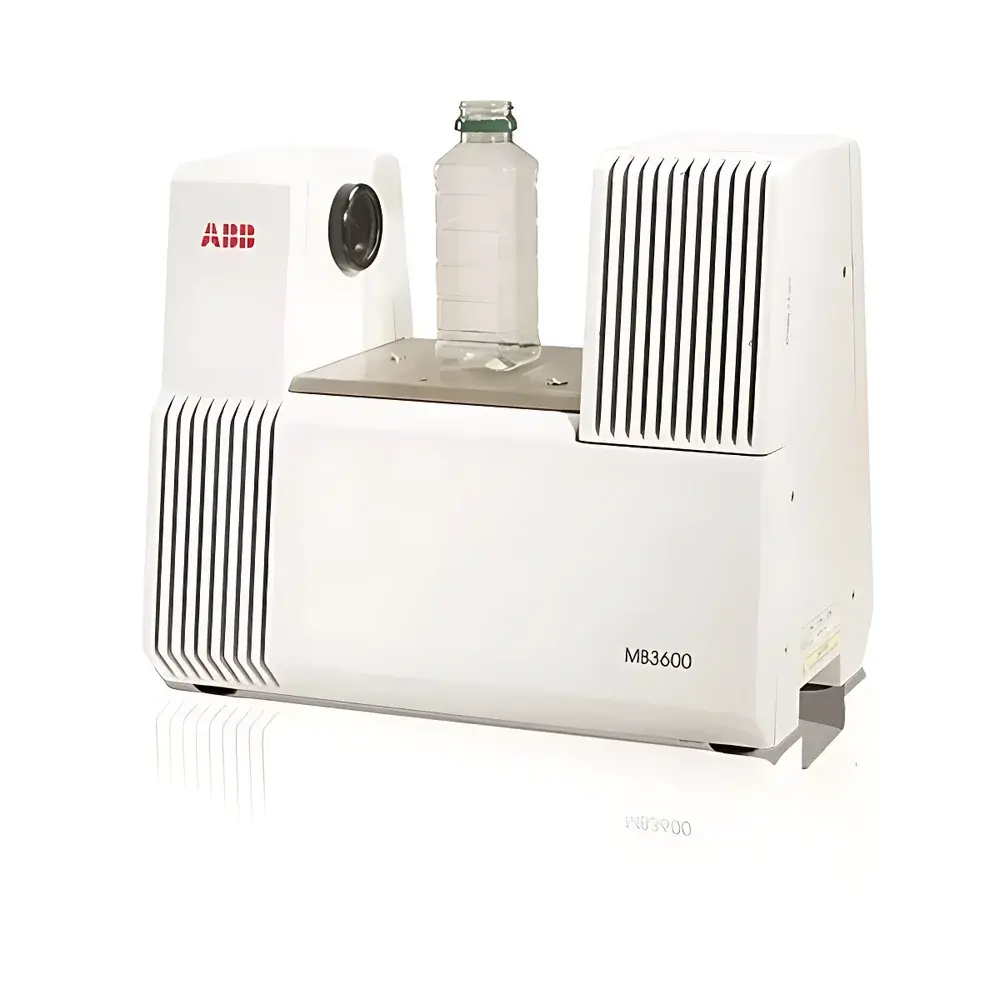
ABB MB3600-CH80 FT-NIR Spectrometer for PET Container Crystallinity Analysis
| Brand | ABB |
|---|---|
| Origin | Canada |
| Model | MB3600-CH80 |
| Instrument Type | Laboratory FT-NIR Spectrometer |
| Principle | Fourier Transform Near-Infrared (FT-NIR) |
| Wavelength Range | 3800–14000 cm⁻¹ |
| Data Sampling Interval | < 0.7 cm⁻¹ |
| Measurement Mode | Transmission |
| Chemometrics Software | Horizon MB |
| Sample Throughput | Non-destructive, sub-10-second analysis per PET container |
| Calibration Basis | Pre-installed quantitative models derived from >150 real-world PET bottle measurements |
Overview
The ABB MB3600-CH80 is a laboratory-grade Fourier Transform Near-Infrared (FT-NIR) spectrometer engineered specifically for rapid, non-invasive quantification of crystallinity in polyethylene terephthalate (PET) containers—including bottles, preforms, and jars—used extensively in beverage packaging. Unlike conventional methods such as differential scanning calorimetry (DSC) or wide-angle X-ray scattering (WAXS), which require destructive sampling, thermal conditioning, and skilled interpretation, the MB3600-CH80 leverages robust FT-NIR spectroscopy to correlate spectral absorption features in the 3800–14000 cm⁻¹ range with crystalline domain content via chemometric regression. Its optical architecture delivers high signal-to-noise ratio and long-term photometric stability, enabling reproducible measurements across shifts and operators. Designed for integration into QC/QA labs, R&D centers, and high-throughput production support environments, the instrument operates without consumables, solvents, or sample preparation—aligning with green analytical chemistry principles and reducing total cost of ownership.
Key Features
- Pre-validated, factory-loaded calibration models for PET crystallinity—built from over 150 reference measurements spanning diverse molding conditions, resin grades, and wall geometries
- Transmission-mode optical path optimized for transparent and semi-crystalline PET geometries, including full bottles and preforms
- High-resolution interferometer with data sampling interval better than 0.7 cm⁻¹, ensuring sufficient spectral fidelity for multivariate modeling of subtle C–H and C=O overtone/combination bands
- Horizon MB software suite providing intuitive workflow navigation, real-time spectral visualization, and automated model validation reports compliant with ISO/IEC 17025 documentation requirements
- Modular sampling accessories: heated disposable vials for molten PET analysis; powder transmission cells for ground resin or regrind; and custom jigs for consistent positioning of irregularly shaped containers
- Embedded audit trail functionality supporting GLP and GMP-aligned data integrity practices, including user login tracking, method versioning, and raw spectrum archiving
Sample Compatibility & Compliance
The MB3600-CH80 accommodates intact PET containers (bottles ≥ 250 mL, preforms, jars) without cutting, grinding, or solvent extraction. It also supports powdered PET flakes, granules, and molten samples using optional accessories. All measurement protocols are fully non-destructive and comply with ASTM D7459–22 (Standard Practice for NIR Spectroscopy of Plastics) and ISO 18390:2015 (Plastics — Determination of crystallinity by NIR). The system meets electromagnetic compatibility (EMC) standards per CISPR 11 and safety requirements under IEC 61010-1 for laboratory electrical equipment. Horizon MB software includes configurable electronic signatures and 21 CFR Part 11–ready audit logs for regulated environments.
Software & Data Management
Horizon MB provides a validated, menu-driven interface that guides users through calibration verification, sample acquisition, and result reporting. It supports partial least squares (PLS) and principal component regression (PCR) modeling, with built-in tools for outlier detection, residual analysis, and prediction uncertainty estimation. Raw interferograms and processed spectra are stored in vendor-neutral .spa format. Data export options include CSV, PDF reports, and direct integration with LIMS via ODBC or REST API. All processing steps—including baseline correction, multiplicative scatter correction (MSC), and derivative preprocessing—are logged and reversible, satisfying traceability requirements for ISO 17025 accreditation and internal quality audits.
Applications
- Quantitative crystallinity mapping across bottle sidewalls, bases, and neck finishes to correlate with blow-molding parameters
- Batch release testing of PET preforms prior to bottling—detecting deviations in thermal history or crystallization kinetics
- R&D screening of nucleating agents, copolymer additives, or recycled content impact on solid-state polymer structure
- Monitoring moisture-induced crystallization during storage or transport of hygroscopic PET resins
- Simultaneous prediction of secondary properties: intrinsic viscosity (IV), acetaldehyde content, hydroxyl number, acid number, density, and wall thickness distribution
- Supporting root cause analysis in line stoppages related to stress whitening, brittleness, or dimensional instability
FAQ
Can the MB3600-CH80 measure crystallinity in colored or metallized PET bottles?
Yes—provided the coating or pigment does not absorb strongly in the NIR region (e.g., carbon black limits transmission). Optional reflectance modules or fiber-optic probes may be deployed for such cases.
Is method transfer possible between different MB3600-CH80 units?
Yes—Horizon MB supports standardized calibration file export/import, and ABB’s cross-instrument normalization routines ensure inter-unit reproducibility within ±0.2% absolute crystallinity for typical PET samples.
Does the system require routine wavelength or photometric recalibration?
No—its permanently aligned Michelson interferometer and built-in HeNe laser reference eliminate drift; only annual performance verification per ASTM E1655 is recommended.
How is model accuracy validated over time?
Users can run control samples with known crystallinity values and generate trending reports for bias, precision, and RMSEP—automatically flagged if exceeding predefined statistical control limits.
Can third-party chemometrics software be used with MB3600-CH80 data?
Yes—raw interferograms and absorbance spectra are exportable in standard formats compatible with Unscrambler®, Pirouette®, or Python-based scikit-learn workflows.
Related Products





