
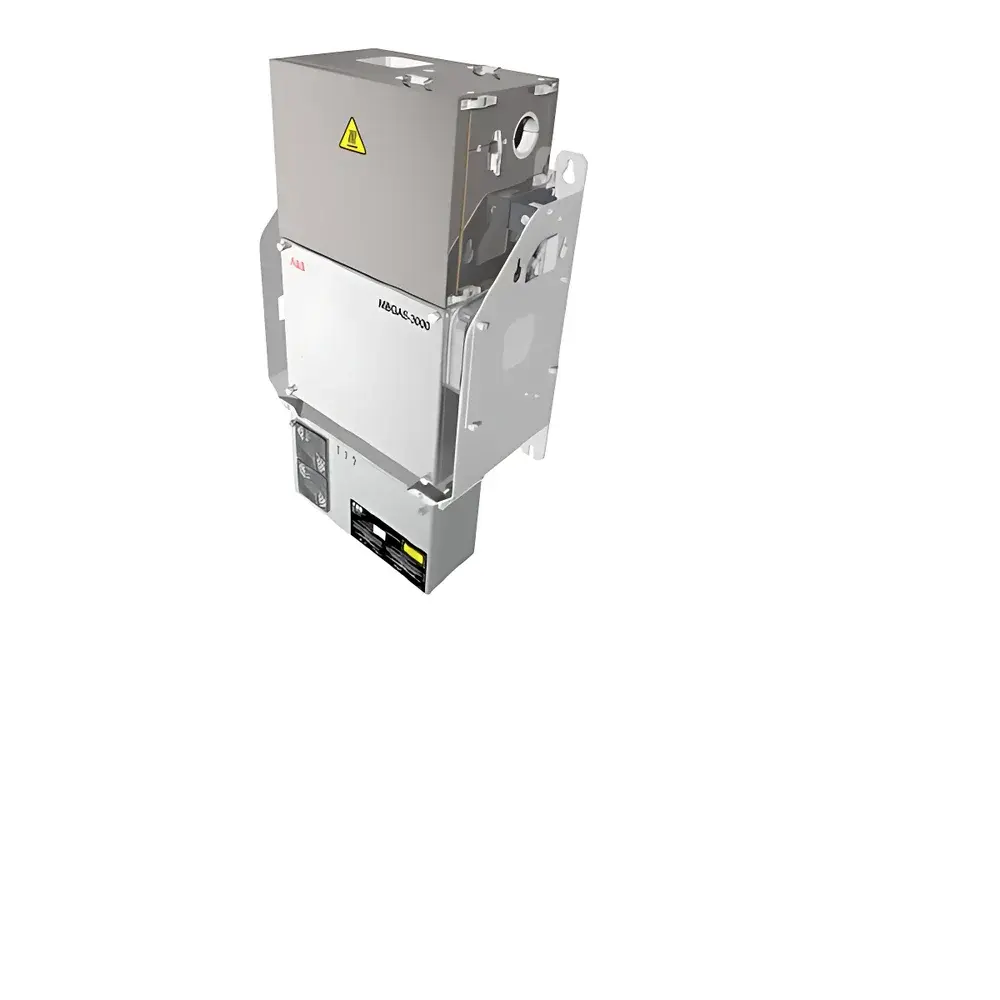
ABB MBGAS-3000 Fourier Transform Infrared (FTIR) Flue Gas Analyzer for Waste Incineration Emissions Monitoring
| Brand | ABB |
|---|---|
| Origin | Canada |
| Model | MBGAS-3000 |
| Instrument Type | Multi-component FTIR Flue Gas Analyzer |
| Measurement Principle | Fourier Transform Infrared Spectroscopy |
| Max. Simultaneous Components | 25 |
| Accuracy (Relative Error) | ≤4% FS |
| Repeatability | ≤2% RSD |
| Response Time (T90) | ≤80 s |
| Long-term Stability (7-day drift) | ≤4% FS |
| Operating Mode | Hot/Wet Sampling |
| Detection of Water-Soluble Gases | HCl, HF, NH₃, SO₂, NO, NO₂, CO, CO₂, CH₄, N₂O, etc. |
Overview
The ABB MBGAS-3000 is a high-performance, benchtop Fourier Transform Infrared (FTIR) flue gas analyzer engineered specifically for continuous, real-time monitoring of complex emission streams from municipal solid waste (MSW) and hazardous waste incineration facilities. Unlike extractive NDIR or electrochemical sensors, the MBGAS-3000 employs broadband mid-infrared absorption spectroscopy—measuring molecular vibrational transitions across 600–4000 cm⁻¹—to deliver simultaneous, quantitative analysis of up to 25 gaseous species without chemical conversion or cross-sensitivity compensation. Its optical architecture features a permanently aligned Michelson interferometer with a temperature-stabilized HeNe laser reference, ensuring wavelength accuracy traceable to NIST standards. Designed for compliance-grade operation in harsh stack environments, the system operates in hot/wet mode (typically 180–190 °C sample path temperature), preserving thermodynamic equilibrium of condensable and water-soluble analytes—including HCl, HF, NH₃, and organic acids—that would otherwise partition into liquid phase during cooled extraction. This eliminates the need for dilution, conditioning, or derivatization, thereby maintaining stoichiometric integrity of the original flue gas matrix.
Key Features
- True multi-component quantification: Simultaneous measurement of ≥25 regulated and process-relevant gases—including CO, CO₂, NO, NO₂, SO₂, N₂O, CH₄, HCl, HF, NH₃, H₂O, O₂ (via optional paramagnetic module), and volatile organic compounds (VOCs) such as formaldehyde and benzene.
- High spectral resolution: 0.5 cm⁻¹ unapodized resolution enables deconvolution of overlapping absorption bands (e.g., NO/NO₂, HCl/HF), minimizing interferences and eliminating the need for empirical correction algorithms.
- Hot/wet sampling configuration: Integrated heated sample cell (up to 190 °C) and optical windows maintain gas-phase integrity throughout analysis—critical for accurate quantification of reactive, polar, and condensable species under EN 15267-3 and EPA Method 320-compliant conditions.
- Long-term optical stability: Sealed, purged interferometer with solid-state laser reference ensures ≤4% full-scale drift over 7 days; infrared source and detector lifetimes exceed 10 years under continuous operation.
- Rugged industrial design: IP65-rated enclosure, redundant cooling fans, and corrosion-resistant 316L stainless-steel sample interface suitable for Class 1 Div 2 hazardous locations per NEC/CEC standards.
Sample Compatibility & Compliance
The MBGAS-3000 is validated for direct integration into continuous emissions monitoring systems (CEMS) compliant with EU Directive 2010/75/EU (IED), EN 14181 (QAL1–QAL3), EN 15267-3 (type approval for FTIR), and U.S. EPA Performance Specification 18 (PS-18) for FTIR-based CEMS. It meets the stringent requirements for monitoring acid gases (HCl, HF) and nitrogen/sulfur oxides under waste incineration BAT conclusions (BREF documents). The hot/wet configuration satisfies EN 13284-1 and ASTM D6348 for non-condensing measurement of moisture-sensitive analytes. All calibration protocols follow ISO/IEC 17025 principles, with traceability to NIST SRM 1971 (multi-gas standard) and certified reference materials from LGC or NPL. Data output supports 21 CFR Part 11-compliant audit trails when paired with ABB’s Symphony® Plus DCS or third-party SCADA platforms.
Software & Data Management
The analyzer operates with ABB’s proprietary MBGAS Control Suite v5.x—a Windows-based application supporting automated zero/span validation, spectral library management (customizable with >500 pure-component IR spectra), and multivariate calibration using partial least squares (PLS) regression. Real-time spectral acquisition (≥1 spectrum/sec), baseline correction, and interference modeling are performed onboard via dual-core ARM processor. Data export formats include CSV, XML, and Modbus TCP/IP; OPC UA server integration enables seamless connection to enterprise-level MES and environmental data management systems (EDMS). Audit logs record operator actions, calibration events, spectral quality metrics (SNR, RMS residual), and instrument health parameters—fully compliant with GLP/GMP documentation requirements for regulatory reporting.
Applications
- Regulatory compliance monitoring at MSW and medical waste incinerators per IED Annex VI and local air permits.
- Process optimization and combustion efficiency assessment via real-time O₂, CO, and unburnt hydrocarbon tracking.
- Acid gas abatement system control (e.g., wet scrubbers, dry sorbent injection) through closed-loop feedback on HCl, HF, and SO₂ concentrations.
- Thermal desorption and pyrolysis off-gas characterization in emerging waste-to-energy technologies.
- Research-grade speciation of dioxin/furan precursors (e.g., chlorobenzenes, chlorophenols) using high-resolution spectral deconvolution.
FAQ
Does the MBGAS-3000 require gas drying or conditioning prior to analysis?
No. The hot/wet sampling design maintains the sample in its native thermodynamic state, eliminating the need for permeation dryers, chillers, or chemical scrubbers.
Can it measure ammonia (NH₃) accurately in high-moisture flue gas?
Yes. Operating above the dew point prevents NH₃ dissolution, enabling sub-ppm detection limits (LOD ≈ 0.2 ppmv) with ≤2% RSD repeatability.
Is the system certified for use in explosion-hazardous areas?
The standard unit carries CE marking for non-hazardous zones; ATEX/IECEx-certified variants (II 2G Ex db IIB T4 Gb) are available upon request.
How often does the system require recalibration?
Typical QAL2 interval is 90 days per EN 14181; zero/span verification is automated daily or per user-defined schedule.
What spectral libraries are included out-of-the-box?
Preloaded libraries cover EPA TO-14/TO-15 compounds, EU IED priority pollutants, and ICH Q5C bioprocess gases—with options to import custom spectra from NIST or proprietary sources.







