
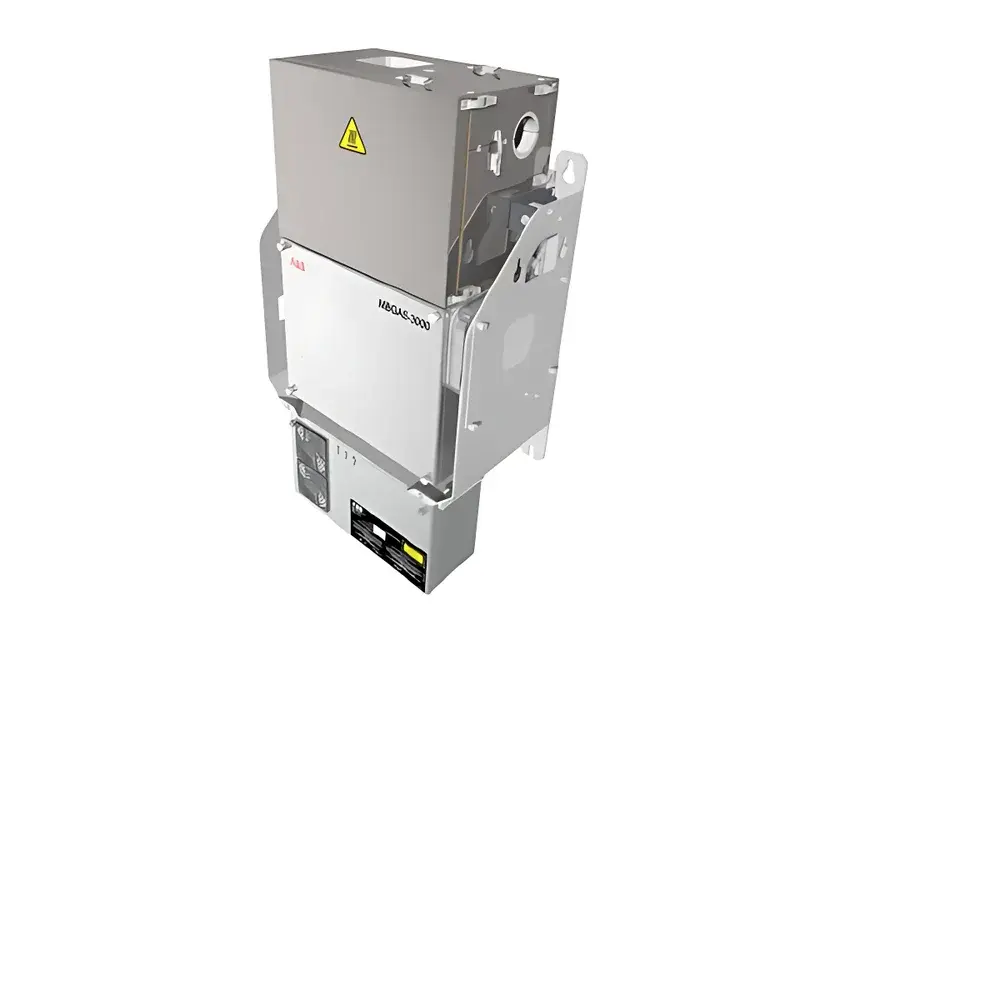
ABB MBGAS-3000 Fourier Transform Infrared (FTIR) Flue Gas Emission Analyzer for Waste Incineration Monitoring
| Brand | ABB |
|---|---|
| Origin | Canada |
| Model | MBGAS-3000 |
| Instrument Type | Multi-component FTIR Flue Gas Analyzer |
| Measurement Principle | Fourier Transform Infrared Spectroscopy |
| Max. Simultaneous Components | 25 |
| Accuracy (Linearity & Span Error) | ≤ ±3% of full scale |
| Repeatability | ≤ 2% RSD |
| Response Time (T90) | ≤ 90 s |
| Long-term Stability (7-day drift) | ≤ 3% of full scale |
| Operating Mode | Hot/Wet Sampling |
| Optical Resolution | ≤ 0.5 cm⁻¹ |
| Laser Source Lifetime | ≥ 10 years |
| Compliance | Designed for EN 15267-3, EN 14181, ISO 12039, and US EPA Methods 320 & OTM-12 |
Overview
The ABB MBGAS-3000 is a high-performance, hot/wet Fourier Transform Infrared (FTIR) flue gas emission analyzer engineered specifically for continuous compliance monitoring in waste incineration facilities. It operates on the physical principle of molecular absorption spectroscopy: infrared radiation passes through a heated, unconditioned gas stream, and the resulting interferogram is Fourier-transformed to generate quantitative spectral data across the mid-IR range (typically 600–4000 cm⁻¹). This enables simultaneous, real-time quantification of up to 25 regulated and process-relevant gaseous species—including CO, CO₂, NO, NO₂, SO₂, HCl, HF, NH₃, CH₄, N₂O, and H₂O—without chemical conversion or catalytic scrubbing. Unlike extractive systems requiring gas cooling and drying—which risk condensation loss of soluble analytes such as HCl and HF—the MBGAS-3000 maintains sample integrity by analyzing the gas stream at process temperature and humidity. Its optical architecture incorporates a stabilized He–Ne laser reference, high-finesse Michelson interferometer, and thermoelectrically cooled MCT detector, ensuring robust spectral fidelity under demanding stack environments.
Key Features
- Hot/wet measurement configuration preserves thermodynamic and chemical integrity of sample gas, eliminating artifacts from water-soluble compound loss (e.g., HCl, HF, NH₃)
- Simultaneous quantification of up to 25 gas components in a single spectral acquisition cycle, reducing cross-interference via high-resolution spectral deconvolution (≤ 0.5 cm⁻¹)
- Long-term stability supported by a >10-year lifetime laser source and drift-compensated optical alignment system
- Integrated data acquisition, spectral processing, and concentration calculation within a single embedded industrial PC platform
- Ruggedized field enclosure rated IP65, with heated optical path and purge-compatible gas handling for particulate-laden flue streams
- Calibration traceability to NIST-traceable gas standards; automated zero/span verification capability per EN 14181 QAL2 requirements
Sample Compatibility & Compliance
The MBGAS-3000 is validated for direct integration into continuous emission monitoring systems (CEMS) deployed downstream of waste incineration air pollution control devices (APCDs), including wet scrubbers, dry sorbent injectors, and fabric filters. Its hot/wet design accommodates flue gas temperatures up to 200 °C and relative humidity levels exceeding 30%, enabling representative measurement of both acidic gases and moisture-sensitive compounds. The analyzer meets the technical requirements of EN 15267-3 (performance certification for automated measuring systems), EN 14181 (quality assurance of CEMS), and ISO 12039 (determination of gaseous pollutants from waste incineration). For U.S. regulatory applications, it supports EPA Method 320 (FTIR determination of organic and inorganic emissions) and OTM-12 (field validation of FTIR CEMS). All firmware and calibration records are structured to support GLP/GMP audit trails and 21 CFR Part 11-compliant electronic signatures when deployed with optional secure software modules.
Software & Data Management
The MBGAS-3000 runs ABB’s proprietary GasVision™ software suite, which provides real-time spectral visualization, multivariate least-squares (MLS) quantitative analysis, and automated interference correction using reference libraries containing >1,200 pure-component IR spectra. Data logging occurs at user-configurable intervals (1–60 s), with raw interferograms and processed concentration time-series stored locally on an industrial SSD. Export formats include CSV, XML, and MODBUS TCP for integration with DCS/SCADA platforms. Remote diagnostics, firmware updates, and spectral library expansion are supported via secure TLS-encrypted Ethernet connection. Audit logs capture all operator actions, calibration events, and instrument status changes with timestamp and user ID—fully compliant with data integrity requirements for environmental reporting.
Applications
- Regulatory compliance monitoring of dioxin precursor gases (e.g., HCl, Cl₂, NOₓ) and greenhouse gases (CO₂, N₂O, CH₄) from municipal solid waste (MSW) and hazardous waste incinerators
- Process optimization support through real-time feedback on combustion efficiency (CO/O₂ ratio), APCD performance (HCl/SO₂ removal), and ammonia slip in SNCR/SCR systems
- Stack testing and periodic verification per EN 14181 QA/QC protocols
- Research and development of advanced thermal treatment technologies, including pyrolysis and gasification, where multi-species speciation is critical
- Transboundary emission reporting under the UNECE Convention on Long-range Transboundary Air Pollution (CLRTAP)
FAQ
Does the MBGAS-3000 require sample conditioning or dilution before analysis?
No. It is designed for direct hot/wet sampling and does not require gas cooling, drying, or dilution—preserving reactive and water-soluble species.
How is calibration maintained under fluctuating stack conditions?
Calibration is verified using automated zero/span checks with certified reference gases; long-term drift is compensated via internal reference laser stabilization and periodic spectral recalibration against built-in library baselines.
Can the system be integrated with existing plant DCS or environmental reporting portals?
Yes. Native MODBUS TCP, OPC UA, and analog 4–20 mA outputs enable seamless integration; data export supports EPA CDX, EMF, and EU IED reporting templates.
What maintenance intervals are recommended for routine operation?
Optical alignment and detector performance verification are recommended annually; laser and interferometer require no scheduled replacement for ≥10 years under normal operating conditions.
Is third-party certification available for regulatory acceptance?
Yes. The MBGAS-3000 holds TÜV-certified QAL1 approval per EN 15267-3 and has been type-approved for use in multiple EU Member State CEMS frameworks.
Related Products







