
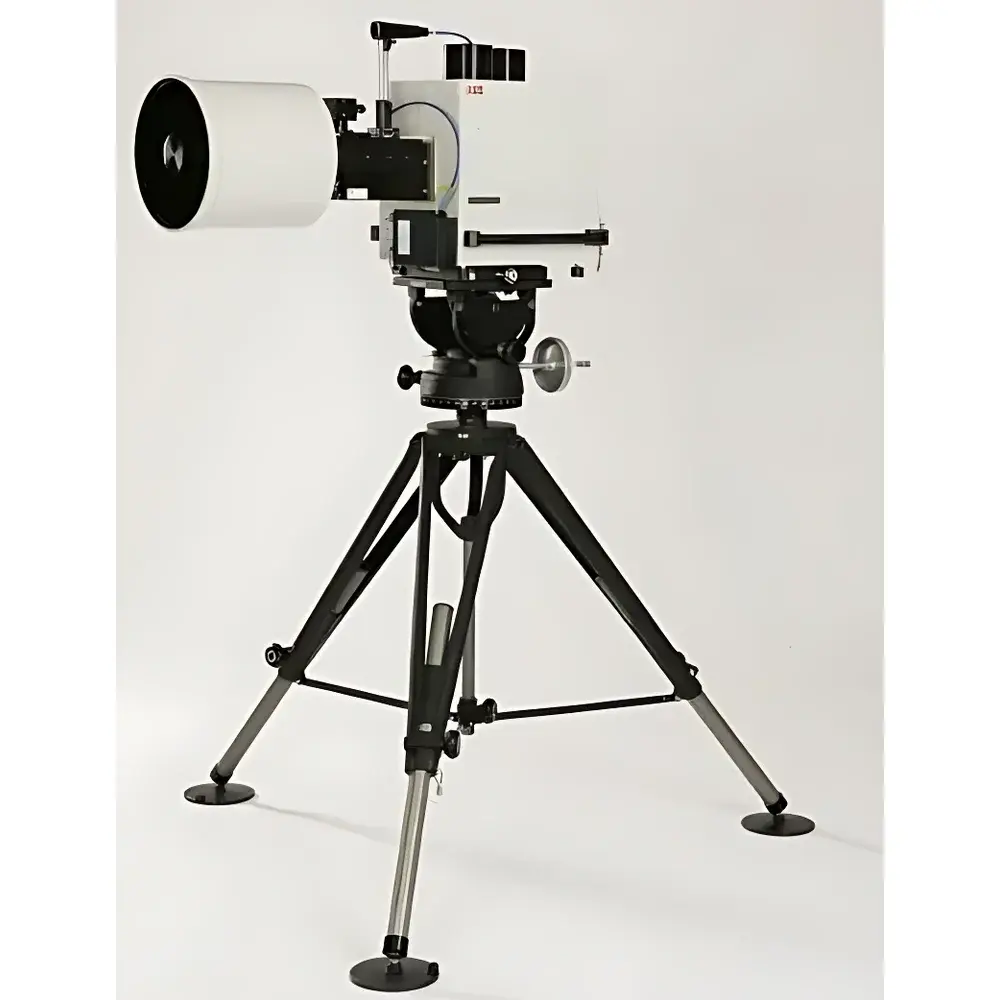
ABB MR304/170 Fourier Transform Infrared (FT-IR) Spectroradiometer
| Origin | USA |
|---|---|
| Manufacturer Type | Authorized Distributor |
| Origin Category | Imported |
| Model | MR304/170 |
| Instrument Type | Fourier Transform Infrared Spectrometer |
| Spectral Resolution | Adjustable up to 1 cm⁻¹ |
| Data Interface | 100 Mbps Ethernet |
| Scan Speed | ≥83 Hz (12 ms per interferogram) |
| Field of View Options | 5 mrad, 28 mrad, 75 mrad |
| NESR | <1.0 × 10⁻⁹ W·cm⁻²·sr⁻¹·cm |
| Compliance | ASTM E1421, ISO 18356, MIL-STD-461G (EMC), GLP/GMP-ready data audit trail |
Overview
The ABB MR304/170 Fourier Transform Infrared (FT-IR) Spectroradiometer is a high-performance, field-deployable instrument engineered for quantitative spectral radiance measurement across the mid-infrared range (typically 2–16 µm, configurable). It operates on the principle of Michelson interferometry, acquiring full-spectrum interferograms at rates exceeding 83 Hz—enabling time-resolved radiometric analysis of transient thermal emissions. Unlike filter-based or dispersive spectroradiometers, the MR304/170 captures all spectral frequencies simultaneously in each acquisition, ensuring inherent wavelength accuracy, high photometric reproducibility, and immunity to spectral misregistration. Its core optical architecture features a patented frictionless flexure-mounted “forked-bone” scanning mechanism with permanently aligned corner-cube retroreflectors, delivering exceptional mechanical stability and insensitivity to orientation or vibration—critical for airborne, mobile, or harsh-environment deployment. The system maintains consistent radiometric calibration across its entire field of view (FOV), supporting both center- and off-axis target measurements without spatial non-uniformity correction.
Key Features
- Real-time FT-IR spectroradiometry with ≤12 ms temporal resolution per spectrum, suitable for combustion dynamics, explosion characterization, and propulsion signature analysis.
- Computer-controlled spectral resolution adjustable from 0.5 cm⁻¹ to 4 cm⁻¹, optimized for trade-offs between signal-to-noise ratio and spectral detail.
- Noise-equivalent spectral radiance (NESR) <1.0 × 10⁻⁹ W·cm⁻²·sr⁻¹·cm, enabling detection of low-emissivity or distant targets under ambient background conditions.
- Modular FOV optics: interchangeable narrow (5 mrad), medium (28 mrad), and wide-field (75 mrad) configurations via SMY-series fore-optics.
- Integrated visible aiming channel and optional CCD imager for co-registered target identification and spatial referencing.
- Ruggedized, compact chassis (≤25 kg) with MIL-STD-461G-compliant electromagnetic compatibility—certified for integration into UAVs, helicopters, and ground-mobile platforms.
- Zero-maintenance interferometer with no consumables, alignment-free operation, and lifetime calibration traceability to NIST-traceable blackbody standards.
Sample Compatibility & Compliance
The MR304/170 is designed for non-contact, passive measurement of thermal infrared emission from dynamic or stationary targets—including aircraft exhaust plumes, rocket motor firings, industrial flare stacks, chemical vapor clouds, and atmospheric aerosols. It complies with ASTM E1421 (Standard Practice for Describing and Measuring Performance of FT-IR Spectrometers), ISO 18356 (Infrared spectroscopy — Vocabulary), and supports GLP/GMP audit requirements through FTSW500 software’s electronic signatures, version-controlled method files, and immutable raw-data archiving. All radiometric calibrations are performed using dual-temperature blackbody sources, and spectral linearity is verified against certified gas absorption standards (e.g., CO, N₂O, CH₄). The system meets environmental operating specifications per MIL-STD-810H for shock, vibration, temperature (-20 °C to +50 °C), and humidity (up to 95% RH, non-condensing).
Software & Data Management
Control, acquisition, and post-processing are managed via FTSW500—a Windows-based, FDA 21 CFR Part 11-compliant application. The software provides real-time interferogram visualization, automated background subtraction, atmospheric transmission modeling (using MODTRAN or HITRAN libraries), and spectral library matching (including EPA, NIST, and custom toxic gas libraries). Raw interferograms and calibrated radiance spectra are stored in HDF5 format with embedded metadata (time stamp, GPS coordinates, FOV, integration time, detector gain, calibration status). FTSW500 supports batch processing, spectral derivative computation, peak area integration, and export to CSV, MATLAB (.mat), or netCDF for third-party modeling. Audit trails record all user actions, parameter changes, and calibration events with timestamps and operator IDs.
Applications
- Military & Defense: Signature analysis of aircraft, missiles, and ground vehicles; counter-UAS infrared threat assessment; battlefield chemical agent detection.
- Environmental Monitoring: Real-time quantification of VOCs, greenhouse gases (CO₂, CH₄, N₂O), and hazardous air pollutants (e.g., HF, HCl, SO₂) during fugitive emission surveys.
- Aerospace & Propulsion: Time-resolved spectral characterization of rocket plumes, turbine exhaust, and scramjet combustion for performance validation and emissions certification.
- Industrial Safety: Mobile leak detection in petrochemical facilities, refineries, and semiconductor fabs—capable of mapping plume dispersion before human exposure thresholds are exceeded.
- Atmospheric Research: Ground-based or airborne profiling of trace gas vertical columns, cloud microphysics, and radiative forcing studies.
FAQ
What spectral range does the MR304/170 cover?
The standard configuration operates from 625 cm⁻¹ to 5000 cm⁻¹ (2–16 µm), with optional extended-range detectors available upon request.
Can the instrument operate unattended in remote locations?
Yes—it supports autonomous operation via programmable acquisition sequences, onboard storage (≥1 TB SSD), and remote control over Ethernet or LTE-enabled gateways.
Is spectral calibration traceable to international standards?
All factory calibrations are NIST-traceable; users receive calibration certificates with uncertainty budgets per ISO/IEC 17025 requirements.
How is radiometric accuracy maintained during field use?
The system performs automatic internal reference checks using a stabilized blackbody source before and after each measurement sequence.
Does ABB provide application-specific spectral libraries?
Yes—standard libraries include EPA Method TO-15 compounds, NATO chemical warfare agents, and industrial process gases; custom libraries can be developed and validated per client requirements.
Related Products






