
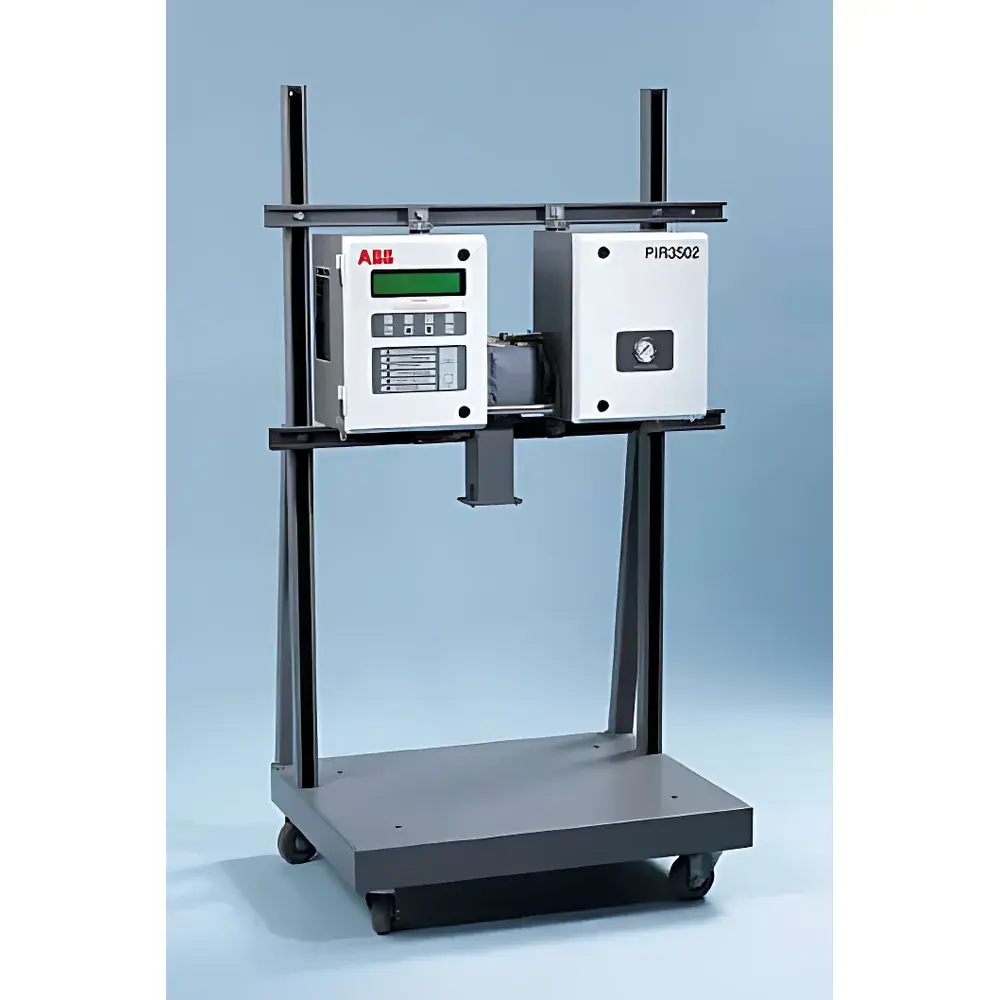
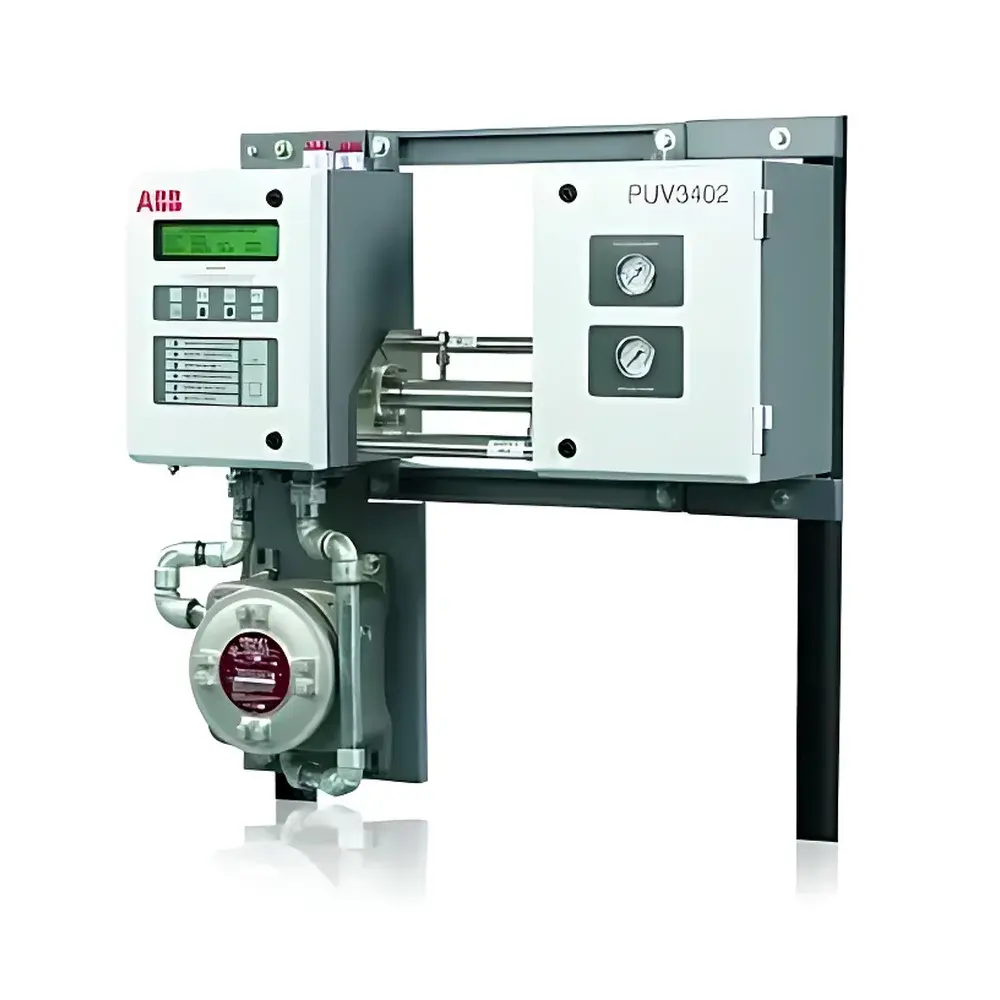
ABB PIR3502 / PFO3372 / PUV3402 Process Multiband Photometer
| Origin | USA |
|---|---|
| Manufacturer Type | Authorized Distributor |
| Origin Category | Imported |
| Models | PIR3502, PFO3372, PUV3402 |
| Operating Principle | In-situ, Online & Portable |
| Spectral Ranges | UV (190–400 nm), VIS (400–700 nm), NIR (700–2500 nm), IR (2.5–25 µm) |
| Wavelength Channels | Up to 8 discrete optical bands |
| Integration | Compatible with VN2300 Analyzer Network |
| Sampling Interface | Direct path (PIR3502/PUV3402) and fiber-optic probe (PFO3372) |
Overview
The ABB PIR3502, PFO3372, and PUV3402 series are industrial-grade process multiband photometers engineered for real-time, in-situ quantification of gas-phase and liquid-phase analytes in continuous production streams. These instruments operate on the principle of selective absorption spectroscopy—leveraging discrete-band optical filtering across ultraviolet (UV), visible (VIS), near-infrared (NIR), and mid-infrared (IR) spectral regions—to deliver stable, interference-compensated measurements under demanding plant conditions. Unlike scanning spectrometers, the fixed-filter architecture enables high-speed response (sub-second measurement cycles), minimal moving parts, and long-term calibration stability—critical attributes for unattended operation in chemical, petrochemical, pharmaceutical, and environmental monitoring applications. Each model is purpose-built: the PIR3502 targets hydrocarbons and CO₂ in IR-active ranges; the PUV3402 addresses aromatic compounds, NOₓ, SO₂, and ozone via UV-VIS absorbance; and the PFO3372 extends flexibility through fiber-optic coupling, enabling remote sensing in confined, hazardous, or thermally unstable zones.
Key Features
- Multi-wavelength photometric architecture supporting up to eight independent optical channels—enabling simultaneous detection and cross-compensation of spectral interferences (e.g., water vapor, particulates, background matrix shifts)
- In-situ optical path design with temperature-stabilized detectors and sealed, purgeable optical housings rated for Class I, Div 1 hazardous areas (ATEX/IECEx compliant configurations available)
- Modular electronics platform compatible with ABB’s VN2300 Analyzer Network—supporting HART, Modbus TCP, and OPC UA communication protocols for integration into DCS, MES, and SIS systems
- Fiber-optic sampling option (PFO3372) with sapphire or quartz probe tips, rated for pressures up to 200 bar and temperatures from −40 °C to +200 °C
- Factory-calibrated reference cells and NIST-traceable wavelength verification standards included with each unit
- Self-diagnostics including lamp intensity monitoring, detector linearity validation, and optical path integrity checks—all logged with timestamps for audit readiness
Sample Compatibility & Compliance
These photometers accommodate both gaseous and liquid process streams without sample extraction or conditioning—eliminating delays, phase separation artifacts, and maintenance associated with extractive systems. The PIR3502 supports hydrocarbon chain-length differentiation (e.g., C₁–C₅ alkanes), CO, CO₂, CH₄, and NH₃ in refinery off-gas; the PUV3402 detects ppm-level nitric oxide, sulfur dioxide, and formaldehyde in flue gas and fermentation headspace; the PFO3372 enables inline monitoring of API concentration, moisture content, and polymerization endpoints in jacketed reactors and extrusion lines. All models comply with IEC 61508 SIL 2 functional safety requirements, meet EMC Directive 2014/30/EU, and support GLP/GMP data integrity per FDA 21 CFR Part 11 when deployed with VN2300’s audit-trail-enabled firmware.
Software & Data Management
Instrument configuration, calibration management, and trend analysis are executed via ABB’s Analyzer Configuration Tool (ACT) v5.x—a Windows-based engineering suite supporting secure role-based access control (RBAC), electronic signature workflows, and automated backup to network drives. Raw absorbance values, calculated concentrations, diagnostic flags, and timestamped event logs are streamed continuously to the VN2300 central server, where they undergo statistical process control (SPC) evaluation using built-in Shewhart and CUSUM algorithms. Historical datasets export in CSV or ASTM E1382-compliant .anf format for third-party chemometric modeling (e.g., PLS regression in MATLAB or Unscrambler). Calibration certificates—including uncertainty budgets per ISO/IEC 17025—are generated automatically upon completion of field verification.
Applications
- Real-time catalyst health monitoring via CO/CO₂ ratio tracking in Fischer–Tropsch synthesis loops
- In-line quality assurance of ethanol purity in fuel-grade bioethanol distillation columns
- Leak detection and perimeter monitoring of chlorine or ammonia in water treatment facilities
- Reaction endpoint determination during batch acetylation or esterification processes
- Continuous verification of solvent composition in API crystallization vessels per ICH Q5C guidelines
- Combustion efficiency optimization via O₂/CO dual-channel feedback in fired heaters and incinerators
FAQ
Can these photometers replace traditional GC or FTIR analyzers in process control?
They serve complementary roles: while GC and FTIR provide broad-spectrum identification, these multiband photometers deliver higher measurement frequency, lower lifecycle cost, and superior ruggedness for dedicated, high-priority control loops—especially where <10 analytes require sub-second response.
What is the typical calibration interval under continuous operation?
Field validation is recommended every 3–6 months depending on process fouling potential; zero/span checks can be automated using integrated solenoid valves and certified gas standards.
Is fiber-optic transmission loss compensated in real time?
Yes—the PFO3372 firmware applies dynamic attenuation correction using reference channel normalization and factory-characterized fiber transmission curves stored in non-volatile memory.
Do the models support custom wavelength selection beyond standard configurations?
ABB offers application-specific filter sets upon request, subject to optical signal-to-noise constraints and mechanical filter wheel compatibility—validated per ISO 17025 prior to shipment.
How is traceability maintained during software updates or configuration changes?
All configuration edits, firmware upgrades, and calibration events are immutably logged with digital signatures, user IDs, and system timestamps—fully compliant with 21 CFR Part 11 Annex 11 requirements for regulated environments.




