
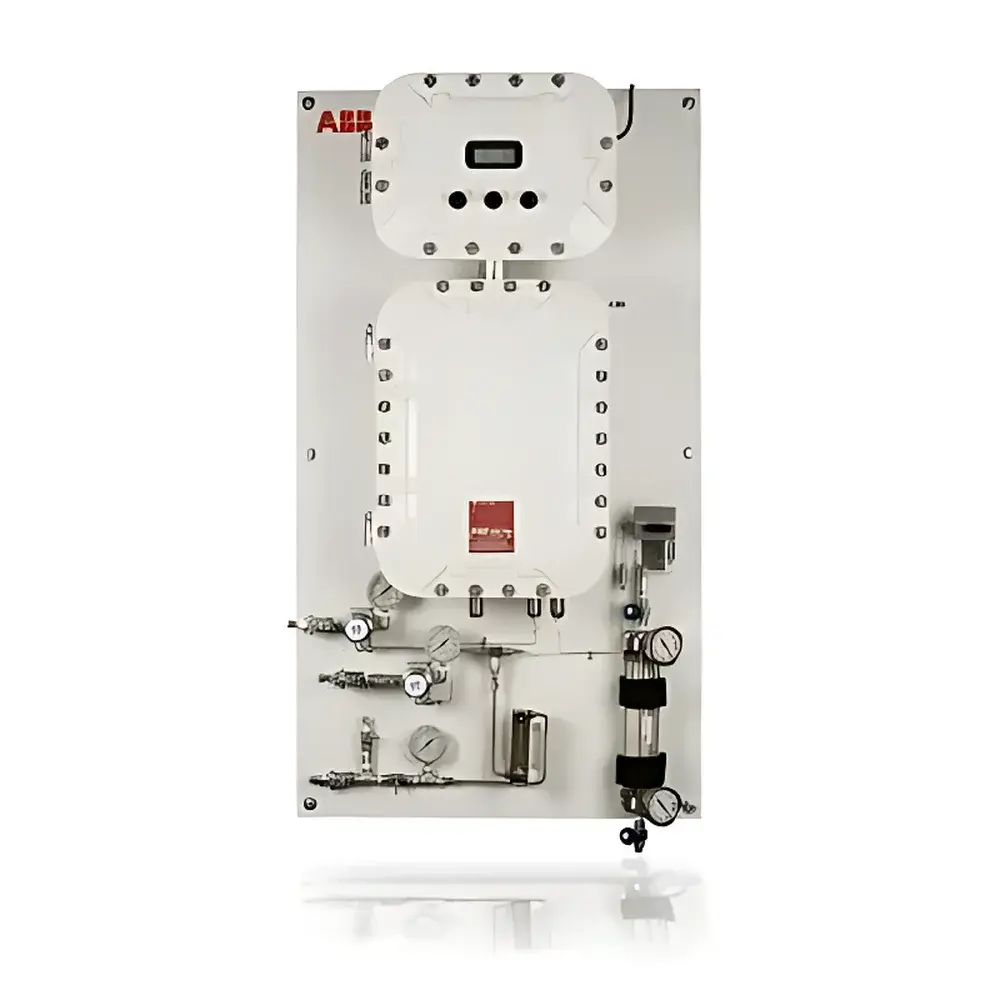
ABB RVP4500 Series Reid Vapor Pressure Analyzer
| Origin | USA |
|---|---|
| Manufacturer Type | Authorized Distributor |
| Origin Category | Imported |
| Model | RVP4500 Series |
| Pricing | Available Upon Request |
Overview
The ABB RVP4500 Series Reid Vapor Pressure (RVP) Analyzer is a fully automated, microprocessor-controlled instrument engineered for precise, regulatory-compliant determination of Reid vapor pressure in petroleum liquids—primarily gasoline, reformulated gasoline blends, naphthas, and liquefied petroleum gas (LPG). It operates on the fundamental principle defined in ASTM D323 and ASTM D5482: measurement of the absolute vapor pressure exerted by a volatile liquid–vapor mixture at 37.8 °C (100 °F) in a sealed, evacuated chamber with a fixed liquid-to-vapor volume ratio (4:1). Unlike traditional manual or semi-automated methods, the RVP4500 Series implements a single-sample chamber architecture that eliminates cross-contamination risk, minimizes operator intervention, and ensures thermodynamic equilibrium under strictly controlled temperature and pressure conditions. Its design adheres to the physical requirements of the ASTM test methods while delivering high reproducibility (<0.1 psi repeatability per ASTM D5482 Annex A1) and traceable accuracy without routine calibration—enabled by factory-certified pressure transducers and integrated thermal stabilization.
Key Features
- Single-chamber, fixed-volume sample cell architecture—reduces mechanical complexity, eliminates purge gas dependency, and supports unattended operation
- Embedded single-board computer with real-time OS for deterministic control of temperature ramping, pressure acquisition, and equilibrium validation
- Self-diagnostic verification protocol executed before and after each analysis—including pressure sensor zero-check, thermal bath stability confirmation, and chamber leak integrity assessment
- Explosion-proof construction certified to Class I, Division 1, Groups C & D per UL 60079-0 and ATEX directives—suitable for hazardous area installation in refineries and terminals
- Compact footprint (W × D × H: 45 × 50 × 35 cm) and low power consumption (<300 W)—enables deployment in mobile labs, process skids, or QC benches with space constraints
- Analytical cycle time of approximately 7.5 minutes from sample introduction to validated RVP result—optimized for high-throughput refinery and blending facility workflows
- Minimum sample requirement of only 2.5 mL—critical for low-volume or high-value samples such as pilot plant fractions or specialty fuels
Sample Compatibility & Compliance
The RVP4500 Series accommodates a broad range of hydrocarbon-based liquid fuels and intermediates, including conventional gasoline, oxygenated blends (e.g., MTBE-, ethanol-, or ETBE-containing), straight-run naphthas, and stabilized light ends. Specific variants support distinct pressure ranges: RVP4500 (0–20 psi), RVP4501 (0–90 psi), RVP4503 (0–30 psi), RVP4540 (0–225 psi for LPG/LNG), and RVP4550 (0–20 psi for air-saturated gasoline per ASTM D5482 Appendix X1). All models are validated against ASTM D323 (standard test method for vapor pressure of petroleum products—Reid method) and ASTM D5482 (test method for vapor pressure of petroleum products—mini-method). Results are accepted by U.S. EPA, CARB, and other regulatory bodies for compliance reporting under Tier 2, RFG, and summer volatility specifications. The system meets GLP data integrity requirements and supports 21 CFR Part 11–compliant audit trails when integrated with ABB’s optional EDA software suite.
Software & Data Management
The analyzer operates via embedded firmware with local touchscreen interface for method selection, sample ID entry, and real-time status monitoring. For enterprise integration, it supports Modbus TCP and OPC UA protocols for bidirectional communication with DCS, LIMS, or MES systems. Raw pressure vs. time curves, equilibrium validation logs, and diagnostic event histories are timestamped and stored internally (≥10,000 analyses). Optional ABB EDA (Enterprise Data Acquisition) software provides configurable report templates aligned with ASTM reporting conventions, electronic signature capability, user access level management, and automated backup to network drives or cloud repositories. All data exports comply with ISO/IEC 17025 documentation requirements for accredited testing laboratories.
Applications
- Real-time RVP monitoring during gasoline blending operations to maintain specification compliance (e.g., EPA 9.0 psi summer limit)
- Quality assurance of reformulated gasoline (RFG) batches prior to pipeline injection or terminal dispatch
- Process control of depropanizer and debutanizer overheads and bottoms streams in fractionation units
- Verification of vapor pressure in ethanol-blended fuels where volatility shifts due to azeotrope formation must be tightly managed
- Regulatory submission testing for ASTM D323/D5482 certification in contract laboratories serving refiners and fuel marketers
- In-line or at-line deployment for rapid turnaround in refinery QC labs handling >50 samples/day
FAQ
Does the RVP4500 Series require daily calibration?
No. The system employs factory-traceable, temperature-compensated pressure sensors and performs automatic zero and span verification during each self-diagnostic sequence. Calibration is required only annually or after sensor replacement, per ASTM D5482 Section 8.3.
Can it analyze air-saturated gasoline per ASTM D5482 Appendix X1?
Yes—the RVP4550 variant is specifically configured for air-saturated samples, with modified thermal conditioning and extended equilibration logic to meet the requirements of Appendix X1.
Is the instrument suitable for LPG analysis?
Yes—model RVP4540 (0–225 psi range) is designed for liquefied petroleum gas and other high-pressure hydrocarbon vapors, incorporating reinforced chamber materials and pressure-rated fittings compliant with ASME B31.4.
How is data integrity ensured for regulatory audits?
All measurements include embedded digital signatures, immutable timestamps, and full diagnostic metadata. When paired with EDA software, the system enforces role-based access control, electronic audit trails, and electronic record retention aligned with 21 CFR Part 11 Subpart B.
What maintenance is required beyond routine cleaning?
Annual verification of thermal bath uniformity and pressure transducer accuracy is recommended. No consumables or reagents are used; the sealed sample chamber requires only periodic inspection for residue buildup after high-boiling samples.






