
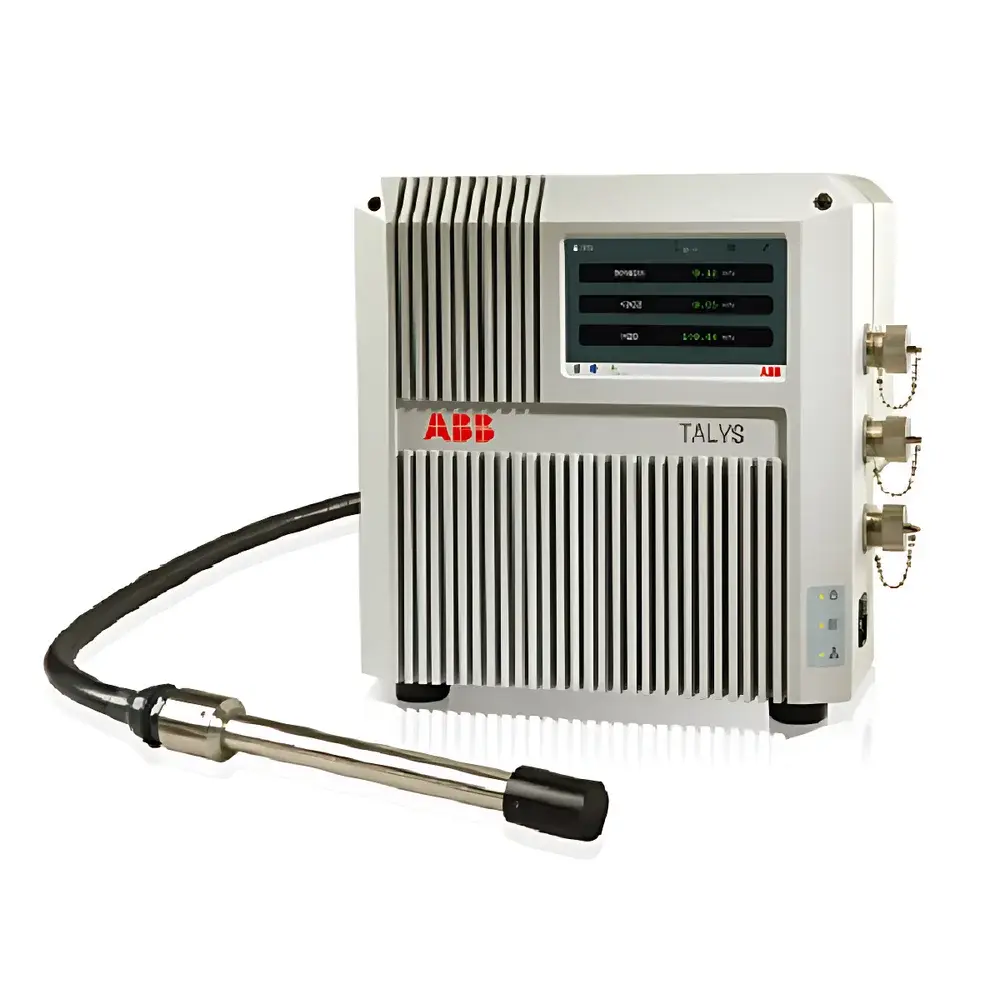
ABB TALYS ASP500-Oleochemicals Online Fourier Transform Near-Infrared Spectrometer
| Brand | ABB |
|---|---|
| Origin | Canada |
| Model | TALYS ASP500-Oleochemicals |
| Instrument Type | Online |
| Principle | Fourier Transform (FT) |
| Wavelength Range | 3800–14000 cm⁻¹ |
| Detector Options | InGaAs 2.1 (4550–10500 cm⁻¹), InGaAs 2.1 TE-cooled (4750–10500 cm⁻¹), InGaAs 2.6 (4000–10000 cm⁻¹) |
| Light Source | Quartz Halogen Lamp with Electronic Stabilization |
| Interferometer | Solid-State Laser Referenced |
| Spectral Resolution (Adjustable) | 1–64 cm⁻¹ |
| Wavenumber Reproducibility (@7300 cm⁻¹) | <0.006 cm⁻¹ |
| Wavenumber Accuracy (@7300 cm⁻¹) | <0.06 cm⁻¹ |
| Sampling Modes | Transmission, Diffuse Reflectance, Transflectance |
| Data Sampling Interval | Better than 0.7 cm⁻¹ |
| Communication Protocols | Modbus TCP (Ethernet), RS232/RS485 (via converter), OPC DA (Ethernet), CANopen (via USB-to-CAN adapter) |
| Chemometrics Software | Horizon MB, Quantify, PLSPlus, PLSIQ, Unscrambler |
Overview
The ABB TALYS ASP500-Oleochemicals is a rugged, industrial-grade online Fourier Transform Near-Infrared (FT-NIR) spectrometer engineered for continuous, real-time analysis of edible and industrial oils and fats in production environments. Based on Michelson interferometry with solid-state laser wavelength referencing, the instrument delivers high spectral fidelity and long-term stability required for unattended process monitoring. Its optical architecture—identical to that of ABB’s MB3600 series laboratory FT-NIR analyzers—ensures full model portability between lab and plant, eliminating recalibration overhead and enabling method transfer across the analytical lifecycle. Designed for integration into hydrotreating, fractionation, refining, and blending lines, the ASP500-Oleochemicals supports closed-loop process control by quantifying critical quality attributes—including iodine value (IV), trans fatty acid content (%Trans), acid value (AV), peroxide value (PV), moisture, and free fatty acids (FFA)—within one minute per measurement.
Key Features
- Identical interferometer design and manufacturing tolerances as ABB MB3600 laboratory FT-NIR systems, guaranteeing seamless chemometric model transfer between R&D, QC, and process environments.
- Pre-loaded, AOCS-validated calibration models for iodine value (Cd 1e-01) and trans fatty acid quantification—deployable without local model development or reference lab validation.
- Multi-detector compatibility: Selectable InGaAs detectors optimized for signal-to-noise performance across key oleochemical absorption bands (4000–10500 cm⁻¹).
- High wavenumber precision: <0.006 cm⁻¹ reproducibility and <0.06 cm⁻¹ accuracy at 7300 cm⁻¹, meeting ISO 12099 and ASTM E1655 requirements for NIR instrument qualification.
- Robust optical path with electronic lamp stabilization and sealed, purged interferometer housing—rated for continuous operation in ambient temperatures up to 50°C and relative humidity ≤85% non-condensing.
- Flexible sampling interface supporting flow cells (transmission), immersion probes (transflectance), and reflective sample interfaces for inline or at-line deployment.
Sample Compatibility & Compliance
The ASP500-Oleochemicals is validated for direct analysis of liquid vegetable oils—including soybean, canola, sunflower, corn, palm, peanut, and blended formulations—without dilution or pretreatment. It meets functional requirements for GMP-compliant environments when deployed with Horizon MB software configured for audit-trail logging and user access controls compliant with FDA 21 CFR Part 11. Calibration models adhere to AOCS Cd 1e-01 (iodine value) and AOCS Cd 14d-92 (trans fat) methodologies. Instrument performance verification follows ASTM E1655 (standard practice for NIR quantitative analysis) and ISO 12099 (animal and vegetable fats and oils — determination of composition by NIR spectroscopy). All factory calibrations are traceable to NIST-standard reference materials.
Software & Data Management
Horizon MB serves as the primary chemometrics platform, providing model development, validation, and deployment workflows aligned with ICH Q2(R2) guidelines. It supports partial least squares (PLS), principal component regression (PCR), and multivariate curve resolution (MCR) algorithms. The system enables secure data exchange via OPC DA for integration into DCS/SCADA systems and Modbus TCP for PLC-level communication. All measurement events—including spectra, predictions, residuals, and diagnostic flags—are timestamped and stored with full metadata (operator ID, sample ID, instrument status). Horizon MB includes built-in tools for model drift monitoring, spectral outlier detection, and automated revalidation triggers based on prediction uncertainty thresholds.
Applications
- Real-time hydrogenation endpoint detection via concurrent IV and %Trans tracking.
- In-line monitoring of palm oil fractionation (olein/stearin separation) through rapid assessment of melting point proxies and saturation profiles.
- Quality release testing of bulk oil shipments prior to dispatch—replacing off-line titration and GC-based methods.
- Blending optimization for functional oil formulations (e.g., low-trans margarines, frying stability blends) using multi-parameter predictive models.
- Early detection of oxidative degradation (via PV and FFA trends) in storage tanks and filling lines.
- Support for regulatory compliance reporting under EU Regulation (EC) No 1924/2006 (nutrition labeling) and FDA trans fat disclosure mandates.
FAQ
Is the ASP500-Oleochemicals suitable for hazardous area installation?
Yes—when equipped with optional ATEX/IECEx-certified enclosures (Zone 1/21, II 2G/2D), the system complies with EN 60079-0 and EN 60079-10-1 for flammable vapor and dust environments.
Can existing lab-developed PLS models be deployed directly on the ASP500?
Yes—provided the lab instrument is an ABB MB3600-series FT-NIR and models were developed using Horizon MB, no spectral resampling or retraining is required.
What maintenance intervals are recommended for uninterrupted operation?
Optical alignment is factory-set and does not require field adjustment; detector and source lifetime exceed 24 months under continuous use. Annual performance verification using NIST-traceable standards is recommended per ISO/IEC 17025 internal audit requirements.
Does the system support remote diagnostics and firmware updates?
Yes—via secure HTTPS-enabled web interface and SSH-accessible command line; all updates are digitally signed and version-locked to ensure integrity and regulatory compliance.
How is measurement uncertainty quantified for regulatory submissions?
Horizon MB reports standard error of prediction (SEP), bias, and RMSEP per analyte, alongside confidence intervals derived from bootstrap resampling—fully exportable for inclusion in CMC documentation or FDA IND/NDA filings.
Related Products




