
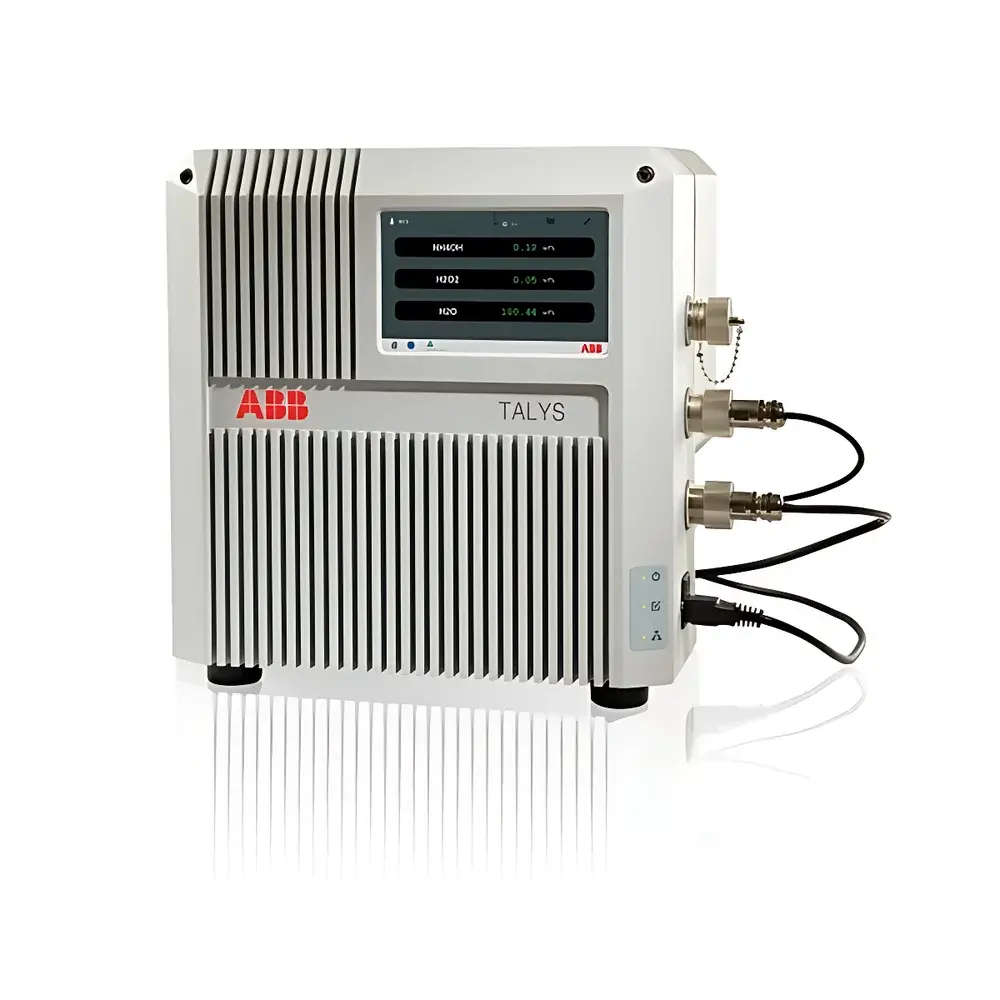
ABB TALYS ASP500-OH Online Hydroxyl Value Analyzer
| Brand | ABB |
|---|---|
| Origin | Canada |
| Model | TALYS ASP500-OH |
| Instrument Type | Online |
| Principle | Fourier Transform Near-Infrared (FT-NIR) Spectroscopy |
| Wavelength Range | 3800–14000 cm⁻¹ |
| Detector Options | InGaAs 2.1 (4550–10500 cm⁻¹), InGaAs 2.1 TE-cooled (4750–10500 cm⁻¹), InGaAs 2.6 (4000–10000 cm⁻¹) |
| Light Source | Quartz Halogen Lamp with Electronic Stabilization |
| Laser Reference | Solid-State Laser |
| Spectral Resolution (Adjustable) | 1–64 cm⁻¹ |
| Wavenumber Reproducibility (@7300 cm⁻¹) | <0.006 cm⁻¹ |
| Wavenumber Accuracy (@7300 cm⁻¹) | <0.06 cm⁻¹ |
| Sampling Modes | Transmission, Diffuse Reflectance, Transflectance |
| Data Sampling Interval | Better than 0.7 cm⁻¹ |
| Software Suite | Horizon MB, Quantify, PLSPlus, PLS-IQ, Unscrambler |
| Communication Protocols | Modbus TCP (Ethernet), RS232/RS485 (via converter), OPC DA (Ethernet), CANopen (via USB-to-CAN adapter) |
Overview
The ABB TALYS ASP500-OH Online Hydroxyl Value Analyzer is a high-precision, process-integrated Fourier Transform Near-Infrared (FT-NIR) spectrometer engineered for real-time quantification of hydroxyl value (OHV) and related functional group concentrations in continuous chemical manufacturing streams. Leveraging the physical principle of molecular vibrational absorption in the NIR region (3800–14000 cm⁻¹), the analyzer detects overtone and combination bands of O–H, C–H, N–H, and C=O bonds—enabling direct, non-destructive measurement without reagents or sample preparation. Its optical architecture is identical to that of ABB’s MB3600-series laboratory FT-NIR systems, ensuring spectral fidelity, photometric linearity, and long-term stability across both lab and plant environments. Designed for integration into hazardous-area process lines (ATEX/IECEx-compliant enclosures available), the ASP500-OH delivers sub-minute analytical cycles with robust signal-to-noise performance under varying temperature, pressure, and flow conditions typical of polyol synthesis, urethane pre-polymerization, and surfactant production.
Key Features
- Identical interferometer design to ABB MB3600 laboratory platforms—guaranteeing spectral equivalence and model transferability between R&D, QC labs, and production lines.
- Multiple detector configurations (InGaAs 2.1, TE-cooled InGaAs 2.1, InGaAs 2.6) optimized for specific wavenumber coverage and signal stability in industrial settings.
- Adjustable spectral resolution (1–64 cm⁻¹) balancing measurement speed, sensitivity, and chemometric model robustness for diverse matrix types.
- High wavenumber reproducibility (<0.006 cm⁻¹ @7300 cm⁻¹) and accuracy (<0.06 cm⁻¹ @7300 cm⁻¹), critical for maintaining calibration integrity over extended deployment periods.
- Integrated solid-state laser reference for real-time interferometer alignment—eliminating mechanical drift and enabling unattended operation for >12 months between maintenance cycles.
- Modular communication interface supporting Modbus TCP (native Ethernet), OPC DA, RS232/RS485 (via industrial converters), and CANopen—ensuring seamless integration with DCS, MES, and APC systems.
Sample Compatibility & Compliance
The ASP500-OH is validated for inline analysis of liquid and semi-viscous streams including polyester and polyether polyols, ethylene/propylene oxide adducts, fatty alcohols, glycols (e.g., ethylene glycol, diethylene glycol), pentaerythritol, and isocyanate-reactive intermediates. It operates under ASTM E1655-22 (Standard Practices for Infrared Multivariate Quantitative Analysis) and ISO 12099:2017 (Animal feeding stuffs, cereals and milled cereal products — Guidelines on the application of near infrared spectroscopy). The system supports full audit trail functionality compliant with FDA 21 CFR Part 11 when deployed with Horizon MB software in GMP-regulated environments. All optical path materials meet USP Class VI biocompatibility requirements; wetted components are constructed from 316L stainless steel and sapphire windows rated for pressures up to 20 bar and temperatures up to 150 °C.
Software & Data Management
Horizon MB serves as the primary chemometric platform, providing model development, validation, and deployment workflows aligned with ICH Q5E and ASTM E2750-21 guidelines. Pre-built quantitative models for hydroxyl value, acid number, iodine value, amine value, saponification number, peroxide value, moisture content, isocyanate concentration, and cis/trans ratio are included—each developed using representative production-grade calibration sets spanning multiple batches and raw material lots. The software enforces strict version control, change history logging, and user role-based access (admin, operator, analyst). Raw interferograms and absorbance spectra are stored in HDF5 format with embedded metadata (timestamp, process tags, instrument ID, environmental sensor readings). Export options include CSV, XML, and OPC UA-compatible structured data for LIMS and digital twin synchronization.
Applications
- Real-time monitoring of hydroxyl number during polyol chain extension—enabling closed-loop adjustment of EO/PO feed ratios to maintain target functionality.
- In-line verification of batch homogeneity prior to reactor discharge in alkyd resin and polyester synthesis.
- Quality gate enforcement at raw material receipt for fatty alcohols and glycerol derivatives—replacing off-line titration with sub-30-second pass/fail decisions.
- Reaction endpoint detection in ethoxylation processes by tracking OH-group consumption kinetics.
- Supporting PAT (Process Analytical Technology) initiatives per FDA Guidance for Industry (2004), facilitating continuous manufacturing compliance for pharmaceutical excipients and specialty polymers.
- Model migration from laboratory MB3600 instruments to ASP500-OH units—validated per ASTM E2777-21 (Standard Practice for Transfer of Calibration Models Between NIR Instruments).
FAQ
Can calibration models developed on an ABB MB3600 laboratory spectrometer be directly deployed on the ASP500-OH without revalidation?
Yes—provided identical optical pathlength, detector type, and resolution settings are used. ABB’s common interferometer design and traceable wavelength calibration enable direct model transfer; final verification per ASTM E2777-21 is recommended for regulated applications.
What sampling interfaces are supported for viscous polyol streams?
The system integrates with heated flow cells (up to 80 °C), immersion probes with sapphire windows, and bypass loop configurations featuring self-cleaning ultrasonic agitation—preventing fouling in high-molecular-weight polyol matrices.
Is the ASP500-OH suitable for use in Zone 1 hazardous areas?
Yes—when housed in ABB-certified Ex d/Ex e explosion-proof enclosures (IEC 60079-1 / -5) or fiber-optic coupled remote configurations, it meets ATEX Category 2G and IECEx requirements for flammable vapor environments.
How frequently must the instrument undergo wavelength calibration verification?
Under normal operating conditions, annual verification using NIST-traceable polystyrene film standards is sufficient; automated internal laser referencing ensures daily stability without manual intervention.
Does Horizon MB support multivariate statistical process control (MSPC)?
Yes—integrated Hotelling’s T² and Q-residual charts enable real-time detection of spectral outliers linked to feedstock variability, catalyst deactivation, or equipment drift, supporting proactive process intervention.



