
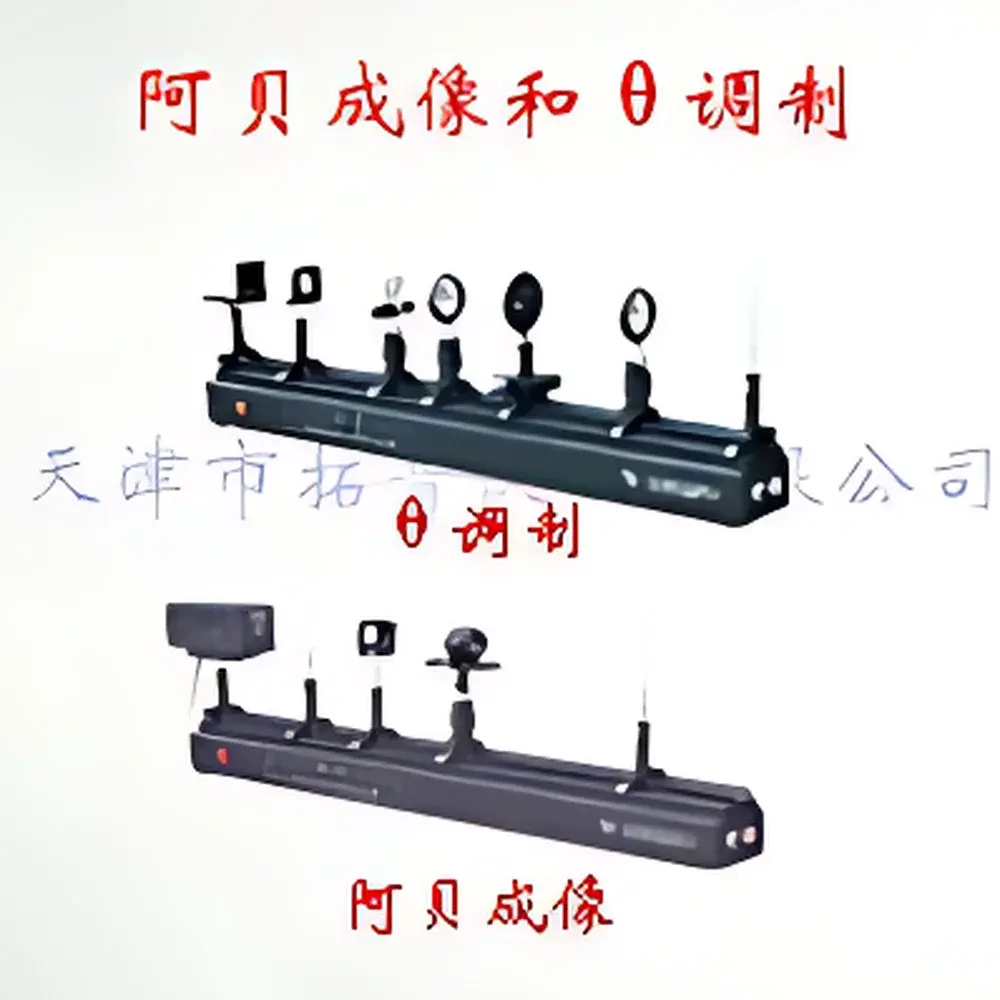
Abbe Imaging and Theta Modulation Experimental System TP WSY-5
| Brand | TP |
|---|---|
| Origin | Tianjin, China |
| Manufacturer Type | Manufacturer |
| Origin Category | Domestic |
| Model | WSY-5 |
| Pricing | Upon Request |
Overview
The TP WSY-5 Abbe Imaging and Theta Modulation Experimental System is a precision optical bench-based teaching and research platform engineered for fundamental instruction and experimental verification of coherent optical information processing principles. It implements classical Fourier optics concepts—including Abbe’s two-step imaging theory, spatial frequency filtering, and angular (θ) modulation—using a collimated He–Ne laser source and high-quality Fourier-transforming lenses. The system operates on the principle that object-plane spatial frequencies are mapped onto the back focal plane (Fourier plane) of a lens, where selective spectral manipulation—via amplitude or phase filters—enables real-time image reconstruction with controlled contrast, edge enhancement, or pseudocolor synthesis. Designed explicitly for university-level physics and optical engineering laboratories, the WSY-5 provides deterministic, repeatable conditions for observing diffraction-limited imaging, band-limited spectrum truncation, and the geometric interpretation of θ-modulated interference patterns.
Key Features
- Modular optical bench architecture with calibrated linear rail (standard 1200 mm length) supporting precise axial alignment and reproducible component positioning
- Integrated He–Ne laser (632.8 nm, TEM00, power stability ±2% over 4 hours) serving as coherent illumination source
- Dual-function Fourier lens set (f = 150 mm and f = 200 mm) optimized for minimal spherical aberration and uniform PSF across ±15° field angle
- Dedicated theta modulation plate with precisely engraved angular grating (periodicity: 0.5° increments, groove depth λ/4 at 632.8 nm) enabling controlled phase-shifted interference in the Fourier domain
- Adjustable single-slit aperture (0.05–2.0 mm width, micrometer-driven) for controlled spatial coherence tuning and bandwidth limitation
- Interchangeable spatial filters—including low-pass, high-pass, and band-stop configurations—mounted on standardized filter holders compatible with ISO 25mm threading
- White-light source (3000 K CCT, CRI >90) included for comparative incoherent imaging analysis and chromatic response evaluation
Sample Compatibility & Compliance
The WSY-5 accommodates standard optical test targets including USAF 1951 resolution charts, Ronchi rulings (20–100 lp/mm), and custom-transparency masks (up to 50 × 50 mm active area). All mechanical components conform to ISO 8015 geometric tolerancing standards; optical surfaces meet MIL-PRF-13830B scratch-dig specifications (60–40). The system supports pedagogical alignment with national undergraduate physics curricula and aligns with ASTM E284-22 (Standard Terminology of Appearance) for qualitative image fidelity assessment. While not certified for industrial metrology, its design enables traceable validation against NIST-traceable interferometric references when used with calibrated CCD detectors.
Software & Data Management
The WSY-5 is a hardware-only platform with no embedded firmware or proprietary software. It is fully compatible with third-party acquisition tools including Thorlabs DCx series cameras, MATLAB Image Processing Toolbox, and Python-based OpenCV pipelines for quantitative analysis of filtered intensity distributions, MTF measurement, and θ-modulation fringe contrast calculation. All optical components feature engraved serial identifiers and standardized mounting interfaces (M4 and M6 threaded holes), facilitating integration into GLP-compliant lab notebooks and audit-ready experimental logs. Data export follows FAIR principles (Findable, Accessible, Interoperable, Reusable) when paired with metadata-tagged TIFF or HDF5 image stacks.
Applications
- Undergraduate laboratory instruction in Fourier optics, physical optics, and optical signal processing
- Verification of Abbe’s criterion for resolution limits in coherent imaging systems
- Spatial filtering experiments: low-pass smoothing, high-pass edge detection, and band-rejection artifact suppression
- Theta modulation demonstrations: angular multiplexing, pseudocolor encoding via rotating diffraction orders, and wavelength-independent phase encoding
- Research into optical encryption using structured Fourier-plane masks
- Calibration reference for computational imaging algorithms requiring ground-truth spatial frequency response data
FAQ
Is the WSY-5 compatible with digital camera sensors for quantitative intensity profiling?
Yes—standard C-mount or SM1-threaded scientific cameras (e.g., IDS uEye, FLIR Blackfly S) can be mounted at the image plane using optional adapter kits.
Can the theta modulation plate be replaced with user-fabricated gratings?
Yes—the plate mounts via kinematic dowel pins and M3 screws; custom plates with alternate angular periods or binary phase profiles may be substituted without optical realignment.
Does the system support white-light spatial filtering experiments?
Yes—the included broadband white source and achromatic Fourier lens pair enable comparative studies of chromatic dispersion effects in spectral filtering.
What safety certifications does the He–Ne laser module meet?
The integrated laser complies with IEC 60825-1:2014 Class IIIB requirements and includes key-controlled emission interlock and beam shutter.
Is technical documentation available in English with SI-unit traceability?
Yes—full English-language user manual, alignment procedure guide, and uncertainty budget templates (aligned with GUM Supplement 1) are provided upon purchase.



