
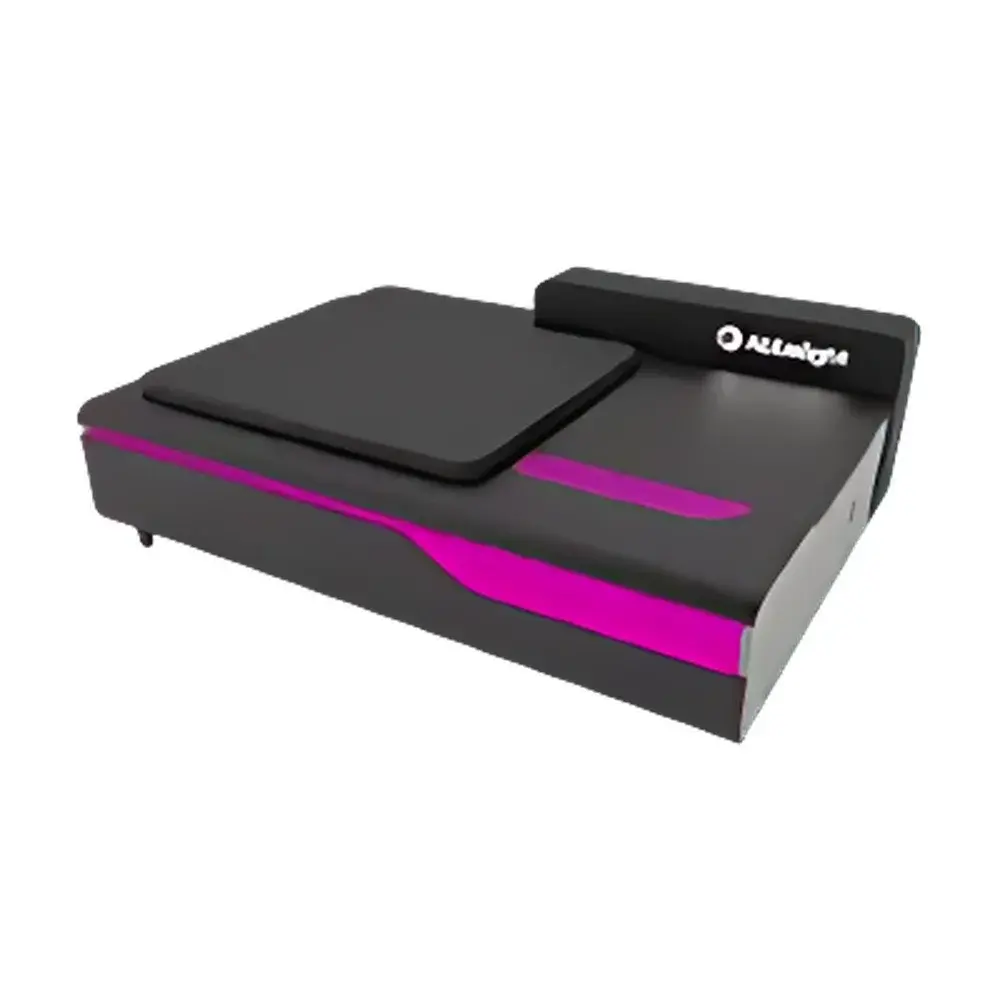
Abbelight SAFe M90 Total Internal Reflection Microscopy (TIRF) Imaging System
| Brand | Abbelight |
|---|---|
| Origin | France |
| Model | SAFe M90 |
| Scan Field of View | 150 µm × 150 µm (with 100× objective) |
| Imaging Speed | up to 330 fps at 512 × 512 pixels |
| Objectives Supported | 60×, 100× |
| Multicolor Capability | Simultaneous 4-channel imaging |
| TIRF Angle Calibration Accuracy | <1.2% error |
| Illumination Modes | TIRF / HILO / Epi (software-switchable) |
| Depth Imaging | Z-stack compatible |
| Dichroic Stability | Precision-engineered cubes for long-term chromatic alignment |
Overview
The Abbelight SAFe M90 is a high-performance, fully automated Total Internal Reflection Microscopy (TIRF) imaging system engineered for quantitative, large-field-of-view super-resolution applications in live-cell and single-molecule biology. Unlike conventional TIRF platforms constrained by narrow evanescent field uniformity and manual angle alignment, the SAFe M90 integrates Abbelight’s proprietary ASTER (Adaptive Scanning TIRF with Enhanced Reproducibility) optical architecture—a patented scanning illumination strategy that ensures homogeneous evanescent excitation across the entire field without compromising axial resolution or signal-to-noise ratio. The system operates on the fundamental principle of total internal reflection at the glass–water interface, generating an exponentially decaying evanescent wave (~100–200 nm penetration depth) ideal for selective visualization of plasma membrane-associated proteins, vesicle docking/fusion events, cytoskeletal dynamics, and receptor trafficking. Designed as a modular add-on for standard inverted microscopes, the SAFe M90 maintains full compatibility with commercial XYZ motorized stages, piezo Z-drives, and third-party objective lenses—including high-NA 60× and 100× oil-immersion objectives—enabling seamless integration into existing microscopy workflows.
Key Features
- ASTER-enabled uniform TIRF illumination: Delivers consistent evanescent field intensity over 150 µm × 150 µm (100×) or 250 µm × 250 µm (60×), eliminating edge falloff and enabling quantitative intensity comparisons across the full FOV.
- Automated, software-driven TIRF angle calibration: Uses reference bead samples and real-time feedback to define optimal incidence angles with <1.2% angular deviation; eliminates manual prism adjustment and inter-user variability.
- Multi-modal illumination switching: One-click transition between TIRF, Highly Inclined and Laminated Optical sheet (HILO), and widefield epi-fluorescence modes—each optimized for distinct biological contexts (e.g., surface-restricted vs. volumetric sampling).
- Simultaneous 4-color imaging: Leverages spatially segmented sCMOS sensor readout and custom dichroic cube sets to acquire four spectrally distinct channels without temporal interleaving or mechanical filter wheel latency.
- High-speed acquisition: Sustains 330 frames per second at full 512 × 512 pixel resolution—sufficient for tracking rapid subcellular events such as synaptic vesicle exocytosis or actin polymerization bursts.
- Z-stack compatibility: Supports precise, drift-corrected optical sectioning via synchronized stage/piezo control, enabling reconstruction of membrane-proximal structures in 3D with sub-200 nm axial confinement.
Sample Compatibility & Compliance
The SAFe M90 is validated for use with standard glass-bottom dishes (e.g., MatTek P35G-1.5-14-C), coverslip-mounted primary neurons, adherent mammalian cell lines (HeLa, U2OS, COS-7), and reconstituted lipid bilayer systems. Its optical design conforms to ISO 19012-1:2021 (microscope metrology) and supports GLP-compliant documentation through timestamped metadata embedding (exposure time, laser power, TIRF angle, objective ID). While not FDA-cleared for diagnostic use, the system meets essential requirements for research-grade instrumentation under IEC 61000-6-3 (EMC) and IEC 60825-1 (laser safety Class 1 when interlocked). All dichroic components are certified for >10,000-hour operational stability under continuous 405/488/561/640 nm illumination, minimizing chromatic shift during long-term timelapse experiments.
Software & Data Management
Control and analysis are unified within Abbelight’s open-architecture SPIM Studio software suite (v4.2+), which provides Python API access, HDF5-native data export, and built-in support for FIJI/ImageJ macro scripting. Acquisition parameters—including laser power ramping, ROI-based region-of-interest readout, and hardware-synchronized external triggers—are stored in human-readable JSON sidecar files compliant with the OME-NGFF specification. Audit trails record all TIRF angle adjustments, objective changes, and illumination mode switches with user ID and UTC timestamps—facilitating 21 CFR Part 11–aligned validation in regulated environments. Raw datasets retain full bit-depth fidelity (16-bit) and support batch processing for single-particle tracking (SPT), colocalization analysis (Manders’ coefficients), and kinetic modeling (e.g., dwell-time histograms for receptor binding).
Applications
- Single-molecule localization microscopy (SMLM) preparation: Provides uniform background suppression for dSTORM/PALM sample conditioning and acquisition.
- Membrane trafficking assays: Quantifies fusion pore kinetics during SNARE-mediated exocytosis using pH-sensitive fluorophores (e.g., synaptopHluorin).
- Cell–cell communication studies: Resolves nanoscale gap junction plaque assembly and connexin43 clustering dynamics in co-cultured epithelial models.
- Cytoskeleton–membrane coupling: Visualizes transient anchoring of actin nodes to PIP2-rich microdomains via dual-color TIRF–HILO correlation.
- Viral entry mechanisms: Tracks individual influenza A virions during clathrin-independent endocytosis with sub-100 ms temporal resolution.
FAQ
Is the SAFe M90 compatible with non-Abbelight microscope stands?
Yes—the system mounts via standard C-mount or Nikon Eclipse port interfaces and supports trigger synchronization with third-party cameras and stages via TTL/USB protocols.
Does ASTER require specialized optics or alignment tools?
No—ASTER operation is fully automated; no user-performed mirror alignment or prism tuning is necessary. Calibration is performed in <60 seconds using a standard 100 nm fluorescent bead slide.
Can Z-stacks be acquired while maintaining TIRF illumination uniformity?
Yes—motorized stage movement is coordinated with dynamic focus compensation to preserve evanescent field geometry across ±5 µm depth ranges.
What camera interfaces are supported?
Native support for USB3 Vision and Camera Link HS standards; tested with Hamamatsu ORCA-Fusion BT, Photometrics Prime BSI Express, and Teledyne Photometrics Kinetix sCMOS sensors.
Is remote operation possible for multi-user core facilities?
Yes—SPIM Studio includes role-based web dashboard access, allowing centralized instrument scheduling, parameter locking, and real-time acquisition monitoring via secure HTTPS.




