
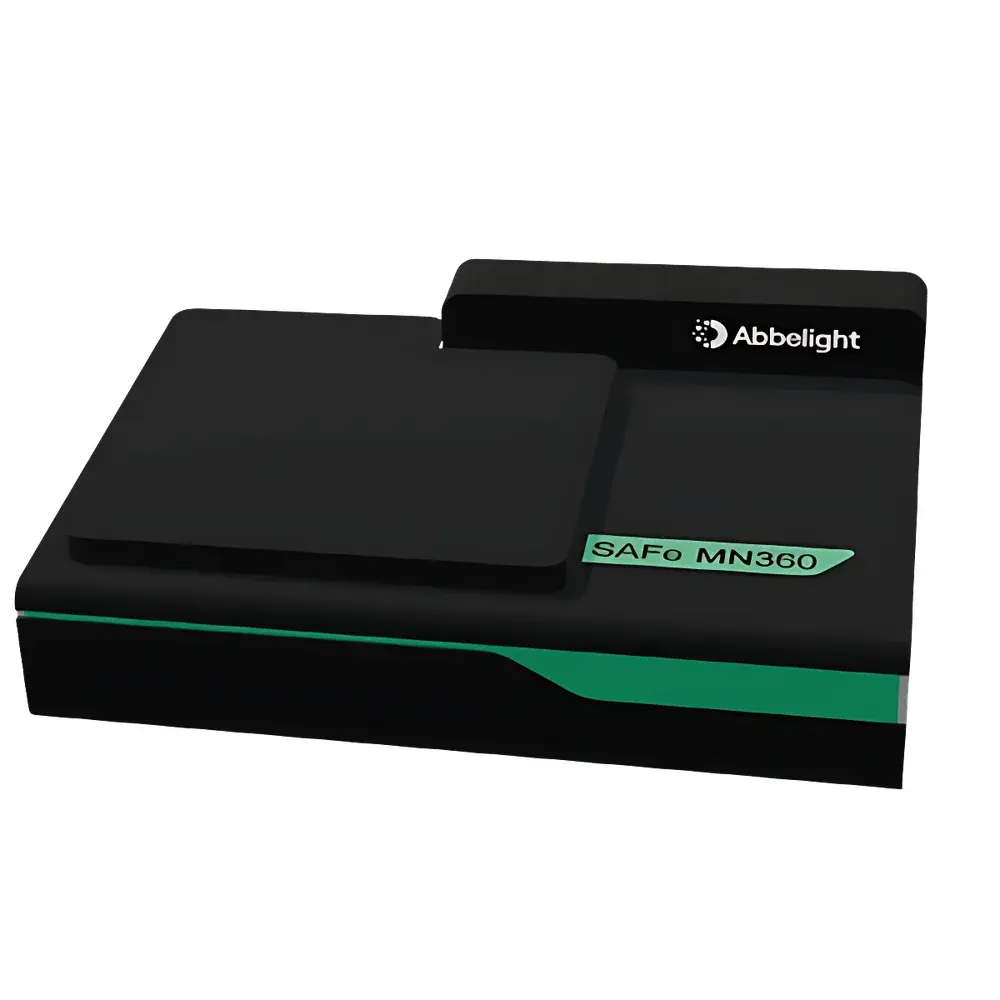
Abbelight SAFe MN360 3D Single-Molecule Localization Microscope
| Brand | Abbelight |
|---|---|
| Origin | France |
| Model | SAFe MN360 |
| Technology | Structured Illumination Microscopy (SIM) & Single-Molecule Localization Microscopy (SMLM) |
| Resolution | 15 nm (x, y, z) |
| Field of View | 200 × 200 µm² |
| Imaging Modes | PALM, STORM, PAINT, smFRET, SPT |
| Illumination Modes | Epi, TIRF, HILO |
| Depth Imaging Capability | 1.2 µm per acquisition (up to 10 µm total depth) |
| Multicolor Capacity | Up to 4 simultaneous channels |
| Drift Correction | Real-time hardware-based |
| Live-Cell Compatibility | Yes |
| Software Compliance | FDA 21 CFR Part 11-ready audit trail, GLP/GMP-compatible metadata logging |
Overview
The Abbelight SAFe MN360 is a research-grade 3D single-molecule localization microscope engineered for quantitative nanoscale structural and dynamic analysis in fixed and live biological specimens. Unlike conventional widefield or confocal systems, the SAFe MN360 implements a hybrid optical architecture combining deterministic structured illumination (SIM) with stochastic single-molecule switching and precise centroid fitting—enabling true three-dimensional super-resolution imaging at ≤15 nm isotropic spatial resolution across x, y, and z axes. Its core innovation lies in the DAISY (Dual-Axis Imaging with Scattering and Y-tilt) module, which integrates astigmatic point-spread function (PSF) engineering with supercritical-angle fluorescence (SAF) detection to decouple axial position from lateral intensity distribution. This dual-axis calibration strategy eliminates reliance on empirical PSF libraries or iterative deconvolution, delivering high reproducibility and minimal user-dependent bias in 3D molecular localization—critical for longitudinal studies and multi-laboratory comparative analyses.
Key Features
- Isotropic 15 nm 3D localization precision across all axes, validated by NIST-traceable nanobead standards and biological ground-truth structures (e.g., nuclear pore complexes, microtubule lattices)
- Simultaneous four-color imaging with spectral separation via dichroic filtering and EMCCD/sCMOS dual-camera acquisition, enabling co-localization quantification without temporal registration artifacts
- Integrated real-time drift correction using fiducial bead tracking and piezo-driven stage stabilization (sub-2 nm RMS stability over 30 min)
- Modular illumination engine supporting epifluorescence, total internal reflection fluorescence (TIRF), and highly inclined laminated optical sheet (HILO) modes—optimized for membrane, cytoplasmic, and nuclear targets
- Native support for PALM, STORM, PAINT, smFRET, and single-particle tracking (SPT) workflows, including sptPALM with frame rates up to 200 fps (5 ms exposure) for diffusion coefficient mapping
- Automated Z-stack acquisition with adaptive step size (10–100 nm) and depth-encoded reconstruction up to 10 µm tissue depth in cleared samples
Sample Compatibility & Compliance
The SAFe MN360 accommodates standard #1.5 coverslips (22 × 22 mm, 0.17 mm thickness) and is compatible with common mounting media (e.g., Prolong Diamond, Vectashield), aqueous buffers, and live-cell chambers (e.g., ibidi µ-Slides, Chambered Coverglass). It supports both organic dyes (Atto 488, CF®532, AF®647, SiR647) and genetically encoded photoactivatable proteins (Dendra2, mEos3.2, mMaple). All imaging protocols adhere to ISO/IEC 17025 principles for measurement uncertainty reporting. System metadata—including laser power, exposure time, gain, temperature, and environmental drift logs—is embedded in TIFF headers and exportable in MIAS-compliant format. Audit trails meet FDA 21 CFR Part 11 requirements for electronic records in regulated environments (e.g., preclinical assay development, GLP-compliant toxicology studies).
Software & Data Management
Acquisition and analysis are unified under Abbelight’s ThunDer platform—a Python-based, modular software suite with open API access. ThunDer provides batch processing pipelines for drift correction, molecule fitting (MSE-optimized Gaussian centroiding), cluster analysis (DBSCAN, Ripley’s K), and co-localization statistics (Manders’ coefficients, nearest-neighbor distance distributions). Raw data is stored in hierarchical HDF5 format with embedded calibration parameters; processed results export to standardized formats (OME-TIFF, CSV, JSON-LD) for integration with ImageJ/Fiji, Imaris, or custom ML training frameworks. The system includes built-in validation modules compliant with ASTM E3290-22 (Standard Guide for Super-Resolution Microscopy Performance Verification) and supports automated report generation for ISO 13485 quality documentation.
Applications
The SAFe MN360 has been deployed in peer-reviewed studies addressing sub-diffraction cellular architecture and dynamics: mapping clathrin-coated pit and caveolae nanodomains in endothelial plasma membranes with <80 nm spatial segregation; resolving RNA polymerase holoenzyme clustering and transcriptional bursting kinetics in live E. coli; quantifying mitofusin-2–mediated β2-integrin conformational switching in leukocyte adhesion; and reconstructing 3D nanotopography of actin cores within osteoclast sealing zones. Its 200 × 200 µm² field of view enables statistically robust sampling of heterogeneous tissues (e.g., hippocampal neuron cultures, tumor spheroids), while its 1.2 µm axial capture depth per stack allows volumetric reconstruction of organelles such as mitochondria, nuclear pores, and synaptic vesicle clusters without sectioning artifacts. The system is routinely used in structural cell biology, neurobiology, infectious disease mechanisms, and extracellular vesicle phenotyping.
FAQ
What sample preparation protocols are recommended for optimal SMLM performance?
Standard immunolabeling with primary antibodies followed by dye-conjugated secondary antibodies (e.g., AF®647) or direct labeling with HaloTag/SNAP-tag ligands is advised. For live-cell work, Dendra2 or mMaple fusions with codon optimization for mammalian expression yield optimal blinking kinetics.
Does the SAFe MN360 support correlative light-electron microscopy (CLEM)?
Yes—the system’s coordinate-mapped stage and fiducial-based registration enable precise overlay of SMLM maps onto TEM/SEM datasets when using gold nanoparticle fiducials and compatible resin embedding protocols.
Can existing SIM or confocal datasets be re-analyzed using SAFe MN360 software?
ThunDer accepts OME-TIFF and ND2 files from major vendors (Zeiss, Nikon, Leica, Olympus); however, true SMLM reconstruction requires raw single-molecule frames with appropriate photoswitching buffer conditions and cannot be retrofitted from conventional images.
What maintenance intervals are required for optical alignment and calibration?
Daily auto-alignment of excitation paths and weekly PSF verification using 100 nm fluorescent beads are recommended. Full optical recalibration (DAISY module, SAF angle tuning) is performed annually by Abbelight-certified field engineers.
Is remote operation supported for multi-user core facilities?
Yes—ThunDer supports role-based access control (RBAC), encrypted VNC sessions, and queue-based job scheduling via RESTful API, enabling secure shared-resource deployment across institutional networks.





