
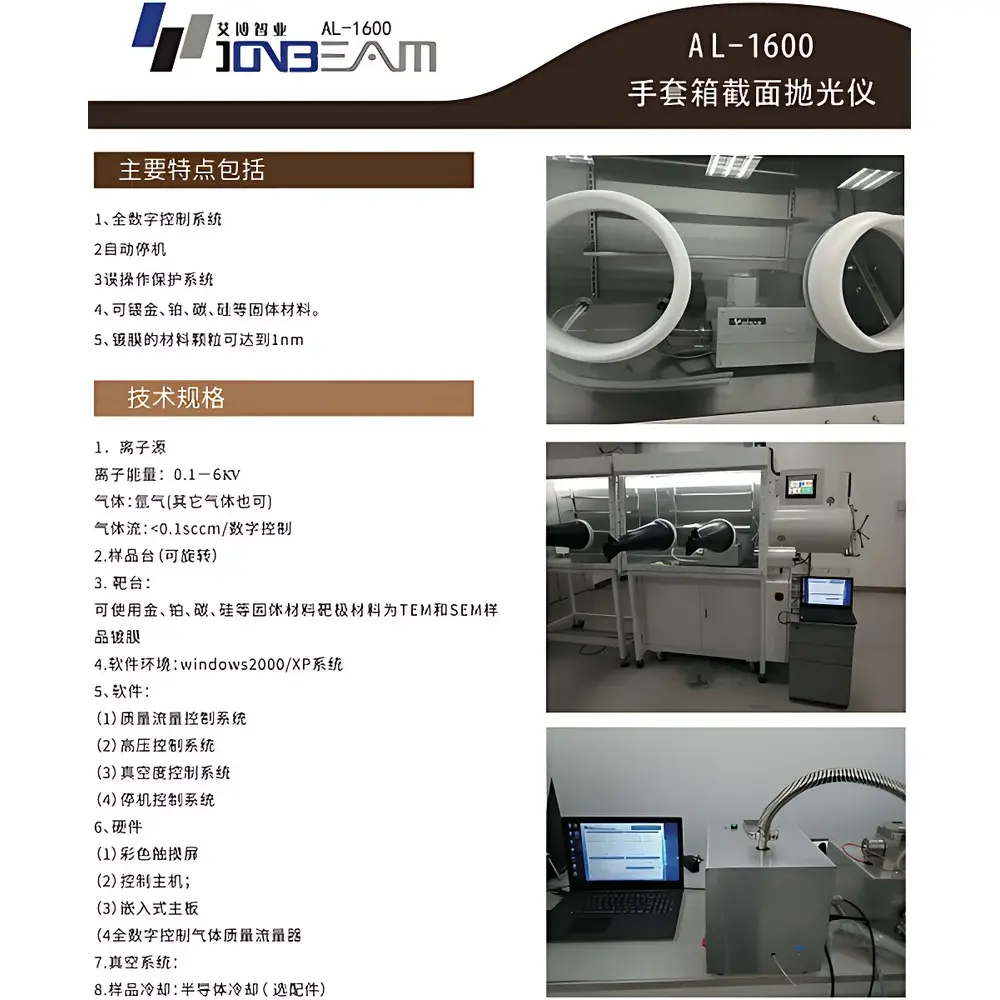
Abel AL-1600 Glovebox-Compatible Ion Beam Sputtering System
| Brand | Abel/Ionbeam |
|---|---|
| Origin | Beijing, China |
| Manufacturer | Yes |
| Country of Origin | China |
| Model | AL-1600 |
| Vacuum Base Pressure | ≤5×10⁻³ Pa (without Ar flow) |
| Acceleration Voltage Range | 200–6000 V |
| Sample Stage | Rotatable |
| Ion Source | Single Ion Gun |
| Cooling Option | Thermoelectric (optional) |
| Glovebox Integration | Yes |
| Primary Functions | Plasma Cleaning, Ion Beam Sputter Deposition, Reactive Ion Beam Etching (with reactive gas introduction) |
| Beam Uniformity | Optimized for Ø25 mm and Ø50 mm substrates |
| Typical Deposited Grain Size | ~3 nm |
| Low-Energy Ion Impact | Minimized substrate damage, suitable for thermally sensitive samples |
| In-situ Cleaning & Deposition | Integrated within single vacuum chamber |
| Control System | Digital, Programmable, Automated |
Overview
The Abel AL-1600 is a compact, glovebox-integrated ion beam sputtering (IBS) system engineered for high-precision thin-film deposition and surface modification under inert or controlled-atmosphere conditions. Unlike conventional magnetron sputtering tools, the AL-1600 employs a focused, electrostatically accelerated noble gas ion beam (typically Ar⁺) to physically eject atoms from solid targets—enabling ultra-low-energy, directional material transfer with minimal thermal load and negligible plasma-induced damage. Its design prioritizes compatibility with anaerobic or moisture-sensitive sample workflows, making it especially suited for preparing electron-transparent specimens for TEM, coating fragile organic or biological substrates, and fabricating model catalysts or quantum device interfaces where stoichiometric fidelity and interfacial integrity are critical. The system operates on the principle of physical vapor deposition (PVD) via ion-induced sputtering, offering atomic-level control over film nucleation, grain size (~3 nm), and thickness uniformity across Ø25 mm and Ø50 mm substrates.
Key Features
- Glovebox-ready architecture with standardized CF-40 or KF-40 vacuum feedthroughs for seamless integration into inert-atmosphere workstations (e.g., Ar/N₂ gloveboxes with H₂O/O₂ < 0.1 ppm).
- Single-axis rotatable sample stage with precise angular positioning—ensuring radial homogeneity during extended deposition runs.
- Programmable digital control system supporting multi-step recipes: pre-sputter cleaning, sequential target sputtering, reactive gas injection (e.g., O₂, N₂, CH₄), and timed etch/deposition cycles.
- In-chamber dual-function capability: plasma cleaning (via low-energy ion bombardment) and sputter deposition occur in the same vacuum environment—eliminating air exposure and cross-contamination risks between preparation steps.
- Low-energy ion acceleration (200–6000 V adjustable) enables gentle surface activation of polymers, 2D materials, and cryo-TEM grids without carbonization or topographical distortion.
- Integrated safety interlocks and real-time pressure/voltage monitoring provide automatic shutdown during vacuum breach, overcurrent, or thermal overload—ensuring GLP-compliant operational integrity.
Sample Compatibility & Compliance
The AL-1600 accommodates rigid and semi-rigid substrates up to 50 mm in diameter—including silicon wafers, TEM copper grids, mica flakes, ITO/glass slides, and polymer films. It accepts conductive and insulating targets (metals, oxides, nitrides, carbides, graphite) without requiring RF biasing or secondary grounding. The system meets fundamental requirements for ISO/IEC 17025-accredited laboratories conducting sample prep for SEM, TEM, XRD, and XPS analysis. While not certified to FDA 21 CFR Part 11 out-of-the-box, its audit-trail-capable software logs all parameter changes, user actions, and timestamped process events—facilitating internal validation per GMP/GLP documentation standards.
Software & Data Management
The embedded controller runs on a real-time Linux-based OS with a touchscreen HMI interface. All process parameters—including ion gun voltage, emission current, argon flow rate (if externally regulated), stage rotation speed, and step duration—are stored as ASCII-formatted .csv log files with UTC timestamps. Optional Ethernet connectivity supports remote monitoring via secure SSH or Modbus TCP protocols. Data export is compatible with MATLAB, Python (pandas), and LabVIEW for statistical process control (SPC) analysis and long-term reproducibility tracking across instrument lifecycles.
Applications
- Preparation of ultrathin conductive coatings (e.g., Cr, Pt, Au, Ti) on TEM grids to reduce charging artifacts during high-resolution imaging.
- Deposition of atomically uniform metal oxide layers (e.g., Al₂O₃, SiO₂) for tunnel junction fabrication in mesoscopic transport studies.
- Controlled surface amorphization or smoothing of semiconductor heterostructures prior to cross-sectional TEM lamella lift-out.
- Reactive ion beam etching (RIBE) of graphene or MoS₂ using O₂/Ar mixtures to define nanoscale electrodes without polymer residue.
- Inert-gas sputter cleaning of cryo-EM specimen supports immediately before vitrification—minimizing hydrocarbon contamination.
FAQ
Can the AL-1600 be operated inside a nitrogen-purged glovebox?
Yes—the system features sealed electrical feedthroughs, non-magnetic stainless-steel construction, and optional dry-compression-compatible vacuum pumps to maintain integrity in inert environments.
Is the ion gun replaceable with alternative source types (e.g., Kaufman-type)?
No—the AL-1600 uses a fixed geometry, single-aperture gridded ion gun optimized for stability at low beam currents (1–20 mA); third-party sources are not supported due to mechanical and HV interface constraints.
Does the system support thickness monitoring during deposition?
Not natively—quartz crystal microbalance (QCM) integration is available as a factory-installed option (model suffix “-QCM”); otherwise, thickness is inferred from calibrated sputter rates and time.
What maintenance intervals are recommended for the ion gun and vacuum components?
Ion gun grids require cleaning every 200–300 hours of cumulative operation; turbomolecular pump oil replacement is advised every 12 months or after 8,000 hours, whichever occurs first.
Is semiconductor cooling necessary for routine TEM grid coating?
Not required for room-temperature stable metals (e.g., Au, Pt), but strongly recommended when depositing on low-Tg polymers or temperature-sensitive biomaterials to suppress thermal drift and dewetting.




