
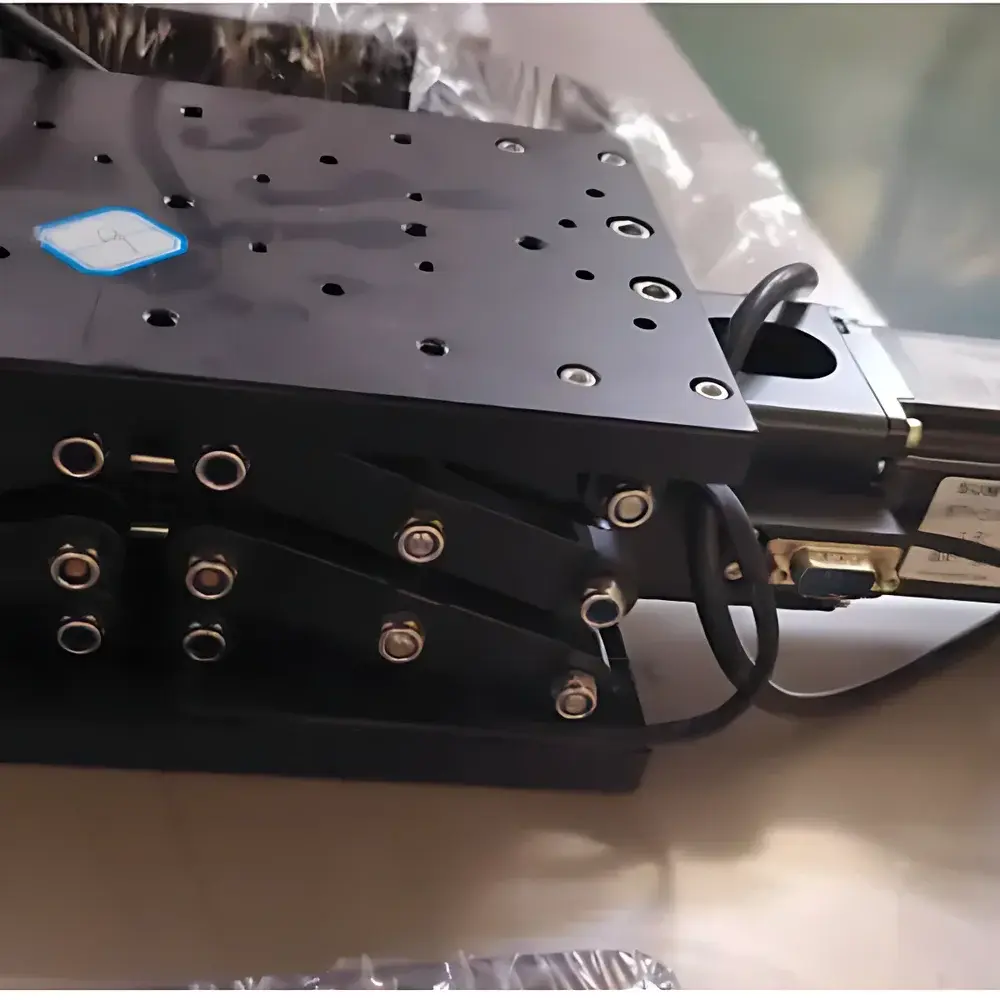
Abner 120×80 mm Manual Scissor Translation Stage
| Brand | Abner |
|---|---|
| Origin | Jiangsu, China |
| Manufacturer Type | Authorized Distributor |
| Product Type | Manual Translation Stage |
| Platform Dimensions | 120 × 80 mm |
| Load Capacity | 500–2000 kg |
| Stroke Range | 6–12 m |
| Actuation | Manual (Hand-Crank or Lever-Operated) |
| Category | Optical Laboratory Translation Stage |
Overview
The Abner 120×80 mm Manual Scissor Translation Stage is a precision-engineered vertical positioning platform designed specifically for optical laboratory applications requiring stable, repeatable, and vibration-damped height adjustment. Unlike industrial-grade scissor lifts intended for cargo handling, this stage integrates the mechanical robustness of scissor-linkage kinematics with metrological-grade dimensional control—optimized for mounting optical components such as mirrors, beam splitters, detectors, and interferometric assemblies on optical tables or breadboards. Its operation relies on a dual-arm crossed-lever mechanism that ensures orthogonal motion fidelity, minimal parasitic tilt ( 25 N/µm). The stage is constructed from anodized aluminum alloy (6061-T6) with hardened steel pivot pins and self-lubricating polymer bushings to maintain long-term positional stability under static load and repeated manual actuation.
Key Features
- Compact footprint: 120 mm × 80 mm top platform surface—engineered to fit standard optical rail systems and modular lab setups without compromising accessibility.
- High-load vertical translation: Rated for static loads between 500 kg and 2000 kg, enabling secure mounting of heavy optical benches, vacuum chambers, or multi-axis alignment fixtures.
- Manual actuation via ergonomic hand crank or lever system—no external power required, ensuring ESD-safe, spark-free operation in laser labs and cleanroom environments.
- Stroke range configurable from 6 m to 12 m (customizable per order), with fine-pitch lead screws (1.5 mm pitch) offering sub-millimeter repeatability (±0.05 mm) across the full travel range.
- Integrated locking mechanism with dual-point mechanical clamping—prevents drift during alignment procedures and satisfies ISO 10110-7 stability requirements for optical component positioning.
- Mounting compatibility: Standard M6 threaded holes (4×) on platform surface; base plate features countersunk slots for rigid fixation to optical tables (e.g., Thorlabs, Newport) using 1/4″-20 or M6 hardware.
Sample Compatibility & Compliance
This translation stage supports integration with standard optical payloads including HeNe lasers, CCD cameras, fiber collimators, and motorized rotation mounts. It complies with mechanical safety standards referenced in ISO 12100 (risk assessment for machinery) and conforms to structural integrity benchmarks outlined in ASTM E1527 for laboratory support equipment. While not classified as medical or regulated process equipment, its design adheres to GLP-aligned documentation practices—including traceable material certifications (RoHS-compliant alloys, REACH-compliant lubricants) and factory calibration reports available upon request. No electrical or pneumatic interfaces are present, eliminating compliance dependencies on IEC 61000 or ATEX directives.
Software & Data Management
As a fully manual mechanical stage, it operates independently of software control. However, its dimensional repeatability and mechanical hysteresis (< 0.03% of full stroke) make it suitable for use in hybrid setups where position data is logged externally via linear encoders (e.g., Renishaw RESOLUTE™) or laser displacement sensors (e.g., Keyence LK-H050). Integration with LabVIEW, MATLAB, or Python-based automation frameworks is achievable through third-party encoder feedback loops—enabling closed-loop height tracking while preserving the inherent safety and simplicity of manual operation. Audit trails for positional settings may be maintained via laboratory notebook entries or LIMS-integrated digital logs compliant with 21 CFR Part 11 when paired with validated electronic recording systems.
Applications
- Precision height alignment of objective lenses in confocal and Raman microscopy systems.
- Vertical positioning of Fourier-transform infrared (FTIR) interferometer mirrors to optimize optical path length matching.
- Adjustment of laser cavity end mirrors in Ti:sapphire or dye laser systems requiring sub-micron beam height consistency.
- Staged elevation of photodetector arrays during quantum optics experiments involving spatial mode characterization.
- Support platform for vacuum-compatible optical viewports undergoing thermal cycling—leveraging low-outgassing surface treatment and zero-power operation.
- Modular integration into multi-axis optomechanical assemblies where decoupled Z-axis control is required without electromagnetic interference.
FAQ
Is this stage compatible with vacuum environments?
Yes—when specified with vacuum-rated lubricants and optional black anodizing (Type II Class 2), it achieves outgassing rates < 1×10⁻⁹ Torr·L/s·cm² per ASTM E595, suitable for UHV-adjacent optical chambers.
Can the stroke height be customized beyond 12 meters?
Standard configurations cap at 12 m; extended-stroke variants up to 18 m are available under OEM agreement with structural recalibration and dynamic stability validation.
Does Abner provide calibration certificates?
Factory-assembled units include dimensional verification reports (platform flatness ≤ ±1.5 µm over 120×80 mm, parallelism ≤ 2 arcsec); NIST-traceable calibration is offered as a value-added service.
What maintenance is required for long-term performance?
Biannual inspection of pivot pin preload and bushing wear is recommended; no scheduled lubrication is needed under normal lab-use conditions due to self-lubricating composite bushings.
Is there a motorized version of this stage?
Abner offers a stepper-motor-driven variant (model SC-12080-M) with integrated 0.9° hybrid stepper and microstepping driver—contact technical sales for torque and resolution specifications.





