
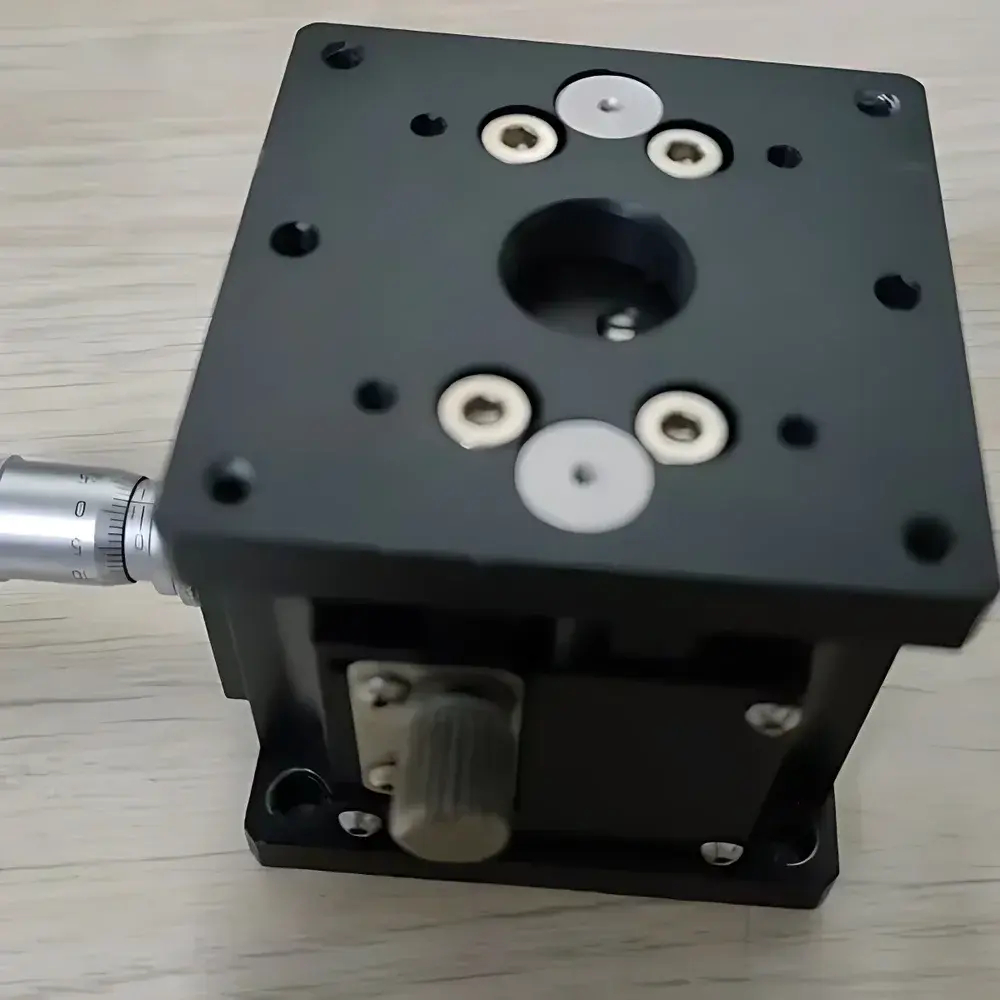
Abner 60×60 Manual Z-Axis Translation Stage
| Brand | Abner |
|---|---|
| Origin | Jiangsu, China |
| Product Type | Manual Translation Stage |
| Platform Size | 60 mm × 60 mm |
| Actuation | Micrometer-Driven Manual Adjustment |
| Motion Axis | Z-axis (Vertical) |
| Guide Mechanism | Crossed Roller Bearings |
| Repeatability | < 10 µm |
| Material | Anodized Aluminum Alloy |
| Mounting Pattern | Standard 1/4"-20 and M6 threaded holes |
| Locking Mechanism | Integrated Micrometer Lock |
| Compliance | Designed for ISO/IEC 17025-aligned lab environments |
Overview
The Abner 60×60 Manual Z-Axis Translation Stage is a precision-engineered optical positioning platform designed for controlled vertical displacement in laboratory and industrial metrology applications. Built upon the fundamental principle of mechanical translation via calibrated micrometer advancement coupled with low-friction crossed roller bearing guidance, this stage delivers deterministic Z-axis motion without backlash or hysteresis. Its rigid aluminum alloy frame—machined to tight geometric tolerances and finished with hard-anodized surface treatment—ensures dimensional stability across thermal fluctuations typical in ambient-lab conditions (20–25 °C). Unlike motorized alternatives, this manual stage eliminates electromagnetic interference, power dependency, and software integration overhead, making it especially suitable for vibration-sensitive optical setups such as interferometry, confocal microscopy alignment, and laser beam height calibration where passive, deterministic control is preferred.
Key Features
- Precision Z-axis motion with integrated 0.01 mm resolution micrometer scale and locking knob for repeatable height setting
- Crossed roller bearing guide system providing high rigidity (> 50 N/µm stiffness), minimal wobble (< 5 µrad tilt error), and smooth linear travel over full 15 mm stroke range
- 60 mm × 60 mm top plate with standardized mounting pattern: four M6 threaded holes on 40 mm centers and four 1/4″-20 tapped holes on 1.5″ centers—compatible with Thorlabs, Newport, and Standa optical breadboards and accessories
- Anodized 6061-T6 aluminum construction offering excellent strength-to-weight ratio (density: 2.7 g/cm³), corrosion resistance, and non-magnetic properties essential for magnetic-field-free experiments
- Zero-backlash micrometer drive mechanism with brass-tipped spindle and hardened steel nut, rated for > 100,000 adjustment cycles under nominal load (≤ 5 kg)
- Integrated lockable micrometer collar enabling rapid coarse positioning followed by fine adjustment without tooling
Sample Compatibility & Compliance
This translation stage supports payloads up to 5 kg while maintaining sub-10 µm repeatability—validated per ISO 9283:1998 methodology using laser interferometric verification. It complies with mechanical safety requirements outlined in ISO 12100 for manually actuated positioning devices. The absence of electronic components ensures full compatibility with ESD-safe cleanroom environments (ISO Class 5–7) and MRI-adjacent installations. Surface finish meets ISO 1302 Ra ≤ 0.8 µm specifications for optical interface stability. While not certified to GLP or GMP as a standalone device, its dimensional traceability and mechanical reproducibility support use within ISO/IEC 17025-accredited calibration workflows when paired with NIST-traceable height gauges or autocollimators.
Software & Data Management
As a purely mechanical, non-electronic positioning solution, the Abner 60×60 stage requires no firmware, drivers, or software integration. All positional data is recorded manually via the engraved micrometer scale or external metrology tools (e.g., digital height gauges, capacitive sensors, or laser triangulation systems). Users may log measurements in LIMS-compatible spreadsheets or ELN platforms (e.g., LabArchives, Benchling) using standardized units (mm, µm) and documented uncertainty budgets. For audit readiness, operators are advised to record initial/final micrometer readings alongside environmental conditions (temperature, humidity) per ASTM E29 guidelines for significant digit reporting.
Applications
- Optical path length tuning in Michelson and Mach-Zehnder interferometers
- Z-height calibration of objective lenses and CCD/CMOS sensor planes in custom microscope assemblies
- Vertical alignment of fiber optic couplers, collimators, and photonic integrated circuit (PIC) test fixtures
- Stage-level height adjustment in white-light interferometry and profilometry systems
- MEMS device probing where electrostatic discharge (ESD) immunity and zero EMI are mandatory
- Teaching labs for kinematics demonstration—leveraging tactile feedback to reinforce concepts of resolution, repeatability, and mechanical advantage
FAQ
What is the maximum recommended load capacity?
The stage is rated for static loads up to 5 kg at center of platform; off-center loading above 2 kg requires moment arm calculation per ISO 8562 to avoid binding.
Is the micrometer scale metric or imperial?
Metric only: 0.01 mm graduation with vernier-assisted reading capability for interpolated values down to 5 µm.
Can this stage be stacked with XY stages for full 3-axis manual control?
Yes—its bottom plate features counterbored M6 holes compatible with standard mounting screws used by Abner’s 100 mm × 100 mm XY stages and third-party kinematic bases.
Does it include mounting hardware?
No—M6 cap screws and washers must be sourced separately to match user-specific baseplate thread depth and torque requirements (recommended torque: 1.2–1.5 N·m).
How is thermal drift managed during extended measurements?
The anodized aluminum structure exhibits a CTE of 23.6 × 10⁻⁶ /°C; for sub-µm stability over 1-hour sessions, ambient temperature variation should be limited to ±0.5 °C per ISO 5725-2 guidelines.



