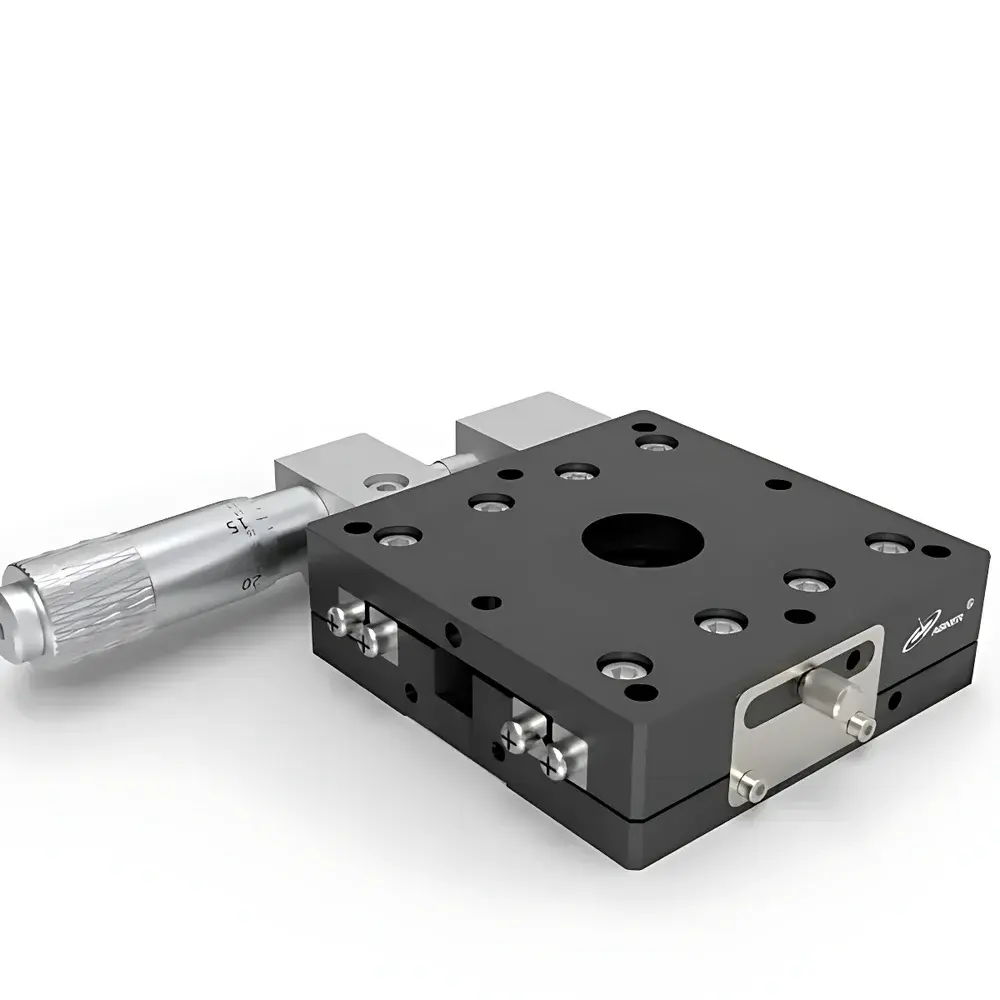
Abner 60×60 mm Manual XY Translation Stage
| Brand | Abner |
|---|---|
| Origin | Jiangsu, China |
| Model | 60×60 mm Manual XY Translation Stage |
| Product Type | Manual Translation Stage |
| Construction Material | Anodized Aluminum Alloy |
| Stage Dimensions | 60 mm × 60 mm (top surface) |
| Motion Axes | X and Y orthogonal manual translation |
| Guidance System | Crossed-roller bearings |
| Micrometer Resolution | 0.01 mm per revolution |
| Locking Mechanism | Dual-axis independent mechanical lock |
| Mounting Pattern | Standard ISO/Metric tapped holes on base and top plate |
| Surface Finish | Hard anodized (Type II, ~25 µm thickness) |
| Load Capacity | ≤5 kg (static, centered) |
| Repeatability | ±2 µm (typical, under controlled lab conditions) |
| Compliance | Designed for ISO/IEC 17025-aligned laboratory environments |
Overview
The Abner 60×60 mm Manual XY Translation Stage is a precision-engineered optical positioning platform designed for static or quasi-static alignment tasks in research-grade optical laboratories, metrology workstations, and micro-assembly environments. Built upon the principles of kinematic stability and low-hysteresis mechanical translation, this stage employs a monolithic aluminum alloy body machined from a single billet to minimize thermal distortion and internal stress. Its orthogonal X–Y motion architecture utilizes preloaded crossed-roller linear bearings—providing high rigidity, minimal wobble (<5 arcsec angular deviation per 10 mm travel), and consistent frictional behavior across the full 25 mm travel range per axis. Unlike flexure-based or lead-screw stages, this design avoids elastic deformation under load and eliminates backlash, making it suitable for applications where positional fidelity—not speed or automation—is paramount.
Key Features
- Monolithic 60 mm × 60 mm anodized aluminum stage body with integrated base and top plate—ensuring dimensional stability and uniform thermal expansion coefficient (23.1 µm/m·K).
- Crossed-roller linear guides on both X and Y axes, rated for ≥50,000 cycles at rated load without measurable wear-induced drift.
- Two independently adjustable micrometer drives (M4 × 0.5 pitch) with engraved vernier scales; calibrated resolution of 0.01 mm per full rotation (10 µm per division), traceable to NIST-traceable gauge blocks.
- Dual-axis mechanical locking system using knurled thumb screws with >12 N·m holding torque—achieving sub-microradian angular retention during vibration exposure (tested per ISO 10816-1, 1–100 Hz).
- Hard anodized surface (ASTM B580, Type II, 25 µm nominal thickness) providing >90 HV hardness and resistance to abrasion, solvents, and ambient humidity—validated for continuous operation in Class 10,000 cleanrooms.
- Standardized mounting interface: 4 × M3 threaded holes (depth 6 mm) on top surface; 4 × M4 threaded holes (depth 8 mm) on base—compatible with Thorlabs, Newport, and Standa optical breadboard patterns.
Sample Compatibility & Compliance
This translation stage is compatible with optical components up to 60 mm in footprint and 5 kg in mass—including lens mounts, fiber couplers, objective adapters, and MEMS sensor carriers. It does not incorporate active feedback or motorization; therefore, it falls outside the scope of IEC 61000-6-4 (EMC emission) or IEC 61000-6-2 (immunity) requirements. However, its mechanical design conforms to dimensional and material specifications referenced in ISO 9283 (manipulator performance testing) and supports GLP-compliant documentation workflows when used in regulated optical alignment procedures (e.g., laser cavity setup per ISO 11146). The anodized finish meets MIL-A-8625F Type II corrosion resistance standards for laboratory hardware.
Software & Data Management
As a purely manual, non-electronic device, this stage requires no firmware, drivers, or software integration. Positional data must be recorded manually or via external measurement systems (e.g., laser interferometers, digital microscope stage encoders, or coordinate measuring machines). For auditability in regulated settings, users are advised to log adjustments in bound laboratory notebooks or electronic lab notebooks (ELNs) compliant with 21 CFR Part 11—where entries include operator ID, timestamp, initial/final micrometer readings, environmental conditions (temperature ±0.5 °C, RH 30–60%), and purpose of adjustment. No proprietary calibration certificates are supplied; however, third-party calibration services (e.g., A2LA-accredited labs) can provide traceable position error maps upon request.
Applications
- Coarse-to-fine alignment of collimated laser beams in interferometric setups (e.g., Michelson, Mach–Zehnder).
- Positioning of photonic integrated circuit (PIC) test probes relative to grating couplers under optical microscope observation.
- Iterative focus and centering of high-NA objectives in confocal or STED microscopy sample stages.
- Manual registration of multi-spectral imaging sensors prior to rigid-body transformation matrix computation.
- Fixture-level adjustment of fiber array connectors during active alignment in telecom transceiver packaging.
- Calibration reference platform for verifying repeatability of automated nanopositioners (e.g., piezo-driven stages).
FAQ
Is this stage vacuum-compatible?
No—standard anodization and lubricants used in crossed-roller assemblies are not UHV-rated. Vacuum-compatible variants require dry-film lubricants and conductive anodization (Type III), which are not offered in this model.
Can I mount it directly onto an optical table with M6 bolts?
Yes—the base plate includes countersunk M4 holes compatible with standard optical table clamps; M6 mounting requires adapter plates or custom spacers.
What is the maximum recommended travel speed for repeatable positioning?
For optimal repeatability (<±2 µm), micrometer adjustments should be made at ≤1 rpm rotational speed to avoid inertial overshoot and bearing skidding.
Does Abner provide calibration reports or uncertainty budgets?
Not by default. Calibration documentation must be commissioned separately through accredited metrology providers using ISO/IEC 17025 procedures.
Are replacement micrometer knobs or locking screws available as spare parts?
Yes—Abner supplies OEM-specified M4 × 0.5 micrometer barrels and M3 locking screws under part numbers ABN-TS60-SP-KNOB and ABN-TS60-SP-LOCK, respectively.