
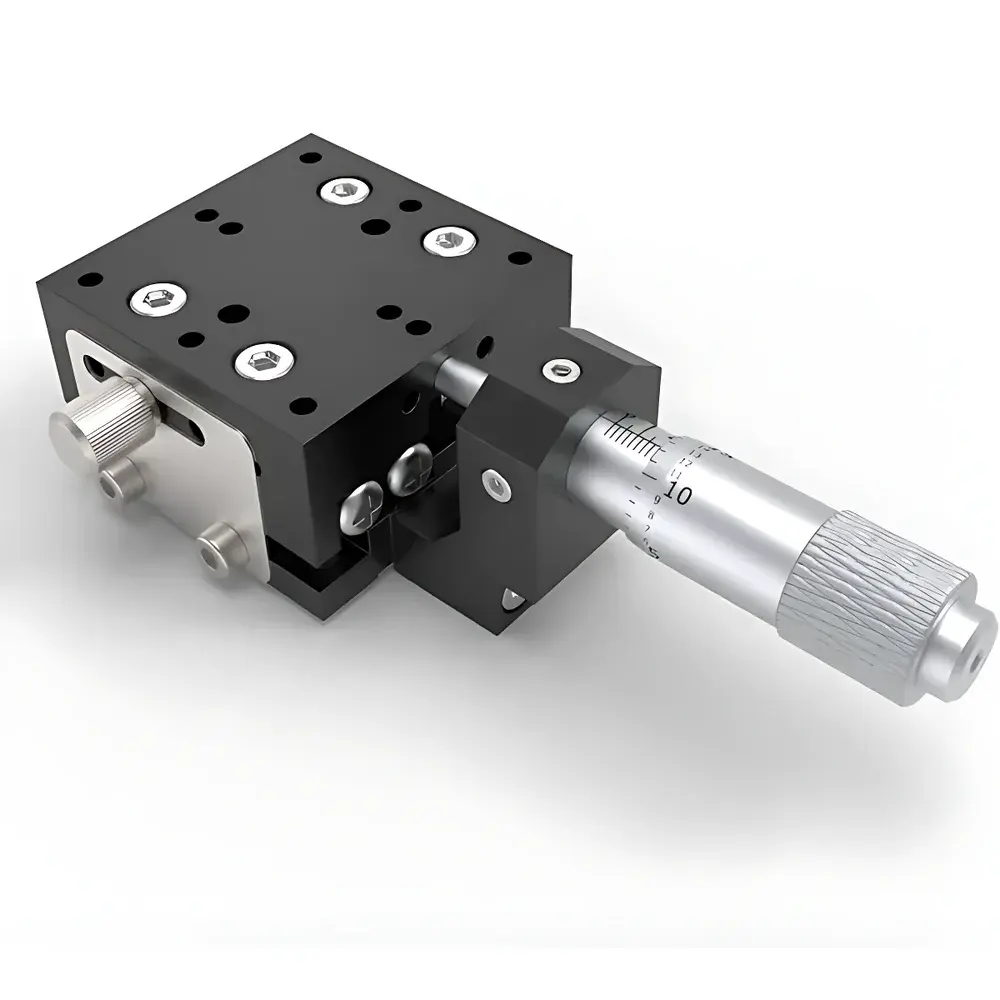
Abner ABN-25×25 Manual Translation Stage
| Brand | Abner |
|---|---|
| Origin | Jiangsu, China |
| Product Type | Manual Translation Stage |
| Platform Dimensions | 25 mm × 25 mm |
| Construction Material | Anodized Aluminum Alloy |
| Guide Mechanism | Precision Linear Bearing Rails |
| Adjustment Method | Manual Micrometer-Driven Translation |
| Repeatability | High (typical for precision mechanical stages) |
| Mounting Interface | Standard M3 and M4 Tapped Holes |
| Compliance | Designed for laboratory-grade optical alignment and micro-positioning applications |
Overview
The Abner ABN-25×25 Manual Translation Stage is a compact, high-stability linear positioning platform engineered for precise one-axis displacement in optical and micro-mechanical experimental setups. Based on the Couette-type mechanical translation principle—where motion is transmitted via a calibrated micrometer screw driving a carriage along hardened linear guide rails—the stage delivers smooth, backlash-minimized movement with consistent mechanical hysteresis performance. Its 25 mm × 25 mm top plate occupies minimal footprint while maintaining structural rigidity under static and dynamic loading conditions typical of benchtop optical assemblies. The stage is not motorized or automated; instead, it relies on manual actuation to ensure deterministic control, eliminate electromagnetic interference, and support environments requiring intrinsic safety or vacuum compatibility (when optionally configured with non-outgassing hardware). It serves as a foundational component in interferometry, confocal microscopy alignment, fiber coupling optimization, and laser beam steering systems where sub-10 µm repeatability and long-term dimensional stability are prerequisites.
Key Features
- Precision-engineered anodized aluminum alloy body providing high strength-to-weight ratio, corrosion resistance, and thermal stability (CTE ≈ 23.1 × 10⁻⁶ /°C)
- Integrated linear bearing rail system with preloaded bushings ensures low-friction, non-binding travel over full stroke (standard stroke: 13 mm; customizable upon request)
- Micrometer-driven adjustment mechanism with fine-pitch thread (typically 0.5 mm pitch) enabling tactile, incremental positioning with visual scale resolution down to 10 µm
- Standardized mounting pattern featuring dual rows of M3 and M4 threaded holes (ISO metric thread standard) for direct integration with kinematic mounts, cage systems, and OEM optical breadboards
- No lubricants required in normal atmospheric operation; compatible with cleanroom Class 1000 environments when handled per ISO 14644-1 protocols
- Zero electrical components—ideal for EMI-sensitive applications such as RF-optical hybrid systems or ultra-low-noise photodetector alignment
Sample Compatibility & Compliance
The ABN-25×25 stage supports payloads up to 1.5 kg with maintained positional fidelity under static load. It accommodates optical components including mirrors (up to Ø25.4 mm), lens tubes, fiber collimators, and miniature sensors without compromising planarity or parallelism. While not certified to ISO 9001 by the distributor, the manufacturing process adheres to GB/T 19001–2016 (equivalent to ISO 9001:2015) quality management practices at the original equipment manufacturer level. Mechanical tolerances conform to GB/T 1184–1996 (geometric tolerance standards for machine elements), ensuring flatness ≤ ±3 µm over the active surface and perpendicularity ≤ 5 arcsec between base and top plate. No RoHS exemptions apply; all materials comply with Directive 2011/65/EU Annex II substance restrictions.
Software & Data Management
This is a purely mechanical, non-electronic device and does not incorporate embedded firmware, digital interfaces, or software dependencies. Consequently, it requires no driver installation, firmware updates, or cybersecurity validation. Position data is recorded manually via scale reading or external metrology tools (e.g., dial indicators, laser interferometers, or CCD-based vision systems). For traceable calibration workflows, users may document positional settings using laboratory information management systems (LIMS) or electronic lab notebooks (ELN) compliant with 21 CFR Part 11 audit trail requirements—though the stage itself contributes no digital data output.
Applications
- Laser cavity alignment and mirror tilt-compensated translation in DPSS and Ti:sapphire oscillator setups
- Stepwise sample translation in micro-spectroscopy and Raman mapping platforms
- Fiber-to-waveguide coupling optimization in integrated photonics packaging stations
- Calibration reference stage for displacement sensor verification (e.g., capacitive, LVDT, or optical encoder characterization)
- Modular building block in custom-built optical tweezers or atomic force microscope (AFM) auxiliary positioning systems
- Education labs for teaching fundamental concepts in metrology, mechanical design, and optical train construction
FAQ
Is this stage compatible with vacuum environments?
Yes—when specified with vacuum-compatible fasteners and dry-lubricated rails (e.g., MoS₂-coated bushings), the ABN-25×25 can operate in rough vacuum (10⁻³ mbar) without outgassing concerns. Standard units are rated for ambient use only.
Can I mount it directly onto an optical table with M6 studs?
Yes—the base includes countersunk M4 holes spaced to match common 25 mm grid optical tables. Adaptor plates with M6 conversion are available separately.
What is the maximum recommended load for repeatable positioning?
For guaranteed ≤ ±2 µm repeatability over 1,000 cycles, keep applied load ≤ 1.2 kg centered within the top plate’s central 16 mm × 16 mm zone.
Do you provide calibration certificates?
Calibration is performed per internal QC protocol (traceable to NIM, China); formal ISO/IEC 17025 certificates are available upon request with additional lead time and fee.
Is the micrometer head interchangeable?
Yes—the stage accepts industry-standard 8-32 UNF or M4 × 0.7 threaded micrometer heads, including those with vernier scales or digital readouts from Thorlabs, Newport, or Standa.





