
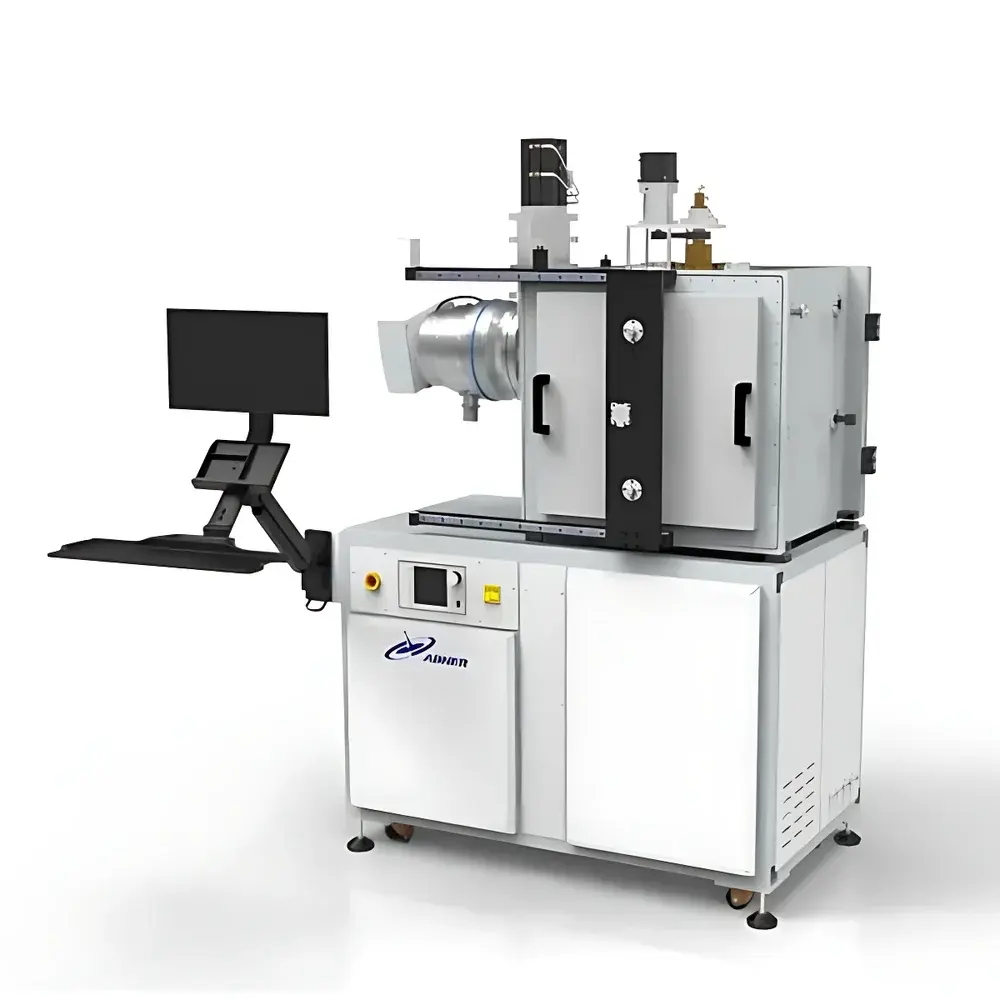
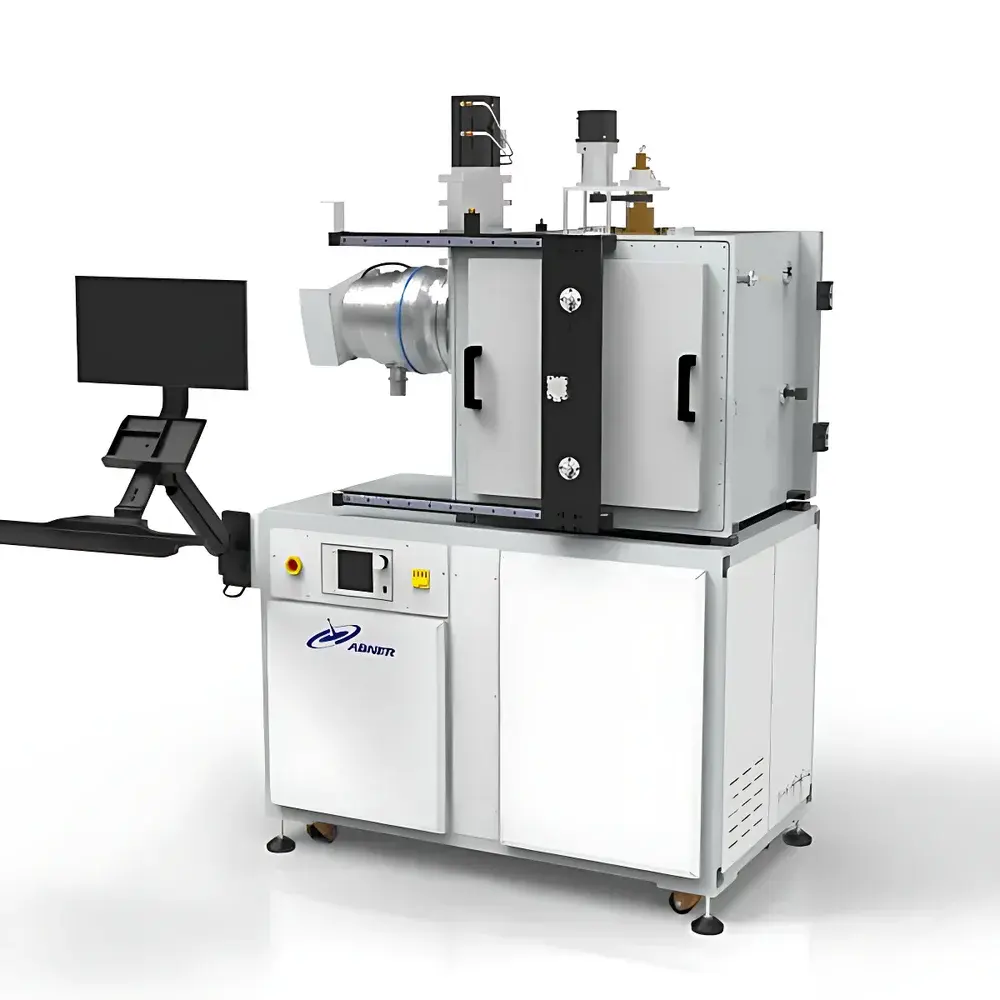
Abner ABN-500-Y1 Thermal Evaporation Coater
| Brand | Abner |
|---|---|
| Origin | Jiangsu, China |
| Manufacturer Type | Authorized Distributor |
| Country of Origin | China |
| Model | ABN-500-Y1 |
| Vacuum Base Pressure | ≤4×10⁻⁵ Pa |
| Pump-Down Time | ≤30 min to 5×10⁻⁴ Pa |
| Thickness Uniformity | ±3% (max deviation ±5%) |
| Thickness Control Accuracy | ±5% |
| Deposition Rate | Up to 5 nm/s (material- and source-dependent) |
| Process Duration Range | 0–30 min |
| Cooling | Water-cooled electrodes and chamber flanges |
| Safety Interlocks | Vacuum, overcurrent, and cooling water flow monitoring |
Overview
The Abner ABN-500-Y1 Thermal Evaporation Coater is a benchtop-scale, high-vacuum physical vapor deposition (PVD) system engineered for precise, repeatable thin-film fabrication in academic research laboratories, materials science departments, and microfabrication pilot lines. It operates on the principle of resistive thermal evaporation—where solid source materials (e.g., metals, oxides, or organic compounds) are heated under high vacuum to generate directional vapor fluxes that condense uniformly onto cooled or room-temperature substrates. The system achieves base pressures down to 4×10⁻⁵ Pa using a dual-stage pumping architecture (mechanical roughing pump + turbomolecular pump), minimizing residual gas collisions and enabling high-purity, low-contamination film growth. Designed for flexibility and operational robustness, the ABN-500-Y1 supports both fundamental thin-film studies and process development for functional coatings in microelectronics, optics, and emerging 2D material device integration.
Key Features
- High-vacuum chamber with stainless steel construction and all-metal sealing (CF flanges), rated for continuous operation at ≤4×10⁻⁵ Pa base pressure
- Dual-pump configuration: oil-free scroll mechanical pump paired with a 680 L/s turbomolecular pump for rapid, clean pump-down (≤30 minutes to 5×10⁻⁴ Pa)
- Multi-source evaporation platform accommodating up to four independent resistively heated sources—including molybdenum boats, tungsten filaments, and ceramic crucibles—for sequential or co-evaporation processes
- Motorized, multi-axis sample stage with programmable rotation (0–30 rpm), tilt (±15°), and vertical translation—enabling thickness uniformity optimization across 4-inch wafers or multiple substrates
- Real-time deposition rate and cumulative thickness control via optional quartz crystal microbalance (QCM) sensor with ±0.1 Å resolution and closed-loop feedback to power supply
- Integrated safety architecture featuring interlocked water-cooling circuits, overcurrent cutoff, vacuum-loss shutdown, and door-open emergency venting per IEC 61000-6-2 and SEMI S2 guidelines
- Intuitive human-machine interface (HMI) with touchscreen control panel supporting recipe storage, stepwise process sequencing, and real-time parameter logging (voltage, current, pressure, rate, thickness)
Sample Compatibility & Compliance
The ABN-500-Y1 accommodates standard substrate formats including silicon wafers (up to 100 mm), microscope slides, glass coverslips, flexible polymer films, and ceramic or metallic coupons. Substrate heating is not integrated but compatible with external hot-stage add-ons (optional). All wetted materials conform to ASTM F56 Standard Specification for High-Purity Stainless Steel Used in Semiconductor Processing Equipment. The system meets ISO 14644-1 Class 5 cleanroom compatibility when operated in controlled environments and supports GLP-compliant data integrity through timestamped, non-editable log export (CSV/Excel). While not FDA-registered, its vacuum integrity, material traceability (source purity logs), and process repeatability align with early-stage R&D requirements referenced in USP and ISO 10993-1 for biocompatible thin-film development.
Software & Data Management
Control firmware supports deterministic timing resolution of 100 ms for process steps and retains ≥100 user-defined recipes with version-stamped metadata (operator ID, date/time, chamber pressure history, source parameters). Raw sensor data—including QCM frequency shift, thermocouple readings, and power supply telemetry—is logged at 1 Hz and exportable without proprietary software dependency. Audit trail functionality records all parameter changes, manual overrides, and alarm events with operator attribution—meeting basic ALCOA+ principles for lab notebook supplementation. Optional Ethernet/IP connectivity enables remote monitoring via secure SSH or Modbus TCP for integration into centralized facility management systems.
Applications
- Microelectronics: Fabrication of adhesion layers (Cr, Ti), electrode stacks (Au/Ti, Al/Cr), and interconnect test structures on Si/SiO₂ wafers
- Optical coatings: Deposition of high-reflectivity mirrors (Ag, Al), anti-reflection layers (MgF₂), and beam-splitter architectures via sequential evaporation
- 2D materials engineering: Direct metallization of graphene, MoS₂, or h-BN devices without plasma-induced damage—preserving carrier mobility and interface quality
- Sensor development: Functional electrode patterning for electrochemical biosensors, MEMS resonators, and piezoresistive transducers
- Academic instruction: Hands-on PVD training covering vacuum fundamentals, Knudsen cell dynamics, mean free path calculations, and stoichiometric control in binary alloys
FAQ
What vacuum level is required for optimal metal film morphology?
For most elemental metals (e.g., Al, Au, Cr), a base pressure ≤1×10⁻⁵ Pa minimizes oxide incorporation and ensures columnar grain growth; the ABN-500-Y1 consistently achieves ≤4×10⁻⁵ Pa with proper maintenance.
Can the system deposit insulating materials such as SiO₂ or Al₂O₃?
Yes—using high-melting-point ceramic crucibles and optimized source temperature ramping profiles; however, electron-beam evaporation is recommended for higher-density oxide films.
Is the quartz crystal monitor calibrated traceably to NIST standards?
The QCM sensor is factory-calibrated using certified reference films (Au, Al); users may perform in-situ recalibration using known deposition rates per ASTM F1592.
Does the system support automated shutter sequencing for multilayer stacks?
Yes—the HMI allows definition of up to 8 discrete shutter-open/close events per recipe, synchronized with source activation and thickness targets.
What maintenance intervals are recommended for the turbomolecular pump?
Annual bearing inspection and rotor balancing per manufacturer specifications; pump oil in the backing pump should be replaced every 3,000 operating hours or semiannually, whichever occurs first.
Related Products



