
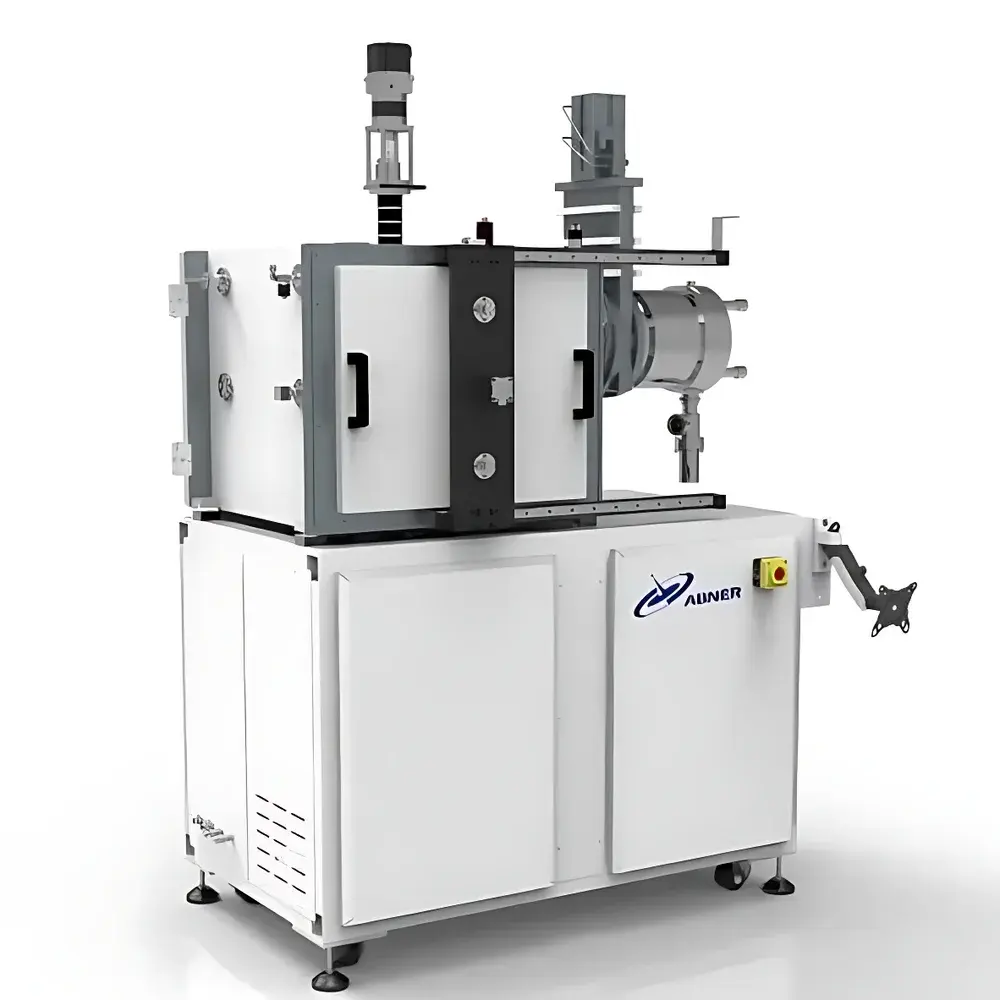
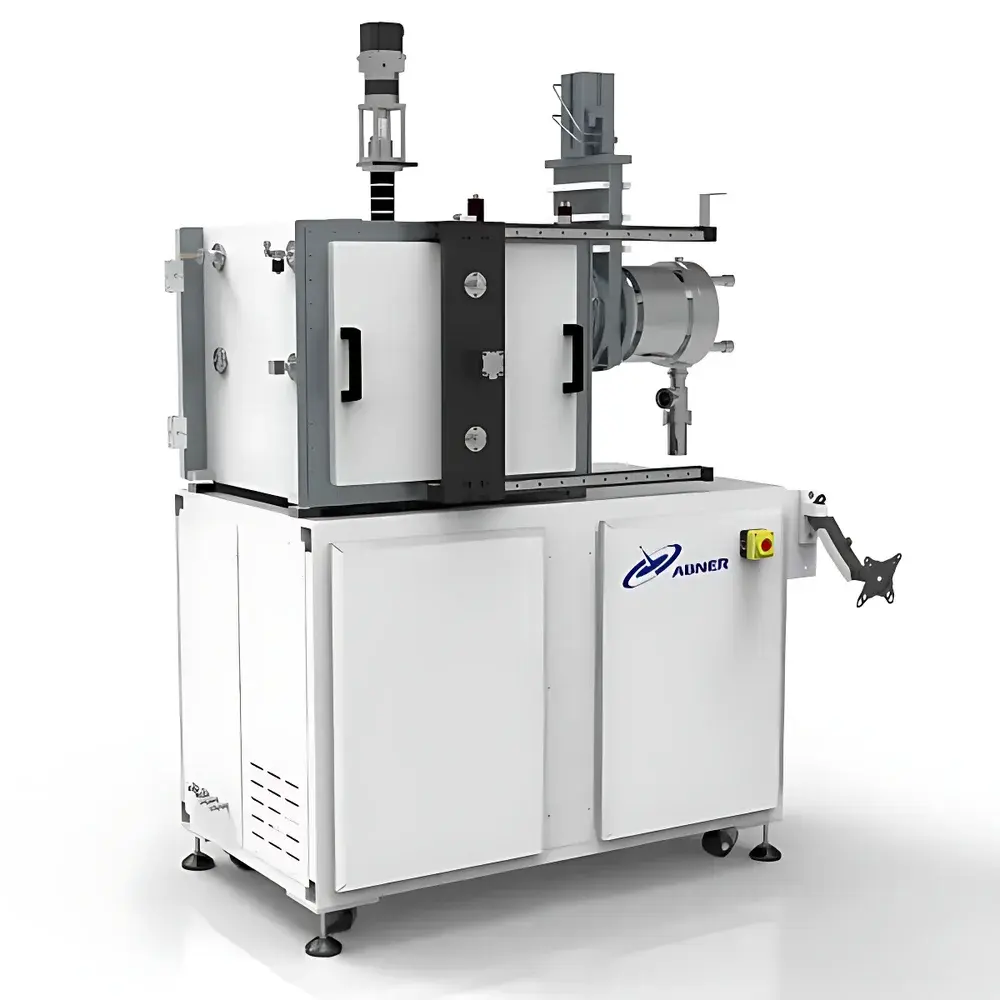
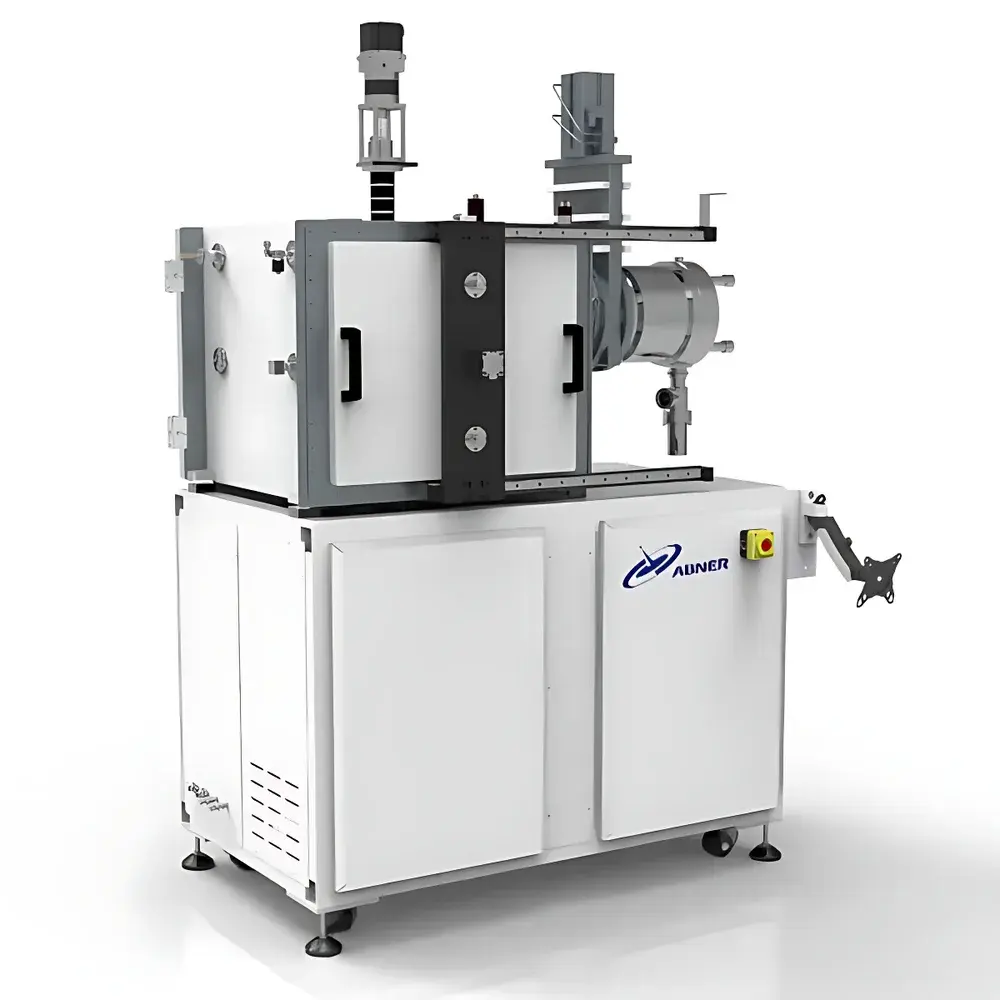
Abner ABN-500-Y2 Magnetron Sputtering Coater
| Brand | Abner |
|---|---|
| Origin | Jiangsu, China |
| Manufacturer Type | Authorized Distributor |
| Country of Origin | China |
| Model | ABN-500-Y2 |
| Base Price | USD 67,000 (FOB Jiangsu) |
| Operating Pressure Range | 5×10⁻⁵ Pa – 5×10⁻³ Pa |
| Gas Inlets | 2 independent MFC-controlled channels |
| Substrate Heating | RT to 300 °C |
| Max DC/RF Current | 0.1–100 A |
| RF Power Stability | ≤5% |
| Target Diameter | 6 inch |
| Uniformity | ±3% over Ø100 mm substrate |
| Compatible Power Modes | DC, RF, Pulsed DC |
Overview
The Abner ABN-500-Y2 Magnetron Sputtering Coater is a bench-to-production scale thin-film deposition system engineered for precision, repeatability, and multi-material compatibility in academic research, R&D laboratories, and pilot-line manufacturing environments. It operates on the principle of magnetron sputtering—a physical vapor deposition (PVD) technique in which energetic argon ions, confined by crossed electric and magnetic fields near a conductive or dielectric target surface, dislodge atoms via momentum transfer. These sputtered atoms travel through a controlled low-pressure environment and condense onto a substrate to form dense, stoichiometrically stable thin films. Unlike thermal evaporation, magnetron sputtering enables high ionization fraction, lower substrate heating, superior adhesion, and excellent compositional fidelity—particularly critical for compound oxides, nitrides, and alloy systems. The ABN-500-Y2 integrates dual-magnetron architecture (balanced or unbalanced configuration), modular power delivery, and programmable process sequencing to support both fundamental materials studies and application-driven thin-film development.
Key Features
- Modular magnetron design with adjustable magnetic field geometry for optimized plasma confinement and uniform sputter yield across 6-inch targets;
- Multi-target station supporting up to three independently controlled sputtering sources—enabling sequential, co-sputtered, or gradient multilayer deposition without breaking vacuum;
- Dual-channel mass flow controller (MFC)-regulated gas delivery system for precise Ar, O₂, N₂, or reactive gas dosing; gas inlet nozzles feature angular adjustability for directional flux tuning;
- Triple-mode power supply compatibility: DC (for metals), RF (for insulators), and pulsed DC (for reactive processes)—all with real-time current monitoring and closed-loop stability control (≤5% RF power fluctuation);
- Motorized rotating substrate stage with integrated temperature control (RT–300 °C), optional bias voltage input (–200 V), and water-cooled backside cooling for thermal management during high-power deposition;
- PLC-based automation platform with 10.1″ capacitive touch HMI interface; supports recipe storage, stepwise process scripting, and time-stamped parameter logging;
- Integrated safety architecture including vacuum interlocks, coolant flow monitoring, over-current/over-voltage cutoffs, emergency stop circuitry, and chamber door position sensing per IEC 61508 functional safety guidelines.
Sample Compatibility & Compliance
The ABN-500-Y2 accommodates substrates up to Ø100 mm (4-inch wafers) with planar or low-curvature geometry—including silicon, quartz, fused silica, glass, polymer foils (e.g., PET, PI), and metallic foils. Its low-temperature operation (down to room temperature, scalable to 300 °C) ensures compatibility with thermally sensitive substrates. All wetted components are electropolished stainless steel (SS304/316L) or ceramic-insulated, meeting ISO 14644-1 Class 5 cleanroom compatibility requirements when operated in controlled environments. Vacuum integrity complies with ISO 27893 for residual gas analysis readiness. The system supports GLP/GMP-aligned operation through audit-trail-capable data logging (timestamped, user-ID tagged), aligning with FDA 21 CFR Part 11 expectations for electronic records when paired with validated software extensions.
Software & Data Management
Process execution and monitoring are managed via an embedded Linux-based PLC runtime with deterministic I/O scanning (<10 ms cycle time). The HMI provides intuitive access to vacuum status (Pirani + cold cathode gauges), gas flow rates (SCCM), power parameters (V/I/W), substrate temperature, and real-time film thickness estimation (when equipped with optional quartz crystal microbalance). All operational data—including alarm history, recipe versions, and manual intervention logs—are stored locally on industrial-grade SSD and exportable via USB or Ethernet (CSV/JSON). Optional LabVIEW-compatible API and Modbus TCP integration enable centralized lab automation (e.g., linking to metrology tools or scheduling systems). Firmware updates follow secure signed-package protocols to maintain system integrity.
Applications
- Semiconductor fabrication: Deposition of adhesion layers (Ti, Cr), barrier metals (Ta, TaN), and interconnects (Al, Cu) on Si/SiO₂ wafers;
- Optoelectronics: ITO, AZO, and IZO transparent conductive oxides for OLEDs, touch sensors, and solar cell front electrodes;
- Optical coatings: High-reflectance dielectric stacks (e.g., TiO₂/SiO₂), anti-reflection films, and UV-blocking layers for lenses and laser optics;
- Functional materials research: VO₂ thermochromic films, YBCO superconducting layers, MoS₂/TMD monolayers, and LiCoO₂ cathode precursors;
- Energy devices: Solid-state electrolyte thin films (LiPON), battery current collectors, and gas-permeable sensor membranes (WO₃, SnO₂);
- Surface engineering: TiN, CrN, and AlCrN hard coatings on cutting tools, biomedical implants, and aerospace components.
FAQ
What vacuum level can the ABN-500-Y2 achieve, and what pumping configuration is used?
The system employs a two-stage vacuum train: a primary dry scroll pump (12 m³/h) followed by a turbomolecular pump (600 L/s) to reach base pressures ≤5×10⁻⁵ Pa. Ultimate pressure is verified using a Bayard-Alpert gauge calibrated per ISO 3567.
Is reactive sputtering supported out-of-the-box?
Yes—the dual-MFC gas manifold allows simultaneous introduction of inert (Ar) and reactive (O₂, N₂) gases with independent flow control and pressure feedback, enabling stoichiometric oxide/nitride synthesis without hardware modification.
Can the system be upgraded for in-situ thickness monitoring?
Absolutely—the chamber includes a standard KF-40 flange port for integration of a quartz crystal microbalance (QCM) or optical monitor (ellipsometer feedthrough), both supported by the PLC’s analog input expansion module.
What certifications does the ABN-500-Y2 carry for international shipment?
It complies with CE marking requirements (EMC Directive 2014/30/EU, Machinery Directive 2006/42/EC) and carries RoHS 2011/65/EU conformity documentation; UL/cUL listing is available upon request for North American deployment.
How is process reproducibility ensured across multiple users or shifts?
Each recipe stores full parameter sets—including pump-down sequence, gas ramp profiles, power ramps, and dwell times—with version control and user authentication. Audit logs record all parameter changes, start/stop events, and alarm triggers with UTC timestamps and operator ID.



