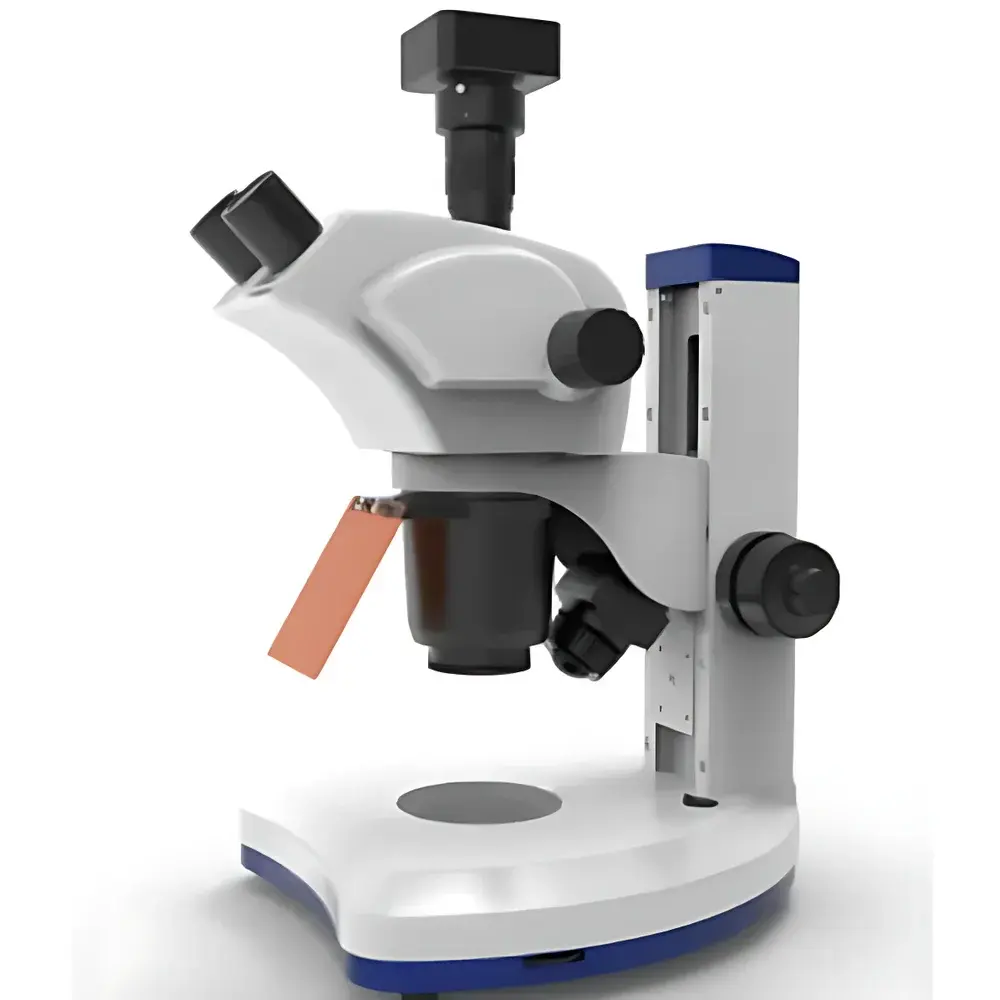
Abner ABN-ISD-021 Stereo Fluorescence Microscope
| Brand | Abner |
|---|---|
| Origin | Jiangsu, China |
| Model | ABN-ISD-021 |
| Instrument Type | Stereo Fluorescence Microscope |
| Excitation Source | High-Power LED Modules (Dual-Channel Optional) |
| Eyepieces | Wide-Field WF10X (22 mm Field Number) |
| Objectives | 5X Infinity-Corrected, NA 0.12 |
| Illumination | 6V/20W Adjustable Halogen Lamp (Transmitted Light) |
| Compliance | Non-Medical Device |
| Regulatory Classification | Research-Use-Only (RUO) |
Overview
The Abner ABN-ISD-021 Stereo Fluorescence Microscope integrates stereoscopic optical architecture with epifluorescence detection to deliver simultaneous three-dimensional structural visualization and high-contrast fluorescence signal acquisition at the specimen surface and shallow subsurface layers. Engineered for in vivo and ex vivo biological observation, it employs a dual-path optical design: one path optimized for long-working-distance stereoscopic imaging (with parallel optical axes and independent zoom optics), and the other incorporating LED-based epi-illumination, dichroic beam splitters, and matched emission filter sets. This configuration enables real-time correlation between anatomical context and fluorescent labeling—critical for precise spatial registration during dissection, developmental staging, or tissue-level screening. Unlike conventional upright or inverted fluorescence microscopes, the ABN-ISD-021 maintains ≥80 mm working distance across all magnifications, supporting manual micromanipulation, probe insertion, and multi-accessory integration without optical obstruction.
Key Features
- Stereoscopic dual-optical-path system with continuous zoom (typically 6.3×–50× total magnification range with 10× eyepieces) and interpupillary adjustment (55–75 mm), ensuring natural depth perception and ergonomic viewing.
- Dual-mode illumination: adjustable 6V/20W halogen lamp for brightfield transmitted-light observation, plus modular high-intensity LED excitation sources (365 nm, 470 nm, 530 nm, and 590 nm standard; custom wavelengths available) with thermal management and stable output (<±2% intensity drift over 4 hours).
- Pre-aligned fluorescence filter cubes (e.g., DAPI/FITC/TRITC/Cy5 configurations) mounted in a rotating turret for rapid channel switching without realignment; each cube includes excitation filter, dichroic mirror, and emission filter certified to OD6 blocking performance.
- Infinity-corrected objective lens set (5×, 10×, 20×) with parfocal design and anti-reflection coatings optimized for fluorescence transmission across visible and near-UV spectra; numerical apertures (NA 0.12–0.40) balanced for resolution, depth of field, and working distance.
- Rigid cast-aluminum base and coaxial focus mechanism with fine-focus vernier scale (1 µm graduation) and coarse/fine dual-speed control—designed to minimize mechanical drift during time-lapse documentation or extended operator use.
Sample Compatibility & Compliance
The ABN-ISD-021 accommodates intact biological specimens up to 120 mm in height and 150 mm in width, including live larvae, dissected organs, whole-mount plant tissues, and embryonic preparations on standard Petri dishes or custom stages. Its open-stage architecture permits integration of environmental chambers (temperature/humidity control), micromanipulators, and external light sources. As a research-use-only instrument, it complies with IEC 61000-6-3 (EMC emissions) and IEC 61000-6-2 (immunity) standards. It is not classified as a medical device under FDA 21 CFR Part 809 or EU MDR 2017/745, nor does it require CE marking for clinical application. All optical components meet ISO 10110 surface quality specifications (scratch-dig 60-40), and LED drivers conform to RoHS Directive 2011/65/EU.
Software & Data Management
While the ABN-ISD-021 operates independently as an optical platform, it is fully compatible with third-party digital imaging systems (e.g., CMOS cameras meeting USB3.0 or HDMI 2.0 interface standards). When paired with Abner’s optional ABN-Capture Suite v3.x, users gain synchronized multi-channel image acquisition, Z-stack generation (via motorized focus drive), annotation tools compliant with MIAME metadata guidelines, and export formats including TIFF (16-bit), OME-TIFF, and JPEG2000. Audit-trail functionality logs user ID, timestamp, exposure parameters, and filter position for GLP-aligned experiment documentation. Raw image data retains embedded EXIF tags for objective magnification, illumination mode, and LED wavelength—enabling traceable reprocessing and cross-platform analysis in Fiji/ImageJ or HALO®.
Applications
- Developmental Biology: Real-time tracking of GFP/RFP-labeled zebrafish embryos or mouse organoids during morphogenesis, leveraging stereo depth cues to distinguish superficial versus internal fluorescence signals.
- Neuroanatomy: Surface mapping of Thy1-YFP-labeled cortical neurons or tdTomato-expressing hippocampal slices during acute brain dissection—facilitating region-specific targeting prior to sectioning.
- Plant Phenotyping: Rapid assessment of root architecture in Arabidopsis seedlings expressing pDR5::GFP auxin reporters, combining wide-field overview with localized fluorescence quantification.
- Entomology & Invertebrate Research: Identification of neural circuits in Drosophila brains using Bruchpilot-GFP staining, with simultaneous manipulation via tungsten electrodes under fluorescence guidance.
- Educational Laboratories: Structured workflows for undergraduate labs covering fluorescence principles, stereoscopic vision physiology, and comparative anatomy—supported by standardized calibration slides and protocol templates.
FAQ
Is the ABN-ISD-021 suitable for live-animal imaging?
Yes—its long working distance, low-heat LED excitation, and modular stage options support short-term (<2 hr) unanesthetized observation of small vertebrates and invertebrates under controlled ambient conditions.
Can I upgrade the fluorescence channels post-purchase?
Yes—the filter turret accepts industry-standard 25 mm diameter cubes; additional wavelengths (e.g., Cy7, mCherry) can be added without optical recalibration.
Does the system support quantitative fluorescence intensity measurement?
When used with a calibrated scientific camera and ABN-Capture Suite, it enables relative intensity comparison across regions of interest (ROI), though absolute photometric calibration requires NIST-traceable reference standards.
What maintenance is required for long-term stability?
Annual verification of LED output intensity (using integrated photodiode monitoring), cleaning of optical surfaces with spectroscopic-grade solvents, and lubrication of focus gears per Abner Technical Bulletin TB-FLUO-04.
Is training provided for academic lab personnel?
Abner offers remote installation support and a 4-hour virtual workshop covering alignment validation, filter cube selection, image acquisition best practices, and troubleshooting common artifacts (e.g., bleed-through, halo effects).