
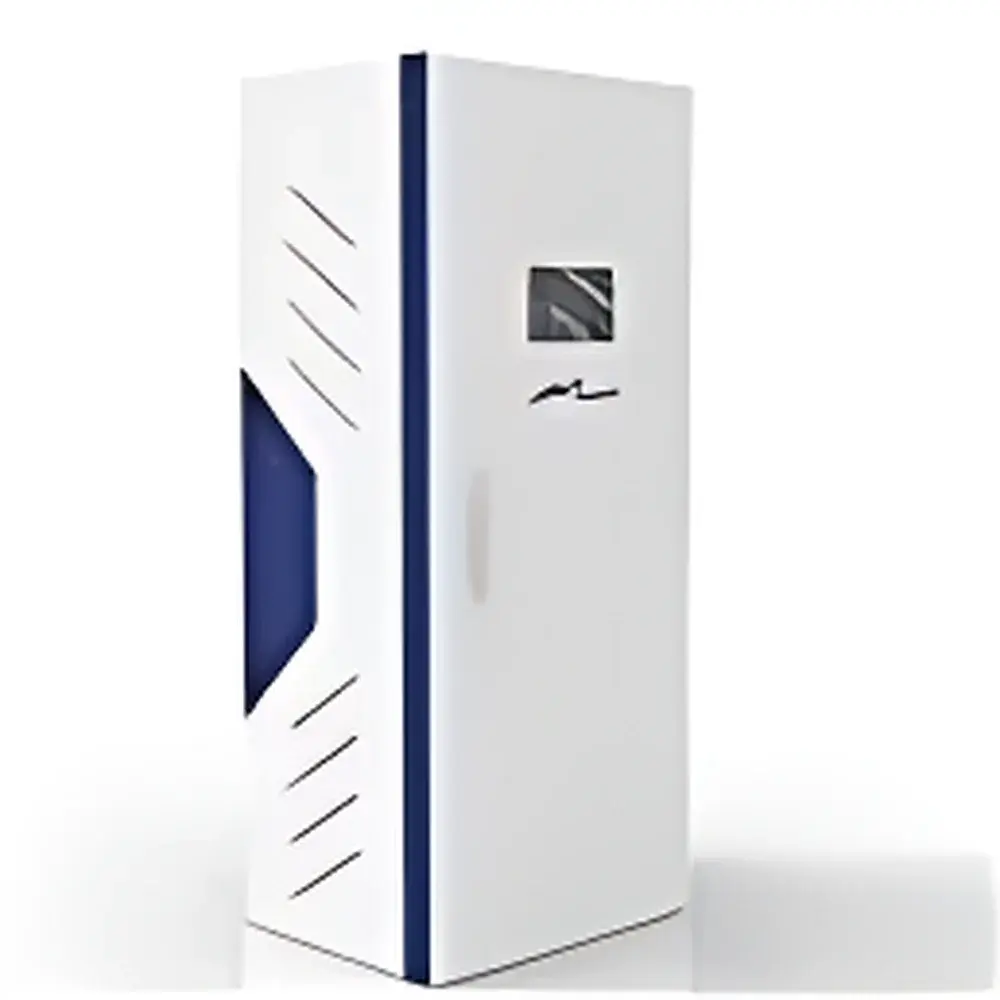
Abner ABN-MCC-001 Intelligent Motion Control Cabinet
| Brand | Abner |
|---|---|
| Origin | Jiangsu, China |
| Manufacturer Type | Authorized Distributor |
| Product Category | Domestic |
| Model | ABN-MCC-001 |
| Price | USD 420 (est.) |
| Instrument Classification | Laboratory Automation Infrastructure |
| Max Axes | 24 |
| Control Modes | Position/Velocity/Acceleration |
| Feedback | Encoder-based Closed-loop |
| Communication Interfaces | EtherCAT, CAN, RS-485, Pulse/Dir, Analog I/O, Digital I/O |
| Safety Features | Overcurrent, Overvoltage, Short-circuit, E-stop, Ground Fault Protection |
| Cooling | Forced-air with thermal monitoring |
| Compliance | CE-marked per EN 61800-5-1, EN 61000-6-2/-6-4, RoHS 2015/863/EU |
| Software Compatibility | LabVIEW, MATLAB Simulink, TwinCAT, CODESYS, Custom OPC UA Clients |
Overview
The Abner ABN-MCC-001 Intelligent Motion Control Cabinet is an industrial-grade, modular motion control infrastructure engineered for precision laboratory automation and high-reliability multi-axis coordination in life science instrumentation. Built upon a deterministic real-time control architecture, it implements synchronized trajectory planning and closed-loop servo regulation across up to 24 axes using position, velocity, and acceleration profiles. Its core operation relies on high-resolution encoder feedback integrated with adaptive PID+ feedforward compensation—ensuring sub-micron repeatability in positioning-critical applications such as automated microscopy stages, wafer handling systems, and MEMS test platforms. Designed explicitly for integration into ISO 17025-accredited laboratories and GMP-aligned instrument clusters, the cabinet meets electromagnetic compatibility (EMC) and functional safety requirements defined in EN 61800-5-1 and EN 61000-6-2/-6-4, supporting audit-ready deployment in regulated research environments.
Key Features
- Scalable multi-axis control: Configurable for 4–24 axes with support for servo, stepper, and linear motors—enabling coordinated XYZ + θ + auxiliary axis motion with real-time interpolation (linear, circular, and point-to-point).
- Integrated power and signal architecture: Consolidated industrial-grade AC/DC power modules, isolated digital I/O banks, analog input/output channels (±10 V, 0–20 mA), and encoder interface circuitry—all mounted on vibration-damped DIN rails within a 19-inch rack-mount enclosure.
- Multi-protocol fieldbus support: Native EtherCAT master capability (IEC 61158 Type 12), plus optional CANopen, RS-485 Modbus RTU, and pulse/direction outputs for legacy or hybrid system integration.
- Hardware-level safety chain: Dual-channel emergency stop inputs, configurable safety torque off (STO), hardware interlock monitoring, and automatic fault isolation per axis—compliant with PL e / SIL 2 per ISO 13849-1.
- Thermal management system: Intelligent fan control with temperature sensors at critical power and logic zones; optional conduction-cooled variants available for vacuum or cleanroom installations.
- Modular expansion design: Hot-swappable drive modules, configurable I/O carriers, and standardized M12/M8 connectors enable field-upgradable functionality without system downtime.
Sample Compatibility & Compliance
The ABN-MCC-001 is compatible with NEMA 17–34 frame servo and stepper motors from leading manufacturers (e.g., Yaskawa, Panasonic, Oriental Motor), as well as linear actuators and piezo-driven stages requiring analog voltage or PWM command signals. It interfaces seamlessly with optical encoders (incremental, absolute, BiSS-C), limit switches, home sensors, and vision-guided positioning systems via programmable trigger I/O. From a regulatory standpoint, the cabinet carries CE marking under the Machinery Directive 2006/42/EC and Low Voltage Directive 2014/35/EU. Electromagnetic emissions and immunity conform to EN 61000-6-4 (industrial emission limits) and EN 61000-6-2 (immunity for industrial environments). For laboratories operating under GLP or FDA 21 CFR Part 11 requirements, optional firmware supports audit-trail logging of configuration changes, user access control, and electronic signature validation when paired with compliant SCADA or LIMS middleware.
Software & Data Management
Control logic is configured and deployed using standard IEC 61131-3 programming environments—including CODESYS Development System v3.5+, Beckhoff TwinCAT 3, or open-source PLCnext Technology. LabVIEW 2020+ and MATLAB R2022a+ users leverage native VIs and toolkits for real-time trajectory generation, data acquisition synchronization, and post-processing analysis. All firmware updates are delivered via signed .hex packages with SHA-256 verification. Configuration files include embedded metadata (timestamp, operator ID, revision hash) and support version-controlled storage in Git-based repositories. Operational logs—covering axis status, fault codes, thermal readings, and bus traffic statistics—are stored in CSV-compliant format on internal microSD (optional) or streamed over TCP/IP to external time-series databases (e.g., InfluxDB, TimescaleDB) for long-term trend analysis and predictive maintenance modeling.
Applications
- Life science instrumentation: Automated probe station positioning for electrophysiology recordings, motorized focus drives for confocal and super-resolution microscopes, and multi-axis scanning stages for hyperspectral imaging.
- Semiconductor metrology: Wafer transfer robots with vacuum-compatible kinematics, mask alignment stages with sub-100 nm repeatability, and laser interferometer-coupled calibration platforms.
- Academic research infrastructure: Reconfigurable motion testbeds for robotics education, MEMS characterization rigs with synchronized actuation and sensing, and optomechanical alignment systems for quantum optics experiments.
- Industrial QC/QA labs: Multi-station inspection conveyors with synchronized camera triggering and stage movement, automated tensile testing fixtures with load-cell–position coupling, and environmental chamber-integrated motion systems for thermal cycling validation.
- Custom OEM integration: Embedded motion controllers for diagnostic analyzers, liquid handling robots with syringe pump coordination, and high-throughput screening platforms requiring deterministic timing across >16 axes.
FAQ
What is the maximum number of axes supported simultaneously?
The ABN-MCC-001 supports up to 24 axes in synchronized real-time control mode, with deterministic jitter <100 µs under full load.
Does the cabinet support absolute encoders and homing routines?
Yes—it natively supports SSI, BiSS-C, and EnDat 2.2 absolute encoders, and includes configurable homing sequences (limit switch search, index pulse capture, or reference mark detection).
Can it be integrated with third-party vision systems?
Yes—via programmable trigger outputs synchronized to motion events, and GigE Vision or USB3 Vision cameras connected through external frame grabbers with precise timestamp alignment.
Is remote diagnostics and firmware update possible over Ethernet?
Yes—using standard HTTP/HTTPS APIs and Modbus TCP register mapping; all updates require cryptographic signature verification prior to installation.
What documentation is provided for regulatory compliance in GLP labs?
A complete Design Qualification (DQ) package, including schematics, traceability matrices, EMC test reports, and a Factory Acceptance Test (FAT) protocol template aligned with ISO/IEC 17025 Clause 5.5.2.





