
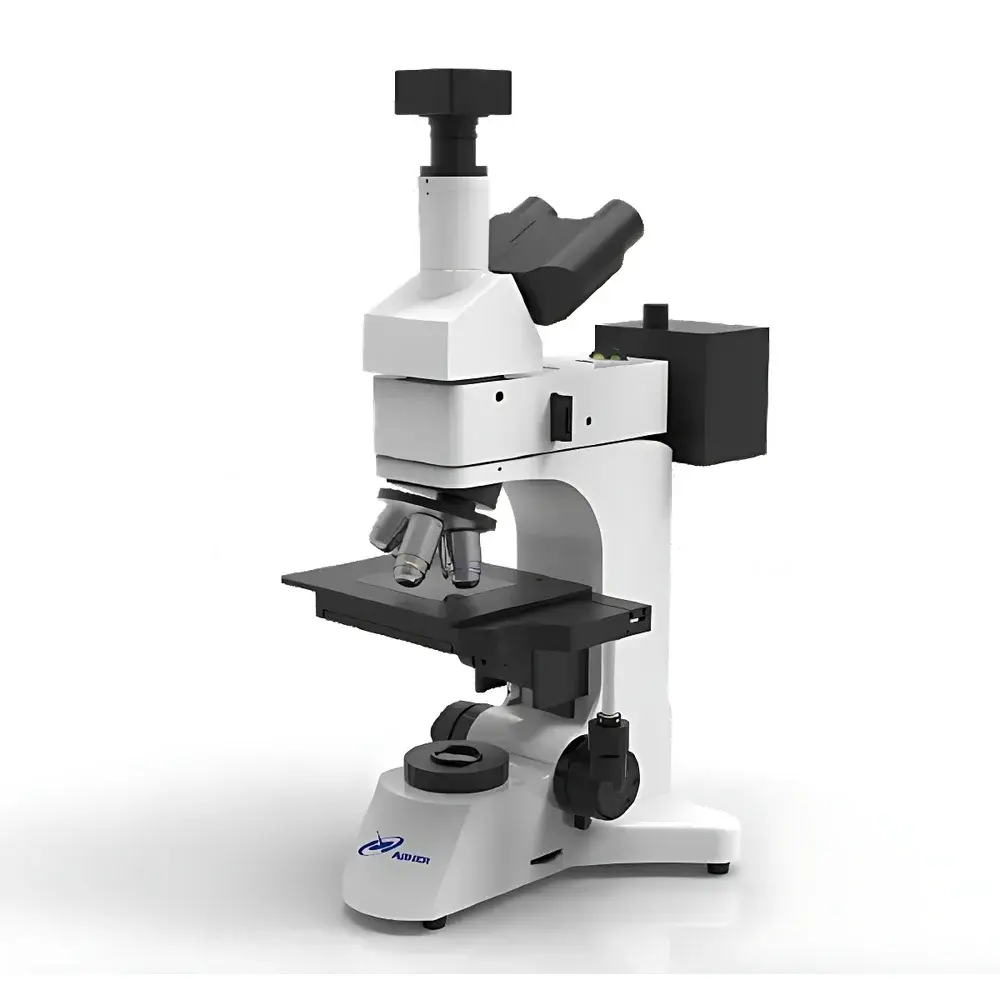
Abner ABN-OMM-001 Upright Metallurgical Microscope
| Brand | Abner |
|---|---|
| Origin | Jiangsu, China |
| Manufacturer Type | Authorized Distributor |
| Regional Category | Domestic (PRC) |
| Model | ABN-OMM-001 |
| Price | USD 2,100 (approx.) |
| Configuration | Upright |
| Image Analysis System | Integrated |
| Eyepieces | Widefield Achromatic SWF10X (22 mm field number) |
Overview
The Abner ABN-OMM-001 Upright Metallurgical Microscope is an engineered optical instrument designed for high-fidelity microstructural characterization of opaque, solid-state materials. It operates on the principle of epi-illumination—where incident light is directed onto the specimen surface via a beamsplitter and objective lens—enabling high-contrast reflected-light imaging without transmission requirements. This upright configuration places the objective lenses above the sample stage, offering ergonomic accessibility, mechanical stability, and compatibility with standard metallographic sample preparation protocols (grinding, polishing, etching). The system employs an infinity-corrected optical path, minimizing chromatic and spherical aberrations across magnifications and supporting consistent resolution up to 1000× with oil immersion objectives (optional). Its optical architecture conforms to ISO 8578:2021 (Metallographic Microscopy — Terminology and Performance Requirements) and supports traceable calibration per ASTM E112-22 (Standard Test Methods for Determining Average Grain Size).
Key Features
- Infinity-corrected optical system with parfocal, parcentric plan-apochromatic objectives (standard 5×, 10×, 20×, 50×, 100×; optional)
- Reflected-light illumination unit with adjustable LED Köhler illumination (6 V/30 W equivalent, 50,000 h lifetime, color temperature ~5700 K)
- Multi-mode contrast capability: brightfield, darkfield, polarized light, and differential interference contrast (DIC) — selectable via rotating turret and dedicated condenser modules
- Ergonomic upright stand with coaxial coarse/fine focusing (1 µm graduation, 0.2 µm minimum step), integrated mechanical stage (76 × 52 mm travel), and specimen holder for standard 1″ × 3″ metallurgical slides
- Dual-view port: trinocular head with 20:80 beam-splitting ratio for simultaneous visual observation and digital acquisition
- Pre-aligned C-mount interface (1× relay lens) compatible with USB 3.0 CMOS sensors (e.g., 5 MP to 20 MP monochrome/color cameras)
Sample Compatibility & Compliance
The ABN-OMM-001 accommodates specimens up to 40 mm in height and 150 mm × 120 mm in footprint—fully compatible with standard metallographic mounts (epoxy, phenolic, bakelite) and as-polished or chemically etched surfaces. It supports quantitative analysis of grain boundaries, phase distribution, inclusion content, porosity, and crack morphology in ferrous/non-ferrous metals, sintered ceramics, semiconductor wafers, and layered 2D materials (e.g., MoTe₂, graphene, transition metal dichalcogenides). All optical components meet RoHS Directive 2011/65/EU and CE marking requirements for laboratory equipment. The system facilitates compliance with ISO/IEC 17025:2017 (general requirements for competence of testing and calibration laboratories) when paired with validated image analysis workflows and documented calibration records.
Software & Data Management
The microscope ships with Abner ImagePro™ Lite — a CE-certified, FDA 21 CFR Part 11–ready software suite supporting audit trail logging, user role management, electronic signatures, and secure data export (TIFF, PNG, CSV, PDF/A). Capabilities include automated grain size measurement per ASTM E112 and ISO 643, phase area fraction quantification, linear intercept analysis, and particle counting with customizable thresholding and morphological filters. Raw image metadata (magnification, exposure time, illumination mode, date/time stamp) is embedded in EXIF tags. Data integrity is preserved through SHA-256 hash verification upon export and optional integration with LIMS platforms via HL7 or RESTful API.
Applications
- Metallurgical R&D: Quantitative assessment of austenite grain growth kinetics, martensitic transformation morphology, and intermetallic precipitation behavior
- Failure analysis: Identification of fatigue striations, cleavage facets, ductile dimples, and environmental embrittlement patterns in fracture surfaces
- Quality assurance: In-process verification of heat treatment uniformity, coating thickness homogeneity (via cross-section imaging), and weld microstructure conformity to AWS D1.1 or EN ISO 17639
- Academic instruction: Hands-on training in ASTM E3-22 (Preparation of Metallographic Specimens) and ISO 13005 (Statistical Analysis of Microstructures)
- Advanced materials: Layer-thickness estimation and domain mapping in van der Waals heterostructures using polarized reflectance contrast
FAQ
Is the ABN-OMM-001 compliant with GLP or GMP documentation standards?
Yes — when used with Abner ImagePro™ Pro (optional upgrade), the system supports full audit trails, electronic signatures, and 21 CFR Part 11–compliant data archiving.
Can it be upgraded to support motorized Z-axis focus or automated stage navigation?
Yes — the base platform includes standardized mounting interfaces and RS-232/USB-C ports for integration with third-party motorized components (e.g., Prior Scientific or Ludl Electronic Products stages).
What is the maximum usable magnification for routine metallography?
With the standard 100× oil-immersion objective and 10× eyepieces, total magnification reaches 1000×; effective resolution is limited by visible-light diffraction (~0.2 µm at 550 nm wavelength).
Does the system support DIC with standard objectives?
Yes — DIC functionality requires matching Nomarski prisms and strain-free objectives (plan-neofluar or plan-apochromat grade); these are available as optional accessories.
Is technical support and calibration traceability provided internationally?
Abner-certified service engineers provide remote diagnostics and on-site calibration; all factory calibrations are traceable to NIM (China National Institute of Metrology) and include uncertainty budgets per ISO/IEC 17025 Annex A.




