
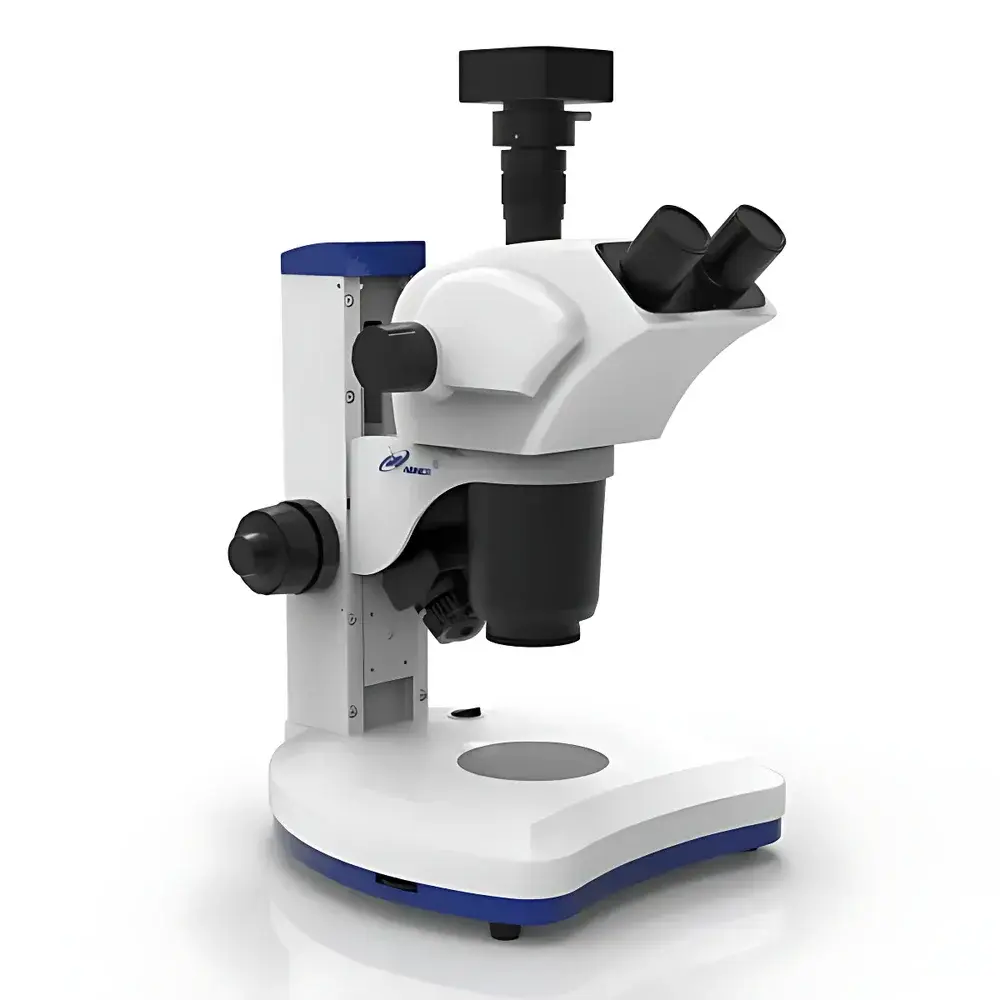
Abner ABN-SZM-001 Stereo Microscope
| Brand | Abner |
|---|---|
| Model | ABN-SZM-001 |
| Origin | Jiangsu, China |
| Zoom Ratio | 1:9 |
| Objective Type | Continuous Zoom Objective |
| Distribution Type | Authorized Distributor (Non-Manufacturer) |
| Compliance | CE-marked for general laboratory use |
| Optical Configuration | Greenough-type dual-path stereo optical system |
| Eyepiece Compatibility | Standard 10× wide-field (WF) eyepieces (23 mm field number), optional 5×–15× |
| Working Distance | Adjustable, nominal 75 mm at lowest magnification |
| Illumination Options | Integrated LED base illumination + optional external ring light or oblique side lighting |
| Camera Interface | C-mount adapter included (1× photo port) |
| Focus Mechanism | Coaxial coarse/fine focusing with 40 mm travel range |
| Construction | Aluminum alloy chassis with precision-machined optical rails |
Overview
The Abner ABN-SZM-001 Stereo Microscope is a Greenough-type stereoscopic optical instrument engineered for low-magnification, high-depth-of-field observation of macro- to meso-scale specimens. Unlike compound microscopes relying on a single optical path and high numerical aperture objectives, the ABN-SZM-001 employs dual, laterally offset optical channels—each with independent objective and eyepiece assemblies—to generate true binocular disparity. This geometric configuration enables natural depth perception and spatial orientation, critical for tasks requiring manual manipulation under visual guidance. Designed for routine inspection, dissection, assembly, and educational demonstration, the microscope delivers consistent optical performance across its 1:9 continuous zoom range (typically corresponding to 6.3×–56× with standard 10× eyepieces). Its modular architecture supports integration into GLP-compliant workflows when paired with calibrated digital imaging systems and audit-trail-enabled software.
Key Features
- True stereoscopic imaging via Greenough optical design, providing anatomically accurate depth cues without computational reconstruction
- 1:9 continuous zoom optics with parfocalized objective lens group, ensuring stable focus throughout magnification range
- 75 mm nominal working distance at minimum magnification—sufficient clearance for probe insertion, soldering irons, or micro-manipulators
- Integrated cold-white LED illumination (5000 K CCT) with adjustable intensity and uniform base lighting; compatible with optional coaxial, annular, or oblique fiber-optic illumination modules
- Ergonomic inclined binocular head (45° tilt) with interpupillary adjustment (55–75 mm) and diopter compensation per eyepiece
- C-mount photographic port with 1× relay optics, enabling direct coupling to industrial CMOS sensors or scientific cameras compliant with USB3 Vision or GigE Vision standards
- Mechanically robust aluminum housing with hardened steel focusing rack-and-pinion mechanism (40 mm vertical travel, 1 µm fine-focus graduation)
Sample Compatibility & Compliance
The ABN-SZM-001 accommodates opaque, translucent, and reflective specimens up to 120 mm in height and 180 mm in width—ideal for printed circuit boards, biological tissue blocks, mineral samples, polymer components, and botanical specimens. It does not require sectioning or metallization. While not certified to ISO 10993 or USP , its optical path is free of hazardous coatings and complies with IEC 61000-6-3 (EMC emissions) and IEC 62368-1 (safety). When used with validated camera systems and timestamped image capture software, it supports documentation traceability aligned with ISO/IEC 17025 clause 7.7 and FDA 21 CFR Part 11 requirements for electronic records (when implemented with appropriate access controls and audit trails).
Software & Data Management
The microscope itself operates optomechanically without embedded firmware. However, its C-mount interface enables seamless integration with third-party imaging platforms—including ToupView, Ocular, or HALCON-based custom solutions—that support TIFF/PNG export, measurement annotation (distance, area, angle), multi-focus stacking (Z-stacking), and batch metadata tagging (operator ID, timestamp, magnification, illumination mode). For regulated environments, users may deploy validated image acquisition software validated per GAMP 5 guidelines, with configuration management logs and user privilege tiers. Raw image files retain EXIF-compatible headers containing magnification, exposure time, and lens ID—facilitating retrospective analysis and report generation.
Applications
- Biological dissection: Real-time visualization of insect morphology, plant organ architecture, or vertebrate embryo staging without flattening or embedding
- Electronics QA/QC: Visual verification of solder joint integrity (IPC-A-610 Class 2/3), component placement accuracy, and PCB trace continuity
- Precision assembly: Guidance during micro-soldering, fiber optic connector polishing, or MEMS device handling under hands-on operation
- Materials forensics: Preliminary assessment of fracture surfaces, coating delamination, corrosion patterns, or additive manufacturing layer bonding quality
- Undergraduate laboratories: Structured pedagogy in comparative anatomy, entomology labs, or introductory materials science courses where tactile-visual correlation is essential
FAQ
Is the ABN-SZM-001 suitable for photomicrography in regulatory submissions?
Yes—when paired with a validated camera system and image acquisition software featuring electronic signatures, audit trails, and secure storage, it meets foundational documentation requirements for ISO 17025 and FDA-regulated settings.
Can I upgrade the illumination system post-purchase?
Yes—the base unit includes standardized mounting threads (M42×1) and power input terminals compatible with Abner’s accessory portfolio, including 360° programmable ring lights and polarized oblique illuminators.
What eyepiece options are available?
Standard 10×/23 mm WF eyepieces are supplied; optional 5× (wider FOV), 15× (higher resolution), or reticle-equipped variants (0.1 mm division) are available under separate part numbers.
Does the microscope support motorized zoom or focus?
No—zoom and focus are manually actuated to ensure mechanical stability and eliminate electromagnetic interference in sensitive lab environments. Motorized add-ons are not offered by Abner for this model.
Is calibration certification included?
A factory-issued optical alignment certificate (verifying collimation, zoom linearity, and interpupillary symmetry) is provided with each unit; NIST-traceable magnification calibration is available as an optional service.




