
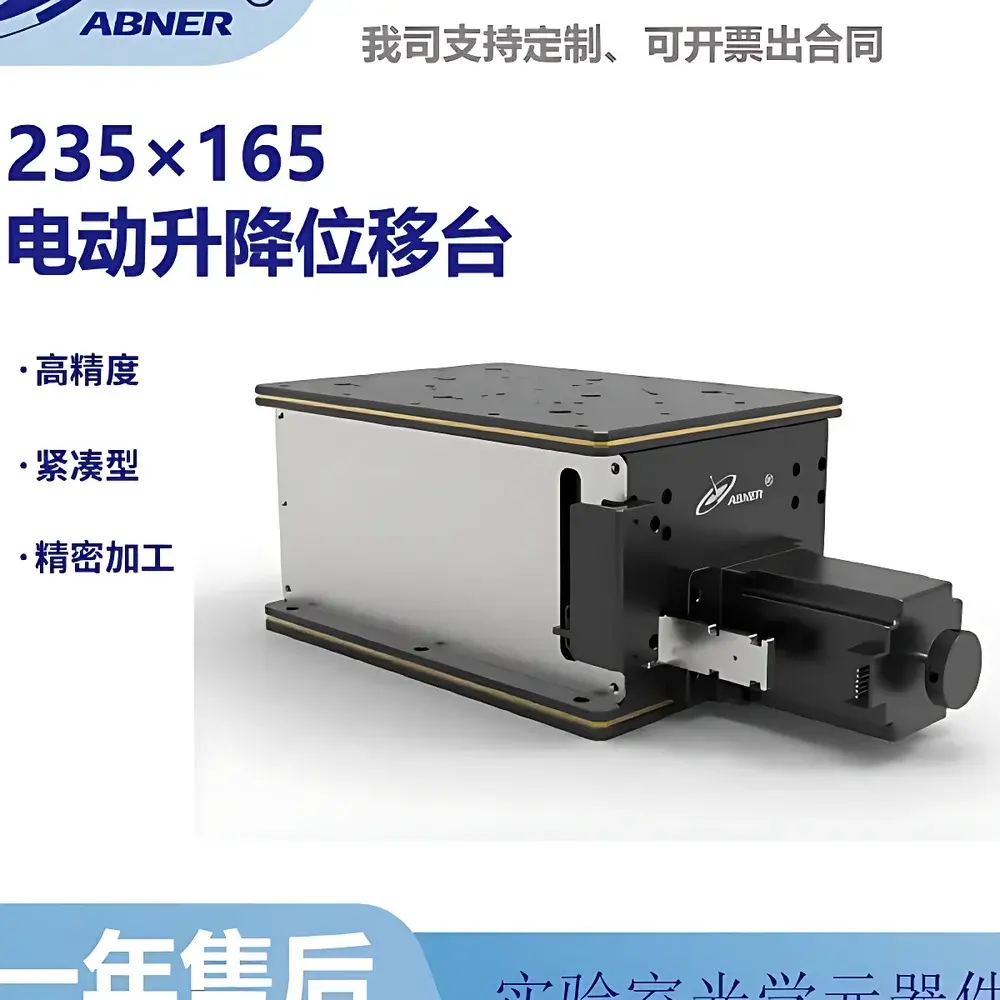
Abner Z-Axis Electric Vertical Translation Stage Model 235×165
| Brand | Abner |
|---|---|
| Origin | Jiangsu, China |
| Type | Motorized Z-Axis Translation Stage |
| Platform Dimensions | 235 mm × 165 mm |
| Travel Range | 100 mm / 200 mm / 300 mm (configurable) |
| Repeatability | ±2.5 µm |
| Load Capacity | Up to 20 kg (depending on travel configuration) |
| Drive System | Shinano Kenshi stepper motor |
| Transmission | MISUMI precision ball screw + crossed-roller linear guide |
| Structural Material | Anodized black aluminum alloy (6061-T6) |
| Compliance | Designed for ISO/IEC 17025-aligned lab environments, compatible with GLP/GMP system integration |
Overview
The Abner Z-Axis Electric Vertical Translation Stage (Model 235×165) is a high-rigidity, motor-driven linear positioning platform engineered for precise vertical displacement in optical alignment, metrology, semiconductor inspection, and automated laboratory systems. Based on the Couette-type motion principle of precision mechanical translation—where rotary input from a stepper motor is converted into linear displacement via a preloaded ball screw—and guided by crossed-roller bearings, this stage delivers deterministic, backlash-free Z-axis movement with nanoscale repeatability. Its structural architecture prioritizes thermal stability and dynamic stiffness, minimizing parasitic tilt and axial wobble during load cycling. Unlike manual or piezoelectric alternatives, this electromechanical stage balances extended travel (up to 300 mm), high payload capacity (≤20 kg), and sub-micron repeatability—making it suitable for applications where both range and fidelity are non-negotiable.
Key Features
- Motorized Z-axis translation with programmable step resolution down to 0.1 µm (dependent on controller and microstepping configuration)
- Monolithic aluminum base and top plate machined from 6061-T6 alloy, anodized to MIL-A-8625 Type II specification for corrosion resistance and dimensional stability
- MISUMI-certified ground ball screw (C5 grade, lead accuracy ±12 µm/300 mm) paired with preloaded crossed-roller linear guides (radial runout < 3 µm)
- Shinano Kenshi PK series hybrid stepper motor with 1.8° step angle, integrated encoder option available for closed-loop operation
- Standard M4 and M6 tapped mounting patterns on platform surface and base; compatible with Thorlabs, Newport, and Standa optical breadboard interfaces
- Low-noise operation (<45 dB at 1 m distance) and vibration-damped mechanical coupling for interferometric and confocal microscopy compatibility
Sample Compatibility & Compliance
This stage supports rigid mounting of optical components (e.g., objective lenses, beam expanders, detectors), semiconductor wafer chucks, and custom fixtures weighing up to 20 kg—provided center-of-gravity remains within 30 mm of the platform’s geometric center. It complies with mechanical safety requirements per ISO 12100 and is designed for integration into systems adhering to IEC 61000-6-2 (immunity) and IEC 61000-6-4 (emission) standards. While not intrinsically certified for hazardous locations, its non-sparking aluminum construction and absence of hydraulic or pneumatic elements make it suitable for cleanroom Class 1000 (ISO 6) environments. Firmware and motion control protocols support audit-trail logging for GLP/GMP-aligned workflows when used with compliant controllers (e.g., Galil DMC-4000 or National Instruments PXI platforms).
Software & Data Management
The stage operates natively via RS-485 (Modbus RTU) or USB 2.0 (virtual COM port), enabling direct integration with LabVIEW, MATLAB, Python (pySerial/pyVisa), and EPICS-based control frameworks. Abner provides a Windows-compatible configuration utility for setting acceleration profiles, homing routines, soft limits, and position-triggered I/O events (TTL-compatible). All position commands and encoder feedback (if equipped) are timestamped with microsecond resolution. When deployed in regulated environments, the system supports 21 CFR Part 11-compliant electronic signatures and audit trails through third-party SCADA middleware such as Ignition or Siemens Desigo CC.
Applications
- Optical path length tuning in Michelson and Mach–Zehnder interferometers
- Z-focus actuation for upright and inverted research-grade microscopes (including motorized nosepiece synchronization)
- Vertical sample positioning in laser-induced breakdown spectroscopy (LIBS) and Raman mapping systems
- Height calibration and probe alignment in wafer-level test handlers and automated probe stations
- Dynamic focus correction in multi-layer additive manufacturing monitoring setups
- Adjustable-stage integration in ISO 10110-compliant optical component testing rigs
FAQ
What is the maximum allowable off-center load before tilt error exceeds ±5 arcsec?
For 100 mm travel variants, eccentric loads >35 mm from platform center induce measurable angular deviation; we recommend keeping CoG offset ≤20 mm for sub-arcsecond stability.
Is vacuum-compatible version available?
Yes—vacuum-rated variant (model 235×165-VAC) features stainless steel fasteners, dry-lubricated guides, and outgassing-tested anodization (per ASTM E595); base pressure rating: 1×10⁻⁶ Torr.
Can this stage be synchronized with XY stages for coordinated 3D motion?
Absolutely—the RS-485 interface supports daisy-chained multi-axis coordination using standard Modbus broadcast commands; synchronization jitter < 100 µs across three axes.
Does the repeatability specification hold under continuous duty cycle?
Yes—±2.5 µm repeatability is validated per ISO 230-2 Annex B after 10,000 cycles at 0.5 Hz, ambient temperature 23±1°C, and 40–60% RH.
Are CAD models and mounting templates provided?
Yes—STEP, IGES, and PDF mechanical drawings (including tolerance stack-ups and GD&T annotations) are supplied upon NDA execution.





