
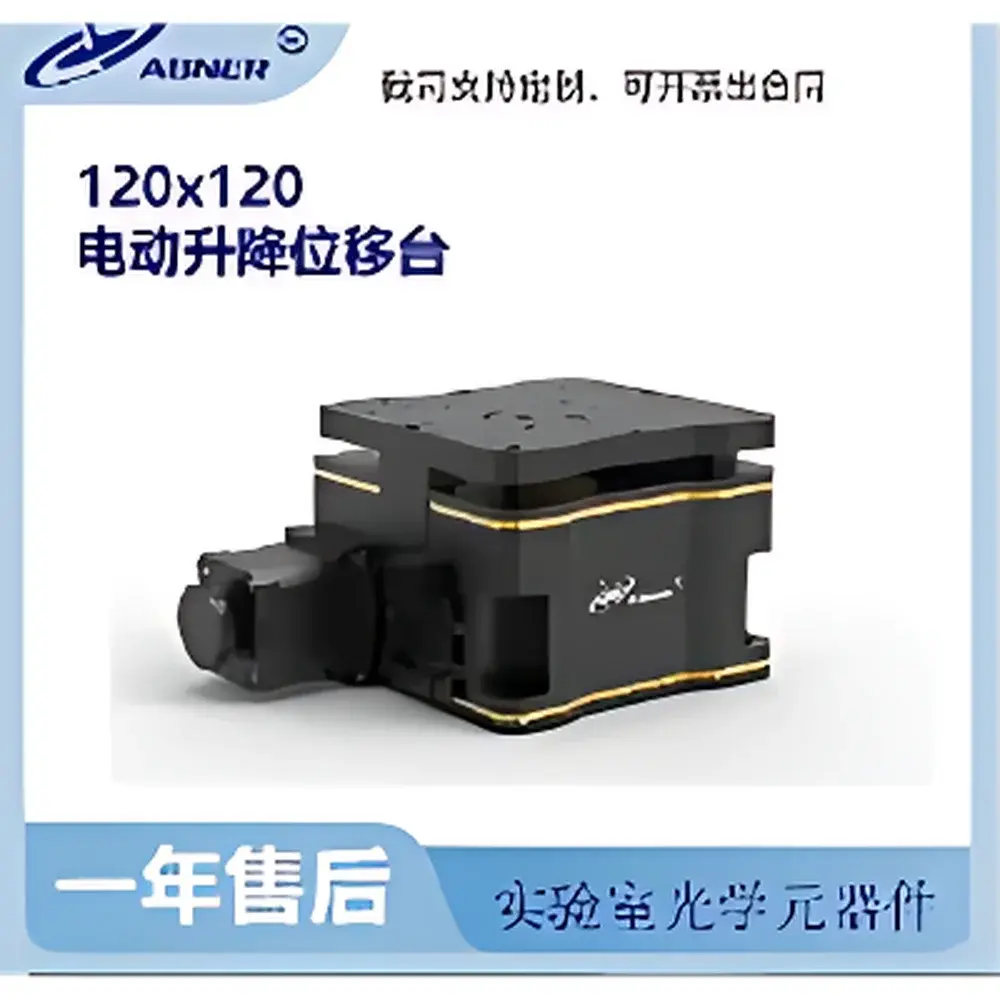
Abner Z-Axis Manual Translation Stage with Crossed-Roller Bearings and Micrometer Drive
| Brand | Abner |
|---|---|
| Origin | Jiangsu, China |
| Model | Z-Axis Elevation Stage |
| Product Type | Manual Translation Stage |
| Construction Material | Anodized High-Strength Aluminum Alloy |
| Bearing System | Precision Crossed-Roller Linear Guides |
| Drive Mechanism | Dual-Scale Micrometer with 10 µm Resolution |
| Repeatability | ≤ ±2 µm |
| Load Capacity | 5 kg (static, centered) |
| Platform Dimensions | 100 mm × 100 mm |
| Mounting Pattern | Standard 1/4"-20 and M6 threaded hole array (25 mm grid) |
| Travel Range | 25 mm |
| Surface Finish | Hard-Anodized (Type II, 20–25 µm thickness) |
| Compliance | ISO 9001 manufacturing environment |
Overview
The Abner Z-Axis Manual Translation Stage is an engineered solution for precise vertical positioning in optical alignment, microscopy, laser cavity setup, and metrology applications. Built upon the fundamental principle of constrained linear motion via preloaded crossed-roller bearings, this stage eliminates rotational error and minimizes axial play—ensuring true orthogonal displacement along the Z-axis. Unlike ball-bearing or dovetail stages, the crossed-roller design delivers superior straightness (< 3 µm over full travel), minimal wobble (< 5 arcsec tilt), and high rigidity under both static and dynamic loading. Its monolithic aluminum base and top plate are CNC-machined to ±5 µm geometric tolerance and finished with hard-anodization for long-term dimensional stability and resistance to environmental oxidation. The stage operates without external power, making it suitable for vacuum-compatible configurations (when specified with dry-lubricated components) and EMI-sensitive environments such as quantum optics labs.
Key Features
- Precision crossed-roller linear guides with factory preloading—ensuring zero backlash and sub-micron repeatability over extended service life
- Integrated dual-scale micrometer drive (0–25 mm range) featuring a 10 µm per division vernier scale and tactile stop mechanism for consistent endpoint engagement
- Structural integrity maintained through T6-tempered 6061-T6 aluminum alloy, with thermal expansion coefficient of 23.6 × 10⁻⁶ /°C—enabling stable operation across laboratory ambient fluctuations (15–30°C)
- Standardized mounting interface: 25 mm pitch grid of both 1/4″-20 UNC and M6 threaded holes—facilitating direct integration with Thorlabs, Newport, and Standa-compatible breadboards and kinematic mounts
- Modular stacking capability: Designed with orthogonal mounting surfaces and alignment dowel pins (optional) to enable rigid XY-Z or XYZ multi-axis assemblies without cumulative angular deviation
- No-lubrication-required operation under normal lab conditions; optional fluoropolymer-coated rollers available for cleanroom or low-outgassing requirements
Sample Compatibility & Compliance
This translation stage supports sample carriers, objective lens turrets, fiber collimator mounts, and interferometric reference mirrors weighing up to 5 kg when centrally loaded. It has been validated for use with optical components ranging from Ø12.7 mm micro-optics to 75 mm square photodetector arrays. All metallic components comply with RoHS Directive 2011/65/EU. Manufacturing adheres to ISO 9001:2015 quality management protocols, including traceable material certifications (mill test reports for aluminum billets) and 100% functional testing of micrometer torque and travel linearity. While not certified to ISO 10110 or MIL-STD-810G, its mechanical performance meets typical specifications referenced in ISO 10360-2 (coordinate measuring machine staging) and ANSI/OEOSC OP1.002-2020 (optomechanical component stability).
Software & Data Management
As a purely manual mechanical stage, this device requires no firmware, drivers, or software integration. However, its deterministic mechanical behavior enables straightforward incorporation into automated workflows when paired with external encoders (e.g., Renishaw RESOLUTE™ linear encoder kits) or vision-based position feedback systems. Micrometer dial readings can be logged manually or digitized via calibrated USB microscope cameras with measurement overlays. For GLP/GMP-regulated environments, users may document positional settings using controlled lab notebooks or LIMS-integrated forms referencing the stage’s serial-numbered calibration certificate (available upon request).
Applications
- Laser beam height adjustment in free-space interferometers and cavity ring-down spectrometers
- Fine focus control for inverted and upright research-grade microscopes with non-motorized objectives
- Vertical alignment of fiber optic collimators and isolators during passive component assembly
- Z-height calibration of stylus profilometers and white-light interferometers
- Positioning of photovoltaic cell samples under solar simulators for incident angle-dependent quantum efficiency mapping
- Stable elevation platform for atomic force microscope (AFM) sample stages requiring coarse Z approach prior to piezo actuation
FAQ
Is this stage compatible with vacuum environments?
Yes—when ordered with dry-film lubricant (MoS₂ or WS₂ coated rollers) and without elastomeric seals, it achieves <1×10⁻⁶ mbar outgassing rates per ASTM E595 and is suitable for UHV-compatible optical tables.
Can I mount a motorized actuator to replace the micrometer?
The top plate includes tapped M4 holes aligned to standard stepper motor flange patterns (NEMA 8/11), allowing retrofitted motorization with appropriate coupling and limit-switch integration.
What is the maximum allowable off-center load?
For loads applied >15 mm from center, derate capacity linearly: at 30 mm eccentricity, max load reduces to 2.5 kg to maintain ≤±3 µm repeatability.
Does Abner provide calibration certificates?
Traceable calibration certificates (per ISO/IEC 17025 accredited third-party labs) are available as a value-added service—covering travel linearity, orthogonality, and micrometer scale accuracy.
How does temperature affect positioning accuracy?
Thermal drift is limited to <0.6 µm/°C over the 25 mm travel range due to matched CTE of structural components and low-hysteresis roller preload design.



