
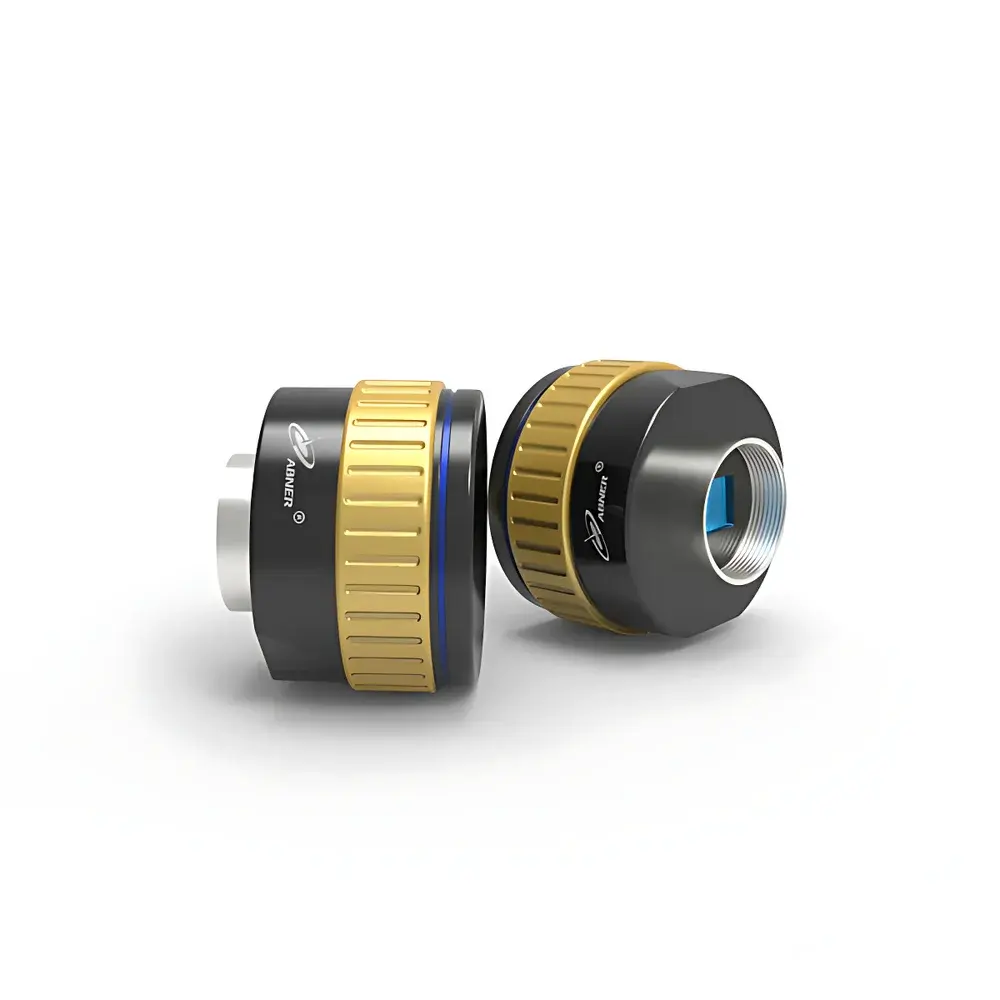
Abner Industrial CCD Camera
| Brand | Abner |
|---|---|
| Origin | Jiangsu, China |
| Manufacturer Type | Authorized Distributor |
| Region of Origin | Domestic (China) |
| Model | Industrial CCD Camera |
| Price | USD 112 (approx. ¥798) |
| Effective Pixels | 8000 × 6000 |
| Pixel Size | 1.4 µm (inferred from IMX586 sensor spec) |
| Sensor | Sony IMX586, 1/2" format |
| Max Resolution | 8000 × 6000 @ 5 fps (MJPEG) |
| Output Formats | MJPEG, YUY2, UYVY, RGB24, GREY |
| Shutter Type | Electronic Rolling Shutter / Frame Exposure |
| Interface | USB 2.0 (UVC-compliant) |
| Power Supply | DC 5 V, 550–650 mA |
| Dimensions | 38 mm × 38 mm × 29 mm |
| Operating Temperature | −20 °C to +70 °C |
| Minimum Illumination | 0.3 lux (at F1.2, 30 fps, gain max) |
| Sensitivity | 1000 LW/PH (center) |
| OS Compatibility | Windows XP–11, Linux (Kernel ≥2.6.26), macOS ≥10.4.8, Android ≥4.0 |
Overview
The Abner Industrial CCD Camera is a high-resolution, USB 2.0–based imaging module engineered for integration into automated industrial vision systems requiring precise spatial resolution, thermal resilience, and cross-platform driverless operation. Built around the Sony IMX586 CMOS image sensor (note: despite “CCD” in naming convention, IMX586 is a back-illuminated stacked CMOS sensor; this designation reflects legacy industry terminology rather than sensor architecture), the camera delivers 48 MP effective resolution (8000 × 6000 pixels) with native 1.4 µm pixel pitch and 1/2″ optical format. Its UVC (USB Video Class) compliance ensures plug-and-play functionality without proprietary drivers across major operating systems — a critical requirement for factory-floor deployment where software standardization and long-term maintainability are prioritized over proprietary SDK lock-in. Designed for continuous-duty operation in harsh ambient conditions, the camera features a compact aluminum-alloy housing rated for −20 °C to +70 °C operation, making it suitable for embedded machine vision applications in manufacturing cells, inline quality inspection stations, and environmental monitoring enclosures.
Key Features
- High-Resolution Imaging: Native 8000 × 6000 resolution supports sub-10 µm measurement precision at working distances typical in PCB AOI, semiconductor wafer metrology, and precision assembly verification.
- Multimode Frame Rate Flexibility: Configurable streaming modes include 8000×6000 @ 5 fps (MJPEG), 4000×3000 @ 12 fps, 3840×2160 @ 30 fps, and 1920×1080 @ 30 fps — enabling trade-offs between resolution and temporal sampling based on motion dynamics and processing bandwidth constraints.
- UVC-Compliant USB 2.0 Interface: Eliminates need for vendor-specific drivers; compatible with standard video capture APIs (e.g., DirectShow, V4L2, AVFoundation), facilitating rapid integration with HALCON, OpenCV, LabVIEW Vision, and custom C++/Python applications.
- Robust Environmental Tolerance: Sealed mechanical design with wide-temperature operational range (−20 °C to +70 °C) and low power draw (550–650 mA @ 5 V) enables direct mounting on robotic arms, inside HVAC-restricted enclosures, or near heat-generating machinery.
- Low-Light Performance: Achieves usable imagery at 0.3 lux (F1.2, max gain), supported by on-sensor low-noise amplification and dynamic range optimization — suitable for dimly lit production environments or nighttime surveillance integration.
Sample Compatibility & Compliance
The Abner Industrial CCD Camera complies with USB IF-certified UVC 1.1 specifications and meets electromagnetic compatibility (EMC) requirements per CISPR 32 Class B for industrial environments. While not certified to ISO 13849 or IEC 62061 as a safety-related component, its electrical isolation and thermal derating align with general-purpose industrial equipment guidelines (IEC 61000-6-2/6-4). The sensor’s spectral response (380–1100 nm, peak QE >80% at 550 nm) supports monochrome and color imaging across visible and near-infrared bands. No regulatory certification for medical device use (e.g., FDA 510(k), IEC 62304) or explosion-proof environments (ATEX/IECEx) is claimed. Integration into GxP-regulated workflows (e.g., pharmaceutical visual inspection) requires user validation of image stability, timestamp accuracy, and audit trail completeness per FDA 21 CFR Part 11 Annex 11 expectations.
Software & Data Management
The camera operates natively via standard UVC protocols — no proprietary firmware update utilities or closed-source control libraries are required. Exposure time, gain, white balance, gamma, and ROI selection are adjustable through standard UVC control requests (e.g., SET_CUR on VC_CONTROL_INTERFACE). Timestamping is hardware-assisted via USB SOF (Start of Frame) synchronization, enabling microsecond-level frame alignment when used with real-time OS kernels or deterministic USB host controllers. Raw frame buffers are accessible in uncompressed formats (GREY, RGB24) or compressed MJPEG streams, supporting both lossless archival and bandwidth-constrained streaming. For traceable data acquisition, users may implement external logging of UVC control parameters alongside image metadata using open-source tools such as v4l-utils (Linux) or DirectShow GraphEdit (Windows), satisfying basic GLP documentation needs.
Applications
- Automated optical inspection (AOI) of printed circuit boards, solder joints, and surface-mount components
- In-line dimensional metrology for machined parts, injection-molded plastics, and sheet metal stampings
- Biological sample documentation in non-GMP lab settings (e.g., colony counting, gel electrophoresis imaging)
- Embedded vision in robotics guidance, pick-and-place verification, and barcode/OCR validation
- Thermal signature correlation when paired with uncooled LWIR sensors in dual-spectrum monitoring systems
- Legacy system modernization where RS-422 or Camera Link interfaces are being replaced with cost-effective USB 2.0 solutions
FAQ
Is this camera truly CCD-based, or does it use CMOS technology?
The model name includes “CCD” as a conventional industry term reflecting its role in high-fidelity industrial imaging; however, the core sensor is the Sony IMX586 — a back-illuminated stacked CMOS device offering superior quantum efficiency and lower power consumption compared to legacy CCD architectures.
Does the camera support hardware triggering or strobe synchronization?
No dedicated GPIO or opto-isolated trigger input is provided. Synchronization must be achieved via software-controlled frame start commands over USB, limiting jitter to ±1–2 ms depending on host USB stack latency.
Can I use this camera under Linux without compiling custom drivers?
Yes — full UVC support is available out-of-the-box on all mainstream distributions with kernel ≥2.6.26. Use v4l2-ctl or guvcview for configuration and ffmpeg or OpenCV’s VideoCapture for acquisition.
What is the maximum cable length supported for stable USB 2.0 operation?
For reliable operation at full bandwidth (480 Mbps), passive USB 2.0 cables should not exceed 5 meters. Active extension solutions (e.g., USB repeaters or fiber extenders) are recommended for longer runs.
Is firmware upgradability supported?
Firmware updates are not publicly documented or user-accessible. Abner provides factory-level calibration and revision control; field updates require authorized service channel engagement.





