
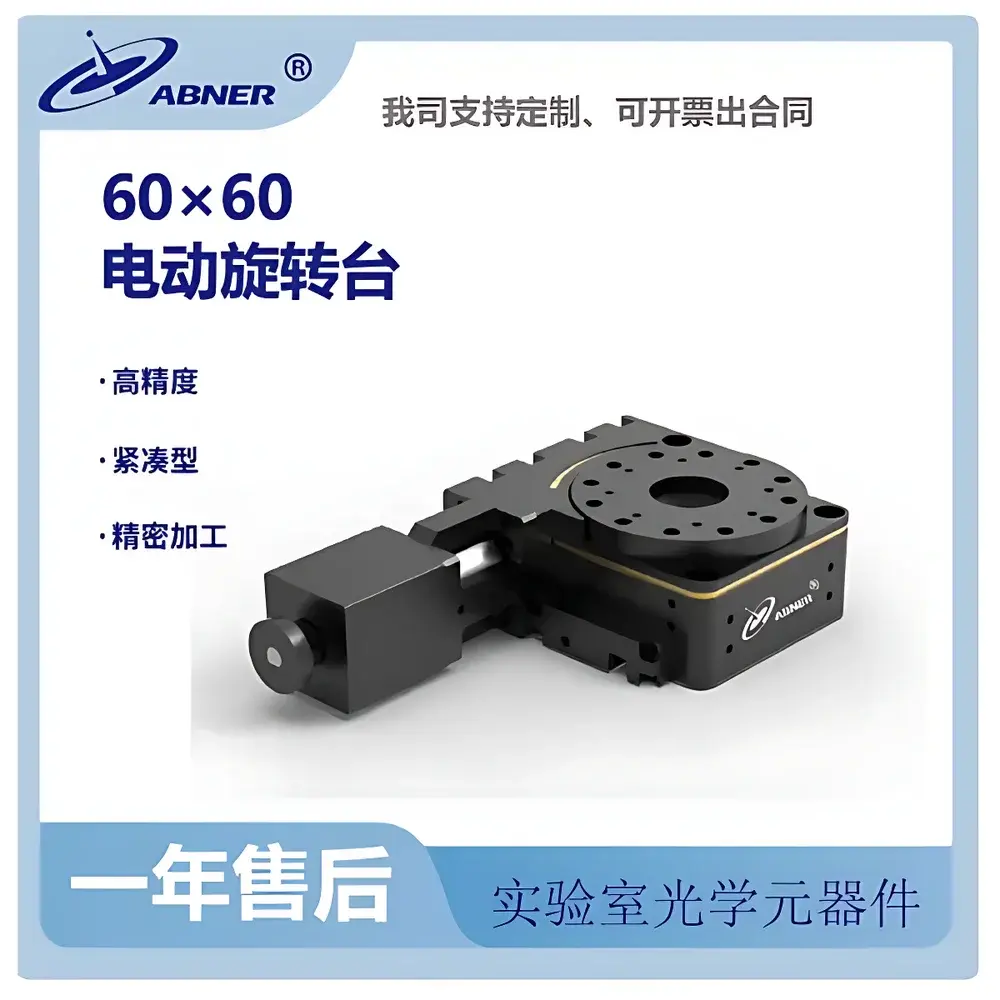
Abner RST-200 High-Precision Motorized Rotary Translation Stage
| Brand | Abner |
|---|---|
| Origin | Jiangsu, China |
| Product Type | Motorized Rotary Translation Stage |
| Construction Material | Anodized Aluminum Alloy |
| Drive Mechanism | Precision Worm Gear or Harmonic Drive |
| Motor Type | Closed-Loop or Open-Loop Stepper/Servo Motor |
| Rotation Range | 0°–360° (Discrete) or Continuous Rotation |
| Positioning Repeatability | < ±5 arcsec (typical) |
| Angular Resolution | Down to 0.001° (dependent on motor + gearbox ratio and controller) |
| Control Interfaces | RS-232, USB, CAN |
| Software Compatibility | LabVIEW, Python (PySerial, PyVISA), PLC (Modbus RTU/TCP) |
| Optional Encoder Feedback | Incremental or Absolute Rotary Encoder (17–23 bit) |
| Mounting Options | Standard M4/M6 tapped holes, compatible with Ø6 mm / Ø8 mm posts and optical breadboard grids (25 mm pitch) |
| Dimensions (L×W×H) | Approx. 120 × 120 × 42 mm |
| Load Capacity | Axial ≤ 5 kg, Moment Load ≤ 0.5 N·m |
Overview
The Abner RST-200 is a high-precision motorized rotary translation stage engineered for sub-arcsecond angular positioning in demanding optical and metrological applications. Based on the principle of mechanical angular displacement via gear-reduced rotary actuation—typically implemented through either a backlash-compensated worm gear train or a strain-wave harmonic drive—the RST-200 delivers deterministic, repeatable rotation with minimal hysteresis and thermal drift. Its monolithic anodized aluminum alloy body provides high stiffness-to-weight ratio and dimensional stability across ambient laboratory conditions (20 ± 2 °C, 40–60% RH), while surface hard-anodization ensures long-term resistance to abrasion and environmental oxidation. Designed explicitly for integration into space-constrained optical benches, automated alignment systems, and compact test fixtures, the RST-200 maintains full functionality within a footprint of just 120 mm × 120 mm—enabling deployment in multi-axis goniometers, fiber coupling stations, and miniaturized spectrometer calibration rigs.
Key Features
- High-rigidity, low-inertia rotating platform with precision-machined aluminum housing and hard-anodized finish (6061-T6, Ra < 0.8 µm)
- Selectable drive architecture: high-backlash-avoidance worm gear (standard) or zero-backlash harmonic drive (optional upgrade)
- Angular resolution down to 0.001° (0.36 arcsec) achievable with 1.8°/step stepper motor, 1:100 gear reduction, and microstepping controller
- Positioning repeatability rated at < ±5 arcsec over full 360° travel—verified per ISO 230-2 Annex B protocols
- Integrated mechanical limit switches and programmable software-defined soft limits for safe operation
- Zero-reference homing capability via optical or Hall-effect home sensor, supporting absolute position recovery after power cycle
- Optional high-resolution rotary encoder (17-bit incremental or 23-bit absolute) enables closed-loop angular control compliant with motion-critical GLP/GMP workflows
Sample Compatibility & Compliance
The RST-200 accommodates standard optical components including collimators, waveplates, polarizers, fiber launchers, and miniature interferometric heads. Its mounting interface conforms to ISO 8015 geometric tolerancing standards and features a 25 mm grid-compatible base with M4 and M6 threaded holes for universal compatibility with Thorlabs, Newport, and Standa optical rails and posts. While not certified as medical or aerospace-grade hardware, the stage meets CE marking requirements for EMC Directive 2014/30/EU and Low Voltage Directive 2014/35/EU. All firmware and communication protocols adhere to IEC 61131-3 (PLC programming) and IEEE 1159 (power quality monitoring during motor commutation). For regulated environments, optional audit-trail-enabled firmware supports FDA 21 CFR Part 11-compliant electronic records when used with validated LabVIEW or Python-based control suites.
Software & Data Management
Abner provides native drivers for Windows/Linux/macOS—including NI LabVIEW VIs (2015+), Python packages (abner_rst_sdk, pip-installable, supporting serial/CAN/USB-HID), and Modbus TCP register maps for direct PLC integration. Real-time angle reporting is timestamped with µs resolution using onboard hardware timers. Data logging supports CSV export with metadata headers (timestamp, commanded angle, encoder feedback, motor current, temperature sensor reading). Firmware updates are performed via signed binary over USB-C, with SHA-256 verification. Optional SDK includes trajectory planning APIs for S-curve acceleration profiles and synchronized multi-axis move commands—essential for laser beam steering and interferometric phase scanning sequences.
Applications
- Active alignment of single-mode fiber arrays in photonic packaging lines
- Angle-resolved reflectance and transmittance measurements (e.g., ASTM E284–22 for optical scattering)
- Calibration of digital inclinometers and MEMS gyroscopes against NIST-traceable angular references
- Rotational scanning in compact Fourier-transform infrared (FTIR) spectrometers
- Automated polarization state generation and analysis in Mueller matrix ellipsometry setups
- Integration into robotic optical assembly cells requiring coordinated 3R (roll-pitch-yaw) motion with traceable kinematic chains
FAQ
What is the maximum continuous torque output at the rotation shaft?
Rated holding torque is 0.12 N·m (open-loop stepper); 0.25 N·m peak (closed-loop servo version). Dynamic torque depends on acceleration profile and load inertia.
Can the RST-200 be operated in vacuum environments?
Standard units are rated for ambient air only. Vacuum-compatible variants (with dry-lubricated gears and outgassing-certified materials) are available under custom order (model suffix “-VAC”).
Is firmware source code or low-level register documentation available?
Yes—Abner provides full register-level datasheets and HAL abstraction layer source (C/C++) for OEM integration upon NDA execution.
How is angular accuracy verified and calibrated?
Each unit undergoes factory calibration using a Renishaw XL-80 laser interferometer with angular optics kit; calibration certificate includes residual error map (± arcsec vs. commanded angle) and uncertainty budget per GUM (JCGM 100:2008).




