
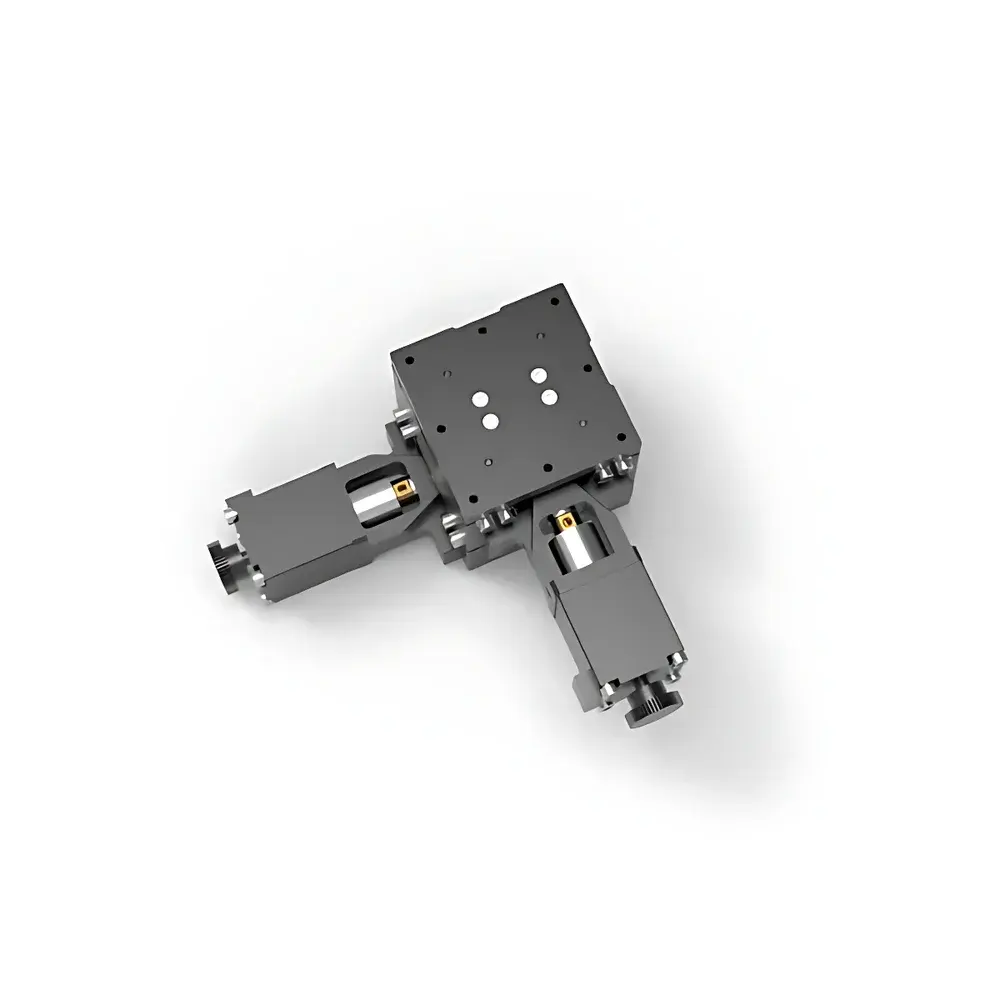
Abner XC19 60×60 mm Dual-Axis Electric Translation Stage
| Brand | Abner |
|---|---|
| Origin | Jiangsu, China |
| Product Type | Motorized XY Translation Stage |
| Model | XC19-60×60 |
| Drive Type | Stepper Motor (Standard) |
| Travel Range | 60 mm × 60 mm (X-Y) |
| Mounting Interface | Standard M4/M6 Tapped Holes (Per ISO 2083) |
| Positioning Repeatability | ≤ ±1.5 µm (Typical, Open-Loop) |
| Maximum Load Capacity | 3 kg (Horizontal), 1.5 kg (Vertical) |
| Encoder Option | Optional Incremental Quadrature Encoder (1 µm Resolution) |
| Compliance | CE Marked (EN 61000-6-2/6-4, EN 61000-6-3) |
| Environmental Rating | IP20 |
Overview
The Abner XC19 60×60 mm Dual-Axis Electric Translation Stage is a precision-engineered motorized XY positioning platform designed for integration into optical alignment systems, automated microscopy setups, laser beam steering assemblies, and metrology-grade instrumentation. Based on a crossed-roller bearing architecture with preloaded linear guides, the stage delivers high stiffness, low wobble, and minimal orthogonality error (< 15 arcsec) across its full 60 mm × 60 mm travel range. Its core motion principle relies on stepper motor-driven lead screws (standard 1.25 mm pitch) coupled with anti-backlash nuts, enabling open-loop positioning repeatability of ≤ ±1.5 µm under nominal loading conditions. The stage’s modular design follows ISO-standard mounting patterns (M4 and M6 tapped holes per ISO 2083), ensuring seamless compatibility with industry-standard optical breadboards, cage systems, and kinematic mounts.
Key Features
- Compact footprint: 120 mm × 120 mm base dimension with integrated 60 mm × 60 mm travel envelope — optimized for space-constrained optical benches and OEM instrument integration.
- Crossed-roller linear motion system: Provides low friction, high load capacity (3 kg horizontal), and sub-micron straightness deviation (< 2 µm over full stroke).
- Stepper motor drive (NEMA 17 compatible): Delivers smooth, jerk-free motion with programmable acceleration profiles; optional closed-loop operation via incremental quadrature encoder (1 µm resolution, TTL output).
- Robust aluminum alloy housing (6061-T6): Anodized surface finish (hard coat, 25 µm thickness) ensures long-term dimensional stability and resistance to laboratory environmental fluctuations.
- Zero-backlash mechanical coupling: Precision-ground lead screws and polymer-coated anti-backlash nuts minimize hysteresis and improve bidirectional repeatability.
- Standard RS-232 and USB 2.0 communication interfaces: Enables direct control from LabVIEW, Python (PySerial), MATLAB, or vendor-neutral motion controllers compliant with ASCII command protocols.
Sample Compatibility & Compliance
The XC19-60×60 stage supports a wide range of optical and mechanical payloads, including collimators, fiber couplers, objective lens holders, and photodetector mounts — provided center-of-gravity remains within the central 40 mm × 40 mm zone to maintain specified angular error limits. It complies with essential electromagnetic compatibility (EMC) directives per EN 61000-6-2 (immunity) and EN 61000-6-4 (emission), and carries the CE marking for use in EU-based research laboratories and industrial QA environments. While not certified for medical device applications (IEC 60601-1) or explosive atmospheres (ATEX), it meets general-purpose requirements for GLP-compliant calibration workflows when used with traceable position verification tools (e.g., laser interferometers or capacitive displacement sensors).
Software & Data Management
Abner provides a Windows-based Motion Control Suite (v3.2+) supporting real-time trajectory planning, multi-stage synchronization, and macro scripting. All position commands and execution logs are timestamped and stored locally in CSV format, supporting audit-ready data export for internal quality documentation. The firmware implements non-volatile memory for user-defined home offset values and velocity presets. For regulated environments, optional firmware upgrade enables 21 CFR Part 11–compliant electronic signatures, audit trails, and role-based access control — fully compatible with enterprise LIMS and ELN platforms via RESTful API extension.
Applications
- Precision optical alignment in interferometry and wavefront sensing systems.
- Automated focus scanning in confocal and multiphoton microscopy.
- Beam path adjustment in ultrafast laser labs requiring stable, repeatable XY positioning.
- Calibration stage for vision-based metrology systems (e.g., coordinate measuring machines with camera-based feedback).
- OEM integration into semiconductor inspection tools and automated wafer probing stations.
- Positioning platform for quantum optics experiments involving single-photon source alignment and cavity mirror tuning.
FAQ
What is the maximum recommended payload for vertical orientation?
For vertical (Z-axis) mounting, the maximum static load is 1.5 kg; dynamic loads must remain below 0.8 kg to preserve specified repeatability and prevent premature wear.
Can this stage be operated in vacuum environments?
No — standard configuration uses lubricated lead screws and polymer components not rated for UHV or HV vacuum; custom vacuum-compatible variants (CF flange mount, dry-lubricated bearings, stainless steel construction) are available upon request.
Is backlash compensation supported in firmware?
Yes — bidirectional backlash compensation is configurable per axis via the Motion Control Suite, using user-measured hysteresis values to correct positional offsets during direction reversal.
Does the stage support absolute positioning without homing?
Only with optional encoder-equipped configuration; open-loop stepper models require reference switch homing prior to each power cycle to establish origin.
What is the typical lifetime under continuous operation at rated load?
Rated for ≥ 10,000 km of cumulative travel (≈ 20 million strokes at 0.5 mm step size) under 2 kg horizontal load and ambient temperature (20–25°C), assuming regular maintenance per Abner Technical Bulletin TB-XC19-MNT-2023.



